
 E-Paper



Threat of diseases looms after Yamuna flood water recedes
The water level in the Yamuna, which had hit a peak of 206.60m on Wednesday, has already come down below the danger level of 205.33m.


As the flood waters recede, and water level comes back to normal in the Yamuna, authorities now face another challenge — to prevent the spread of any enteric and water-borne diseases such as cholera, diarrhoea and typhoid in the areas that were inundated.
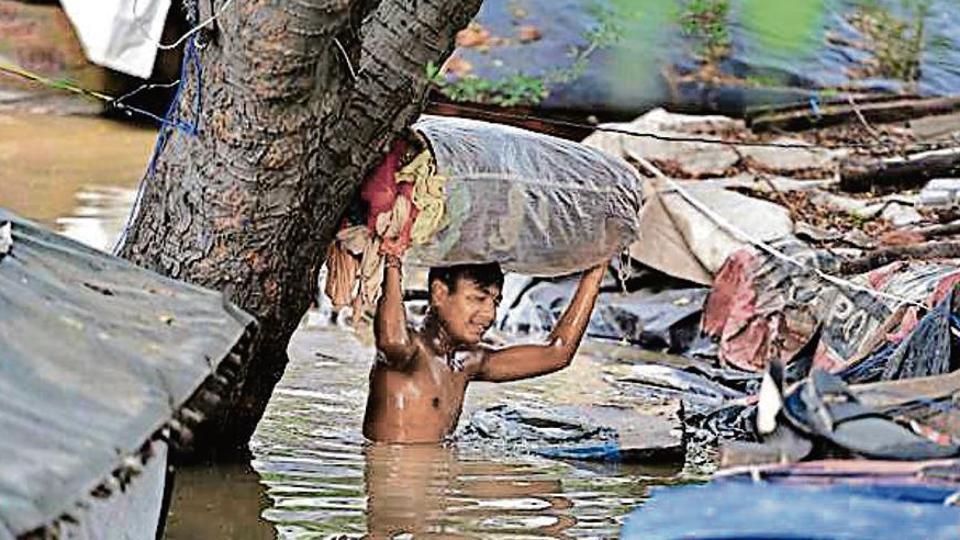
The water level in the Yamuna, which had hit a peak of 206.60m on Wednesday, has already come down below the danger level of 205.33m. Around 4 pm on Friday, the water level stood at 204.27m.
“After every flood, when the water level starts receding, there is always a threat of outbreak of enteric and water-borne diseases. Some of the water gets trapped in some puddles and depressions, which become breeding ground of diseases, including bacterial and viral. Local people often defecate openly in the floodplains. The flood water enters and pollutes other water sources,” said Dr BK Tripathi, head of the medicine department at Safdarjung Hospital.
The government and civic agencies, however, said all measures, including sprinkling of bleaching powder, anti-larva spray and distribution of ORS pouches in relief camps, were being taken to prevent any outbreak.
“While medical teams and doctors are taking rounds of campsites, ambulances have been kept ready. We would also sprinkling bleaching powder from where the water is receding,” said a senior government official from east Delhi district, where nearly 10,000 people had to be shifted to relief camps.
Out of the 11 revenue districts in Delhi, the Yamuna flows through six districts. The maximum impact of the flood, however, was borne by two districts – East Delhi and North East Delhi, according to officials of the irrigation and flood control department. At least 30 campsites have been set up in these two districts alone, where the evacuated people have taken shelter.
Relief and rescue operations in six districts would continue till further orders from Kailash Gahlot, revenue minister of Delhi, said a senior government official from north-east district, from where around 6000 people had to be put up in government tents.
Another threat is the outbreak of vector borne diseases such as malaria and dengue.
“The receding water level leaves behind puddles. Water gathers in abandoned plastic cups and containers, creating conducive environment for aedes and anopheles mosquitoes to breed. While aedes mosquito breeds in clean stagnant water and is responsible for dengue, anopheles breeds in polluted water like drains and can cause a malaria outbreak,” said a senior official of the National Vector Bourne Control Program.
To prevent such outbreaks, civic agencies have scaled up their anti-mosquito drives. Insecticides are being sprayed in possible mosquito breeding grounds in east Delhi and Shahdara districts.
“Anti-larval chemicals are being sprayed to prevent malaria and dengue outbreaks. ORS sachets and chlorine tablets are being distributed in camps as a further prevention measure. Handbills to create awareness are also being distributed,” said a spokesperson from the East Delhi Municipal Corporation.
Authorities are assessing the flood banks from where the people were displaced so that they can return.
“We are assessing the damage and the grounds from where the water has receded. We are in touch with the Central Water Commission and India Meteorological Department. The people would be allowed to return to their homes when the flood water recedes completely and there are no chances of any water discharge from Haryana in large quantities,” said a senior official of the irrigation and flood control department.


