
 E-Paper



Capital’s creative class calls this locality home
Established in the 1960s for and by city’s journalists and writers, the lush green locality has spearheaded many eco-friendly initiatives

 Prefer HTon Google


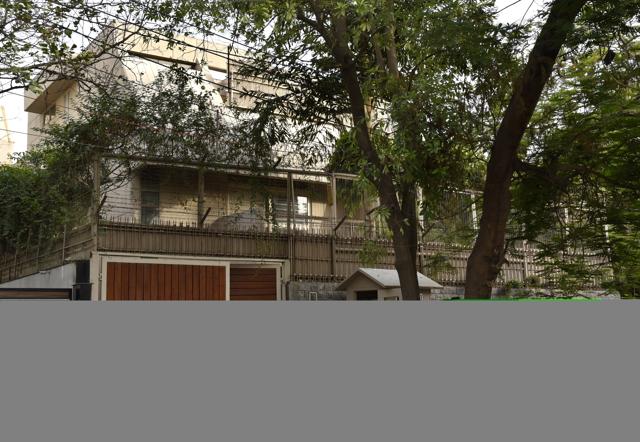
Named after the red-flowered Gulmohar trees that adorn it, Gulmohar Park was the first journalists’ colony in the Capital. Today, it is known to be one of the greenest neighbourhoods of south Delhi and home to eminent writers and journalists.

A roof above their heads
In the 1960s, journalists made meagre wages with no housing incentives. Only a few accredited correspondents received subsidized government accommodation; and the Delhi Development Authority (DDA) allotted land only to housing cooperative societies.
“Journalists are considered the fourth pillar of democracy. The society wanted us to be free and honest and not become victims of paid news and corruption in order to give ourselves a roof. We appealed to the government to allot us land as cooperatives,” said Kedar Nath Gupta, a retired news editor and a resident of Gulmohar Park since 1972.
Though initial requests were made to former prime minister Pandit Jawaharlal Nehru, the decision to set up a colony for journalists was taken by Prime Minister Lal Bahadur Shastri. The housing cooperative societies were formed in 1961-62 and DDA allotted land in 1965-66 and advised them to form a coordination committee and get land at one place. The committee was allotted over 47 acres. About 325 plots of varying sizes (based on need and affordability of each member) were allotted to the four societies for further allotment to their members. Plots were allotted by 1969 by a draw of lots. The cost per square yard of developed plot came to Rs 35.
The cooperative housing societies ensured there were ample green areas and parks, a large tract of land for a community and sports centre, a police post which has now been converted into a housing centre for senior officers, a small but sufficient shopping complex, a bank, a mother dairy booth, a vegetable shop and other community amenities.
Farms, snakes & bandits
Old-timers recall that the tract of land allotted to what is now Gulmohar Park was largely under cultivation in the Shahpur Jat belt, mostly with cauliflower and tobacco farming. Snakes were found in large numbers here during the construction work. At that time a gang of robbers lived here and had made a small tunnel to hide their loot. The DDA had to seek help of a special task force to get it vacated. Most of the trees seen today were planted and nurtured after the layout was finalised and the roads earmarked.
Padma Shri Geeta Chandran, who lives in block B, recalled how the area was semi-rural till the early 1970s. “The adjoining areas (where Ansal Plaza now stands) was cauliflower and spinach farmland and fresh vegetables were peddled by women vendors. We witnessed heavy rains until 1975 and that was the time when big snakes emerged from the drains,” said Chandran.
Self-sustaining
Author and journalist Dr Baldeo Sahai, 98, recollects how the first banking facility started in the colony with the help of a minister. He said a spot near the market where a bank stands today had been earmarked for a flour mill.
“We wanted a bank, but when we approached the DDA, they refused to budge. So, along with a few other senior journalists, I approached minister Bhishma Narain Singh. He changed the land use,” said Sahai.
The colony has nearly all the facilities for its residents. For example, its community-cum-sports centre has academies for a multitude of outdoor sports, indoor games, a swimming pool, cricket field, gymnasium, restaurant and outdoor areas for the youngest to the oldest.
“Gulmohar Park is a unique enclave, some of our overseas friends say it is better than a gated community in the West that may not have as many or nearly all facilities,” said Gupta.
Growth
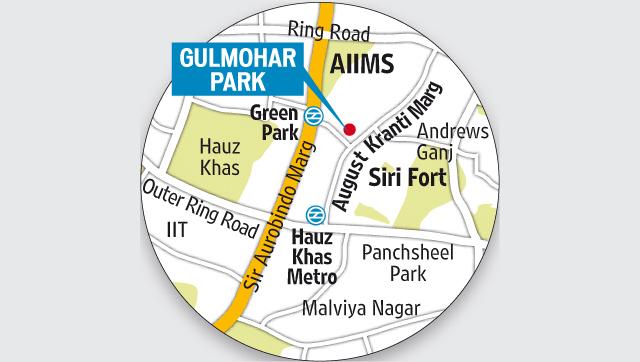
The colony lies between Hauz Khas and Balbir Saxena Marg. Once the colony was populated, the government turned attention to the Siri Fort area, especially prior to and during the Asian Games. As the number of families here grew, this green enclave and its surrounding areas started inviting scores of morning walkers. Groups of writers, journalists, lawyers, judges and politicians would enjoy walks in the mornings and get-togethers in the evenings.
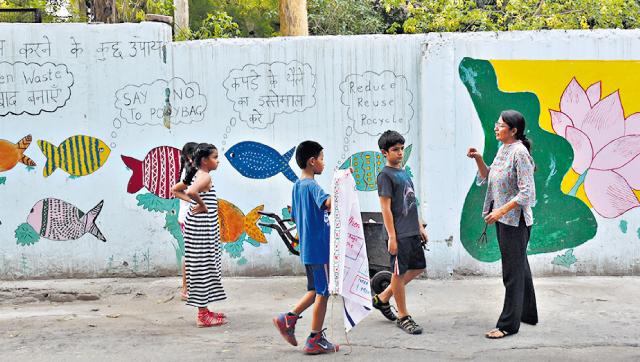
Gulmohar Park has now been home to four generations. The residents have taken up several eco-friendly initiatives. Walk across the four blocks (A, B, C and D) in Gulmohar Park and you will come across dustbins in almost every street, trees have been counted with numbers written on them and a colourful dhalao encourages passersby not to throw waste outside it. Also, some residents are converting kitchen waste into useful compost. With an aim — encourage people to not use polybags — children and adults have come together to form an environment club called Green Robinhoods.
Chandran says that over the years, the colony has developed at a great pace. Simple services are easily available within the colony and the Metro is at a stone’s throw.
Famous residents
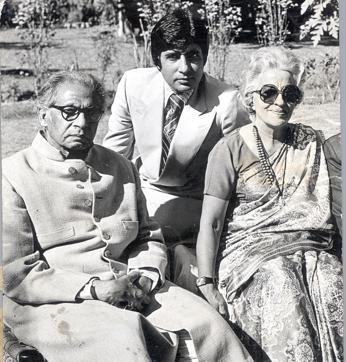
Residents fondly remember the illustrious founders of the four societies and others who contributed to making today’s Gulmohar Park. Geeta Chandran’s mother-in-law, Kamala Chandran, was the first president of the Gulmohar Park Women’s Club. Former famous residents include author Anita Desai, humorist and poet Gopal Vyas, actress Nandita Das and sculptor KS Radhakrishnan. Potters Bani De Roy and Lena Batra have homes here.
“Social activists Subhadra Butalia and Razia Ismail gave the colony its activist face. When in the late ’70s we had an incident of dowry death, Butalia founded Karmika and began a social campaign against the evil. My husband Rajiv and I were part of the Karmika theatre group that performed street plays against dowry deaths,” recalls Chandran.
But, there are problems
Residents point out very few journalists are left in the colony. Most of the prominent journalists have moved out or sold their houses to non-journalists. Multistorey buildings have come up in some places where once small bungalows existed. MR Virmani, a former journalist, who started living here in 1975, said, “We had a galaxy of senior journalists as the original residents of the colony. But with time their number has dwindled,” said Virmani, a resident of block A.
Another thing that bothers residents is that very few Gulmohar trees are left in the area. Some trees in the locality are more than 40 years old, claim residents, which are being threatened by concretization.
“Gulmohar tree is very fragile, prone to both termites and a strange death wish wherein its trunks get hollowed making them brittle and susceptible to Delhi’s storms. Just last week the colony lost at least a dozen old trees, including the one in front of my parent’s house,” said Chandran.
But residents have continued to enjoy living in this well-planned, green and self-sufficient enclave that has been enjoyed by international journalists, diplomats and multinational executives who have rented homes over the years. This colony has given birth to scores of media giants and companies. So, in a number of ways, Gulmohar Park, has maintained the flavour of a journalists’ colony.


