
 E-Paper



What Delhi can learn from China’s battle against pollution
China introduced a four-tier warning system for severe weather including smog in 2013 with red being the most serious, followed by orange, yellow and blue. Delhi too can implement such a plan to improve its air quality.

 Prefer HTon Google


China introduced a four-tier warning system for severe weather including smog in 2013 with red being the most serious, followed by orange, yellow and blue.
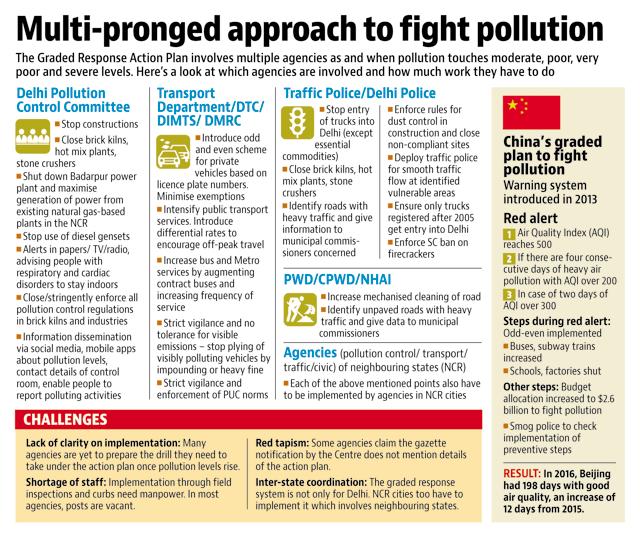
A red alert is issued under two different circumstances - if a city’s Air Quality Index (AQI) reaches 500 and if there are four consecutive days of heavy air pollution with AQI over 200. Two days of severe air pollution (AQI over 300), can also call for a red alert, official news agency Xinhua reported.
During a “red alert”, even-odd road rationing formula is to be implemented. Government increases the frequency of modes of public transport likes buses and subway trains.
Li Kunsheng from the city environmental protection department told the official news agency, Xinhua in December that Beijing “…had about 5.7 million registered vehicles, which emit 500,000 tonnes of pollutants every year, contributing over 30 per cent of the hazardous PM2.5 accumulated locally.”
In the case of an alert, schools and factories are to be suspended or closed based on more detailed and flexible standards.
Besides, as part of the Beijing-Tianjin-Hebei integration effort, the air pollution alert system in the three adjacent municipalities and province has to be synchronised.
“After experiencing frequent bouts of smog, the Chinese public has become increasingly sensitive to the health hazard. To address public concerns, the government aims to cut the density of respirable particulate matter by at least 10 per cent in major cities by 2017,” state media reported in November.
Despite the measures, authorities often have to depend on favourable weather conditions for the smog to disperse. In winter, for example, a cold front is often awaited for the pollution to clear.
In January, the Beijing government announced that more than $2.6 billion (18.2 billion Yuan) will be pumped into Beijing’s budget in 2017 to fight air pollution.
The city has also unveiled a “smog police” to carry out checks and implement anti-pollution rules.
“The 150-strong environment, food, drug and tourism safety police force has been established and will be officially inaugurated soon,” a Beijing public security bureau officer was quoted as saying in January.
The environment police squad has been empowered to detain suspects in serious environment-related cases.
Beijing’s air quality has improved. In 2016, Beijing had 198 days with good air quality, an increase of 12 days from 2015.


