
 E-Paper



COP26: An ambitious climate plan
India showed its commitment to tackle the climate crisis through its five national pledges. Rich nations must follow suit

 Prefer HTon Google


Prime Minister (PM) Narendra Modi on Monday announced an ambitious and bold five-point climate action plan at the 26th edition of the Conference of the Parties (COP26) meeting in Glasgow, Scotland. The five national pledges are: Increase non-fossil energy capacity to 500 GW by 2030; meet 50% of energy requirements from renewable energy (RE) by 2030; reduce the total projected carbon emissions by one billion tonnes from now to 2030; by 2030, reduce the carbon intensity of the economy by 45% (from the previous target of 35%) and, achieve the net-zero target by 2070. India has the lowest per capita emissions of the world’s major economies — emitting 5% of the total, despite accounting for 17% of the world’s population. India is the fourth-largest carbon emitter after China and the United States (US). China has pledged to turn carbon-neutral by 2060 while the US and the European Union aim to do so by 2050.
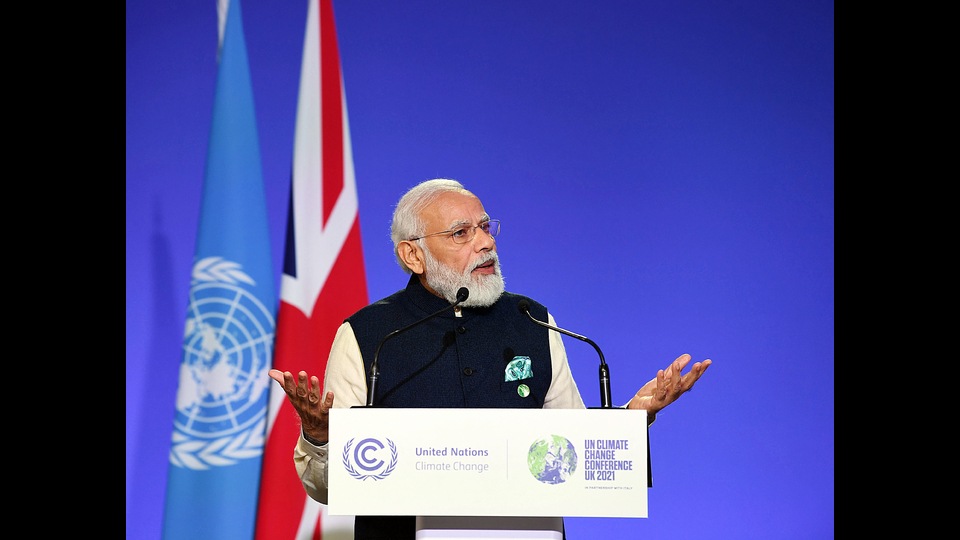
The PM’s statement, which builds on the principles of climate justice and equity, has been welcomed across the board. Energy experts and environmentalists have said that it balances India’s development needs and is consistent with what scientists agree is needed to keep temperatures from rising more than 1.5 degree Celsius: The world has to reach net-zero CO2 emissions by mid-century, then hit net-zero across all greenhouse gases by 2070. India’s pledges are significantly more ambitious than the 2015 nationally determined contribution (NDC). India is yet to submit an updated NDC.
Despite being a developing country with its growth challenges, the five pledges show that New Delhi is resolute about acting decisively against the climate crisis. The commitments will need massive structural changes across sectors, but India must undertake them in its self-interest, and also ensure that all policies and projects have a strong climate lens. Geopolitical pressure may have played a part in forging India’s stand, but climate negotiations are not restricted to the environment and energy issues. They have a robust strategic component too. With the five pledges, India has now put the ball in the court of the developed nations. The PM reminded them that they must ramp up their contributions to help less-developed countries decarbonise and that India’s “expectation [is] that the world’s developed nations make $1 trillion available as climate finance as soon as possible”. India has done its bit and more; now the rich world must follow suit.


