
 E-Paper



How Donald Trump decided the tariff for India
Some experts have suggested that Trump’s calculations of tariffs imposed by a specific country could have nothing to do with tariffs at all

 Prefer HTon Google


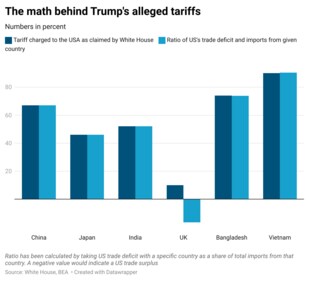
India charges a tariff of 52% on US products, Donald Trump claimed while slapping a tariff of 26% on India as part of his reciprocal tariff announcements. Where does this 52% number come from? Some experts have suggested that Trump’s calculations of tariffs imposed by a specific country could have nothing to do with tariffs at all. Instead, they seem to be a mark-up of US’s merchandise trade deficit with a given country.
A cursory analysis of the tariffs levied on other countries proves that this is the rationale.
A post (one among the many which pointed this out) on microblogging site X (formerly twitter) by Justin Wolfers, professor of economics at University of Michigan flagged this.
OMG, this is *bananas*. The White House "reciprocal" tariff bears no relation to actual tariff barriers. It's equal to half of the trade deficit (as a share of imports). This is indescribably crazy.
A basic calculation of numbers suggests that this is indeed the case. For example, the India’s merchandise exports and imports to US in 2024 were $87.5 billion and $41.9 billion respectively. This leaves a trade deficit of $45.6 billion. This number is 52% of India’s exports to the US and 52% is what Trump has claimed Indian tariffs on the US are. The math also checks out for countries such as China, Japan, Bangladesh, Vietnam etc.
Indian analysts, also suggested that this could indeed have been the case. “Trump seems to have used the respective trade deficit of each country with the US as the basis for reciprocal tariff calculations, rather than the actual level of tariffs imposed by each country”, Madhavi Arora, Chief Economist, Emkay Global said in a note.
India’s actual tariffs on US imports, are likely to be much lower than 52% which is what Trump has claimed. A Barclays research note issued last week had said that India’s import tariffs on US were an estimated 10.5%in 2023. HT had covered this note here. To be sure, they were much higher than the 2.7% tariffs on Indian exports to the US and significantly higher than import tariffs imposed by many south-east Asian countries the US.
“Asia has been hit much more than India on tariffs and India is less export-exposed vs EM Asia, but India is unlikely to be non-synced with EM Asia on the cyclical downturn. China’s survival response to massive tariff blow will matter for India, amid its excess industrial capacity and dumping in the world/Asian markets. While we negotiate with US/other trade partners, we might have to protect against Chinses responses (read tariffs), which could immediately hit domestic industries, and will have a disinflation impulse”, Arora added in her note.


