E-Paper



Indian migrants' problem of document transfers | Number Theory
The National Statistics Office (NSO) conducted a survey in 2020 that can help us answer this question

 Prefer HTon Google


The run-up to India’s 79th Independence Day has been mired in debates around citizenship and voting rights. The ongoing debate around Special Intensive Revision (SIR) of electoral rolls and controversies and claims and counterclaims about (West) Bengali migrant workers being dubbed Bangladeshis has also brought to fore questions about whether or not people being probed have enough documents. Another story in these pages earlier this week, looked at linguistic diasporas inside and outside India.

All this raises the question: What proportion of migrant workers actually transfer their documents when they move places within the country? The National Statistics Office (NSO) conducted a survey in 2020 that can help us answer this question. Its summary finding is that only around half of India’s migrants transfer their documents when they move. Here is a more detailed takeaway from the numbers from the survey.
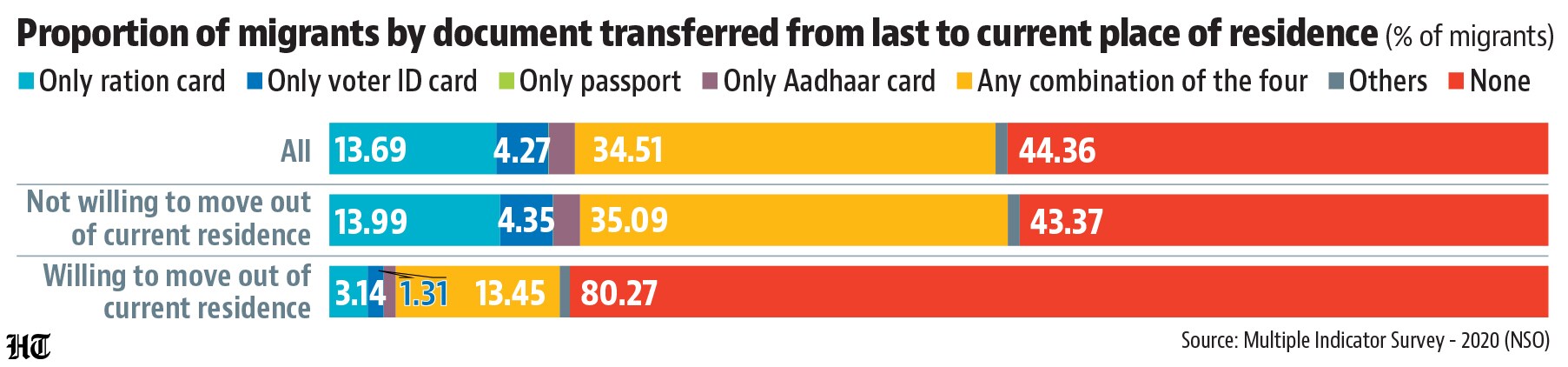
 44% of migrants in India don’t transfer any documentsThe Multiple Indicator Survey (MIS) data shows that 29% of Indians were migrants and 44% of migrants had not transferred any documents at all. The proportion of people who did not transfer voter ID cards is higher. The survey specifically asked if people had transferred exactly one of either ration card, voter ID card, passport, and Aadhaar card, or any combination of these four documents. 4.3% had transferred only their voter ID cards and 34.5% had transferred a combination of these four. This implies that at least 61.2% had not transferred voter ID cards. To be sure, this analysis must be read with two caveats. One, the survey was conducted in 2020, when a lot of urban migrants moved back to villages (amid the pandemic). Two, the MIS does not allow one to remove seasonal migrants from the analysis, who may not need to transfer documents. However, this analysis is meaningful despite these caveats because 71% of migrants listed marriage as the reason, a well-known trend in migration in India. Moreover, 97% migrants expressed no willingness to move out of the place of enumeration. This suggests most surveyed migrants weren’t seasonal migrants. Of the 3% that were willing to move, 80% did not transfer documents, as expected.
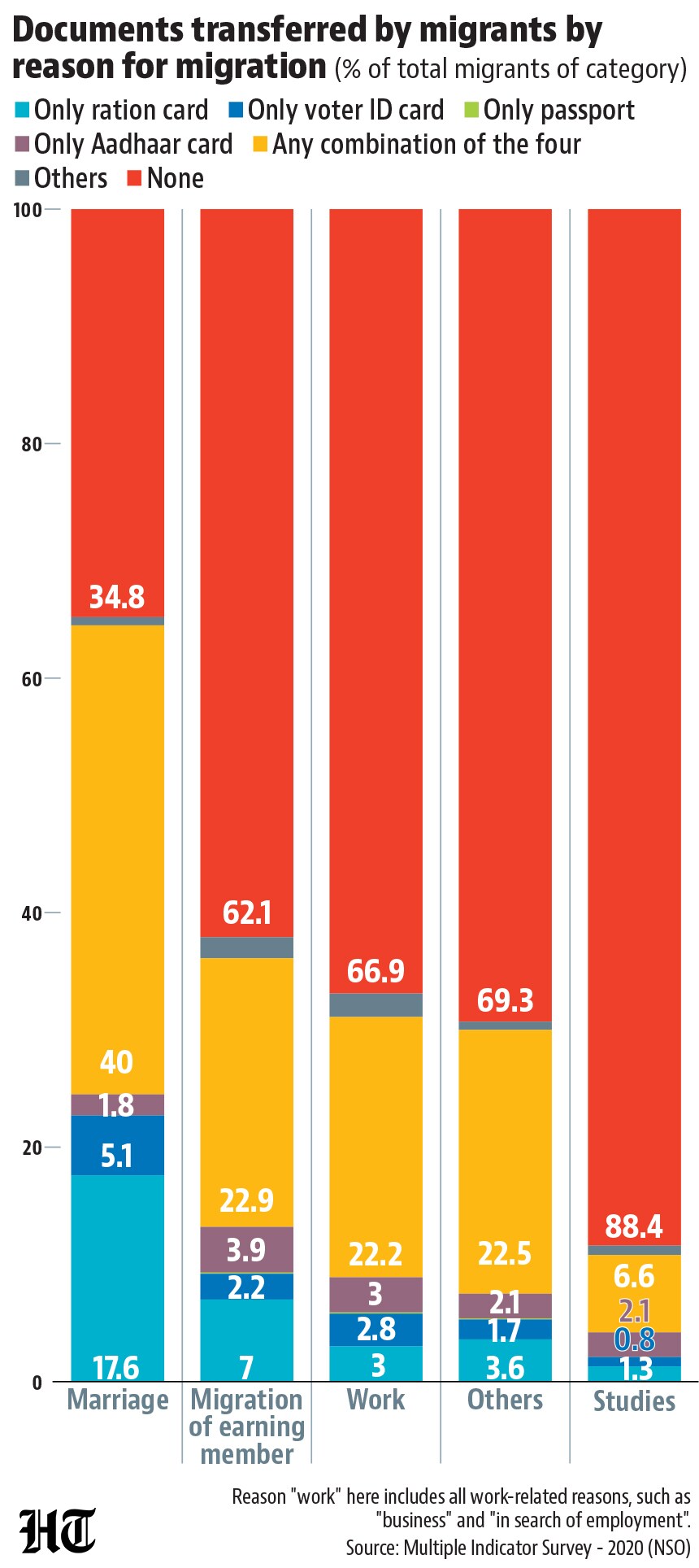
- Those migrating for work or studies are even less likely to transfer documentsWhile they are a relatively small proportion of migrants, those migrating for work and studies were less likely to transfer documents. 67% and 88% of such migrants did not transfer documents compared to 35% of those migrating for marriage. To be sure, unlike the marriage migrants, those migrating with the earning member of the family were not much likely to transfer documents. At any rate, these numbers support the anecdotally known trend of people travelling to vote instead of transferring their documents.
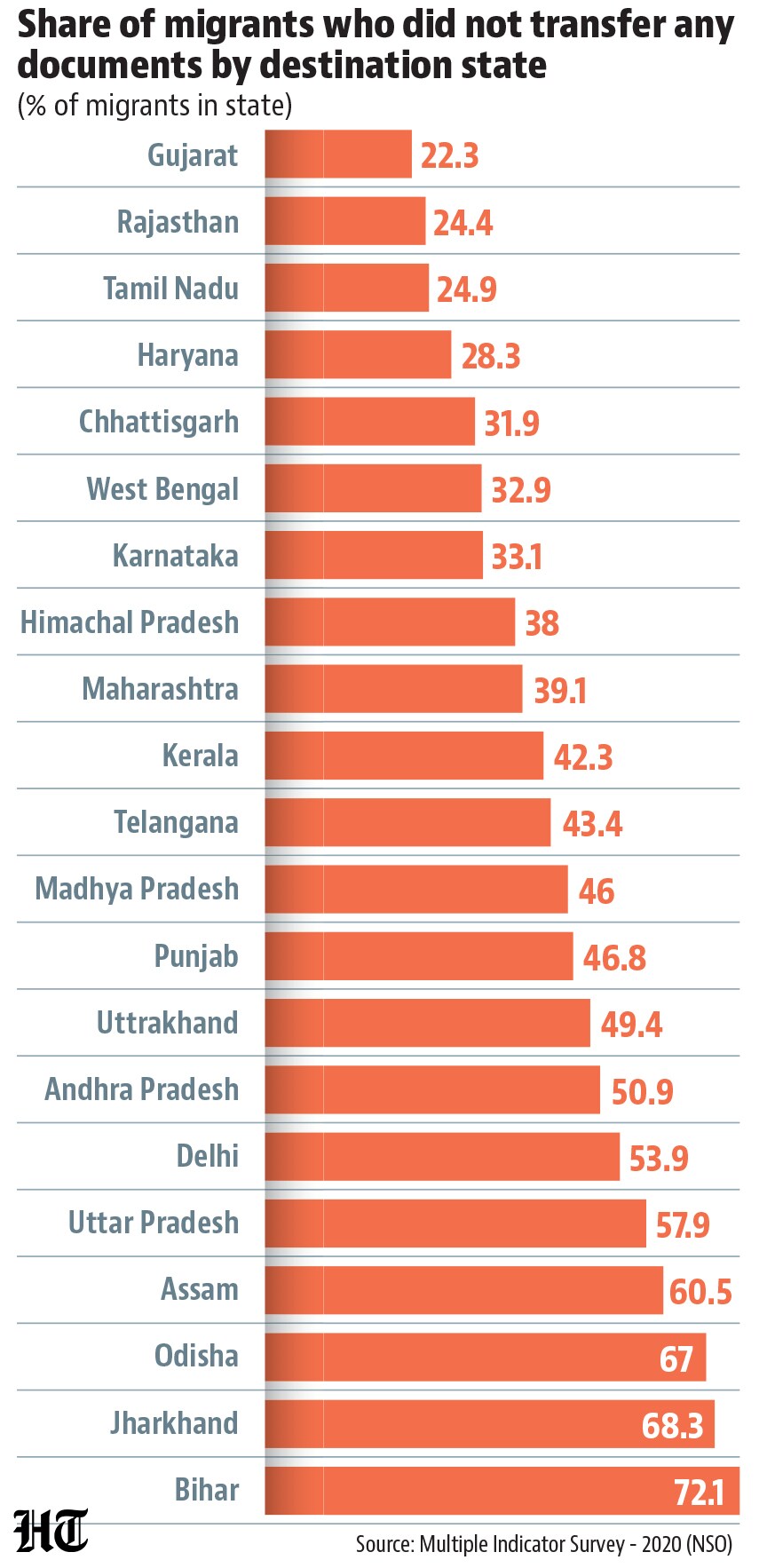
- The lack of document transfer is significant across statesThe popular image of migrants may be of poor people migrating interstate for blue collar work, but that perception is not completely correct. As even the 2011 census showed, most migration is intrastate and the leading reason for migration is marriage; women drive this trend. Therefore, the problem of document transfer is present across states at different levels of development and with different work-migration patterns. For example, Odisha (known as a poor state with outflow of interstate migrant workers) has almost the same proportion of migrants in its population as Delhi (known as a rich city with inflow of interstate migrant workers), and more than 50% of migrants in each reported not transferring any documents at all.
- To be sure, as the accompanying chart shows, the proportion of migrants that transfer documents does vary significantly across states. The point of this analysis is that it does not have easily predictable patterns that one can be just as easily addressed. It also lends credibility to the anecdotally known problem that getting a document made or transferred in India is a cumbersome exercise and rampant with petty corruption. In other words, unless facing dire consequences, people are unlikely to engage in the exercise willingly. If authorities expect migrants to transfer documents in India – the SIR exercise essentially expects people to do this even if they migrate to a different constituency in the same district – it is they who need to step up and make the process seamless and free of harassment.