
 E-Paper



More flags than ever, but the same football factories | Number Theory
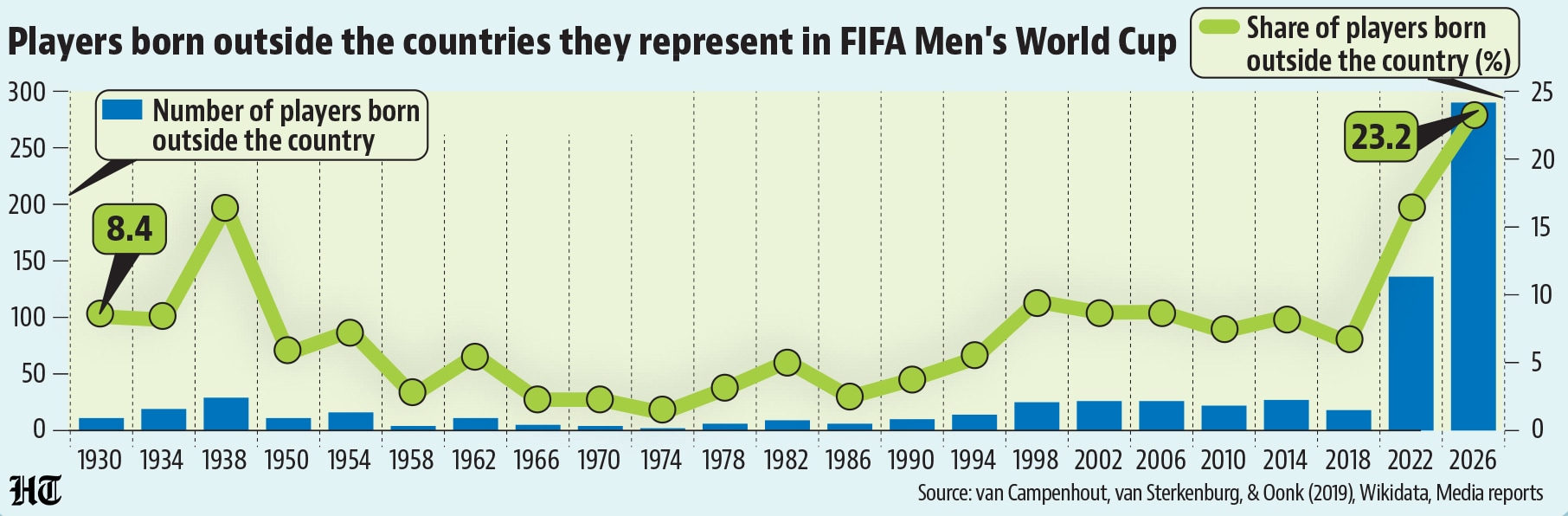
The number of foreign-born players rose from 18 in 2018 to 136 in 2022 and 290 in the ongoing World Cup, accounting for 23.2% of all players.
Published on: Jul 14, 2026, 07:14:29 IST

 Prefer HTon Google
Share via


Copy link

The first part of this two-part series explored whether the expansion of the FIFA World Cup has improved the representation of teams beyond the traditional footballing powers, but only in the tournament’s early stages. This part examines the geographical diversity within World Cup squads as the number of foreign-born players has surged, and what this reveals about the movement of the footballing talent pool beyond the pitch.

More flags than ever, but the same football factories
 The World Cup’s new competitive edge was born elsewhereForeign-born players were unusually common in the World Cup’s early years, but for reasons quite different from today. FIFA had no firm eligibility rules, allowing footballers to switch national teams. Luis Monti, for instance, played the 1930 final for Argentina before winning the 1934 tournament with Italy. Political upheaval and shifting borders also blurred national affiliations.FIFA subsequently imposed much stricter rules, tying players to the country they had represented in an official competition. As a result, the share of foreign-born players remained in the low single digits through much of the post-war era, touching just 1.3% in 1974. The rules were relaxed again in 2003, particularly for dual nationals who had represented one country at youth level but not its senior team. The latest surge, however, is unprecedented in scale, even if not in kind. The number of foreign-born players rose from 18 in 2018 to 136 in 2022 and 290 in the ongoing World Cup, accounting for 23.2% of all players. This is largely because countries with smaller domestic talent pools are increasingly drawing on large diasporas developed elsewhere. Federations such as Morocco’s have consciously cultivated diaspora talent, turning players raised in European football systems into a core part of the national team project. Curacao had only one locally born player in this World Cup, while foreign-born footballers formed the majority in the squads of DR Congo, Morocco, Algeria, Haiti and Cape Verde. This has given football’s smaller nations a much deeper bench from which to challenge the established powers.
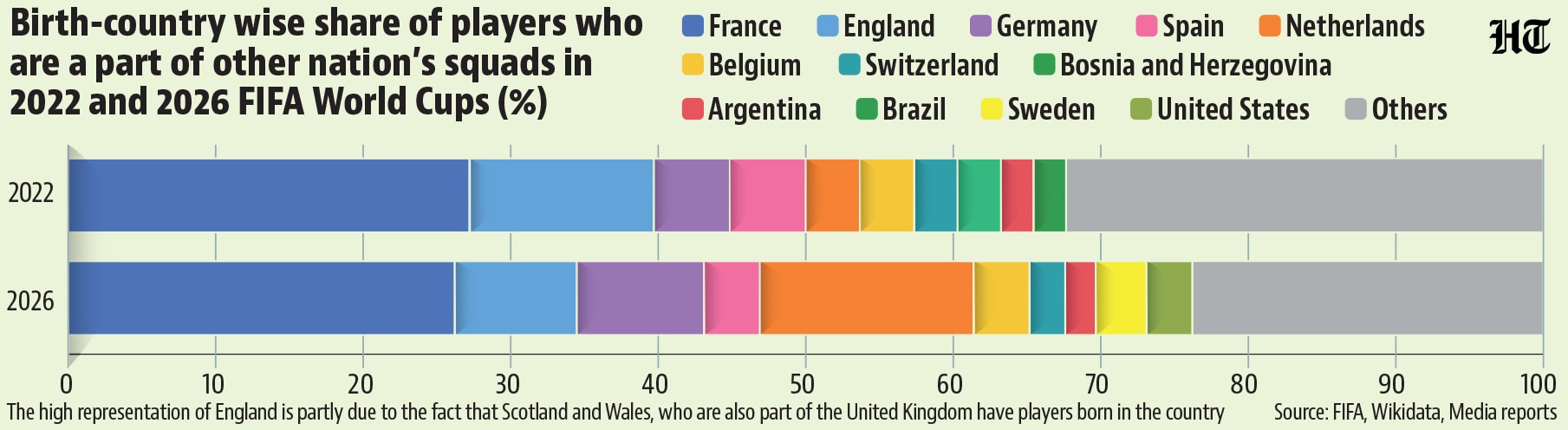
- And this is largely because the tournament has expanded faster than its talent baseAt least in the group stage, the World Cup is now more geographically diverse, but the production of elite footballers remains heavily concentrated. Of the foreign-born players representing another country in 2026, more than a quarter were born in France. The Netherlands accounted for another 14.5%, Germany for 8.6% and England for 8.3%. Together, these four European countries produced well over half of all foreign-born players in the tournament. This concentration complicates the story of the World Cup’s expansion. More teams from outside football’s traditional centres now have a chance to qualify and compete, but many are doing so with players developed in the academies, leagues and youth systems of older footballing powers. France has remained the largest source across the past two editions, while the Netherlands’ share has jumped from 3.7% in 2022 to 14.5% in 2026.
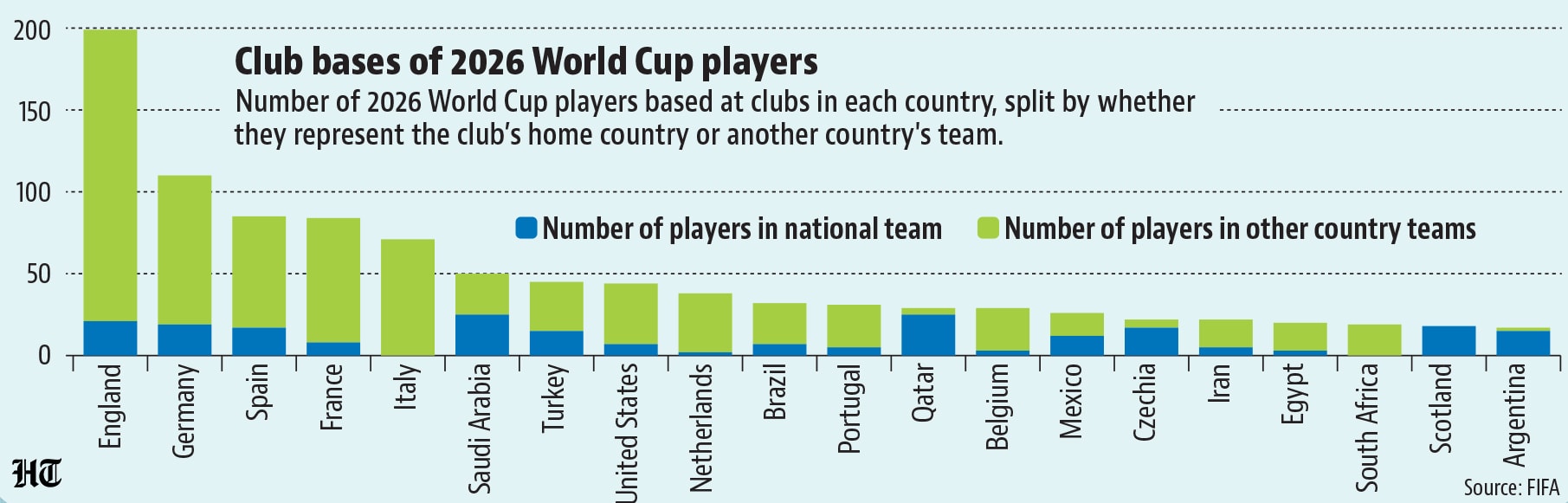
- Europe’s real dominance lies in the club pipelineWhile birthplace shows where footballers come from, club affiliation reveals where the modern game’s power really sits. English clubs sent 199 players to the 2026 World Cup, but only 21 are representing England. The remaining 178 are representing other countries. Germany’s clubs supplied 91 players, France (76), Italy (71) and Spain (68). Between them, Europe’s five biggest football economies supplied 484 players to foreign national teams. Italy’s case is particularly striking. Its national team did not qualify, yet its clubs still sent 71 players to the tournament. The Netherlands displayed a similar reach, with 36 of its 38 club’s players representing countries other than the Dutch team. Saudi Arabia and the United States are emerging as alternative hubs, with their clubs employing 50 and 44 World Cup players, respectively, but their international spillover remains smaller. In short, the World Cup may now be more global in participation, but the route to it still runs disproportionately through Europe. To be sure, birthplace and club affiliation data do not tell the full story. Many players born and trained in Europe and playing for European national teams have family roots in Africa, the Caribbean and elsewhere, and therefore do not appear in the foreign-born count. The current French squad, for instance, is almost entirely of African descent. The game’s evolution therefore is not only built in academies and leagues, but also by the migration histories that feed them. Few players capture this better than Folarin Balogun, born in New York to Nigerian parents, raised in England and now representing the US – a footballing biography that shows how migration can expand the idea of a national team even as politics keeps trying to narrow the idea of the nation.


Unlock a world of Benefits with HT! From insightful newsletters to real-time news alerts and a personalized news feed – it's all here, just a click away! -Login Now!


