E-Paper



Number of school-going children is already falling in India | Number Theory
Without prejudice to Uttar Pradesh’s decision of closing schools – government schools are mostly understaffed and under-resourced in India

 Prefer HTon Google


In June, the Uttar Pradesh government decided to merge some government schools in the state. The move triggered criticism from the opposition and also challenges intuitive reasoning. Uttar Pradesh is the most populous state in India and its population is still rising, given the fact that its total fertility rate (TFR) is still more than the replacement level of 2.1 and the second highest in the country after Bihar’s. TFR is the the average number of children a woman is expected to have and when it goes below 2.1 it entails a fall in population levels. Without prejudice to Uttar Pradesh’s decision of closing schools – government schools are mostly understaffed and under-resourced in India and children might have to travel longer distances to attend school – data is clear is on at least one aspect of the debate: the number of school-going children might have already started falling in India. Here are four charts which explain this in detail.
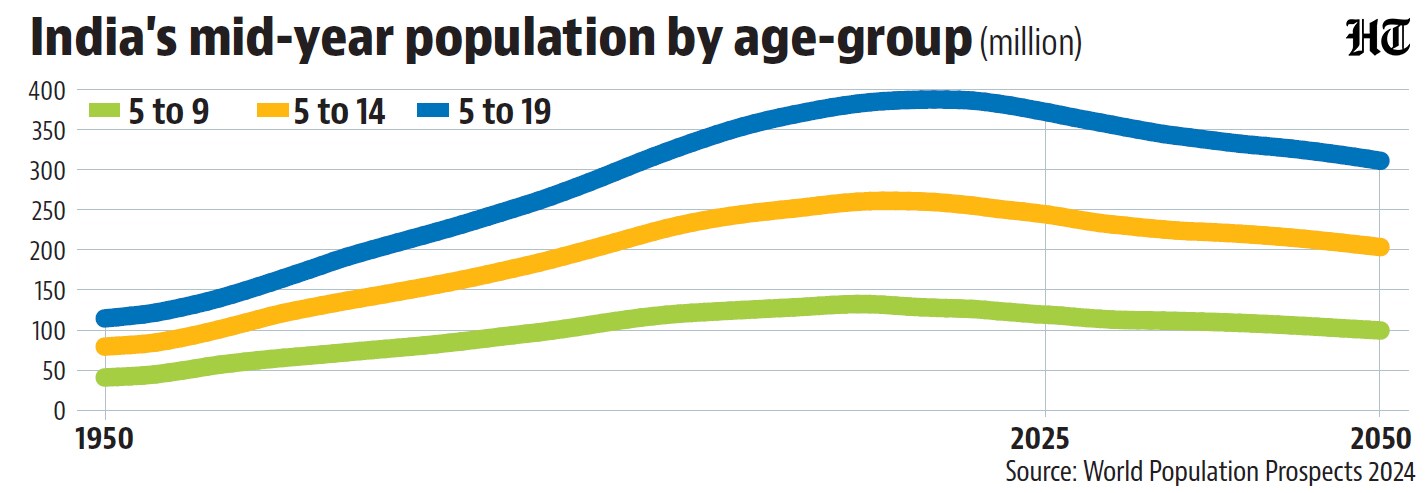
 India’s population of children is estimated to have peaked in the 2010sAccording to population estimates released by the UN in 2024, India’s total population and working age population (taken as the 20-64 age group by the UN) is expected to increase up to 2061 and 2049. Clearly, India is in no immediate danger of a declining pool of workers. However, its population of children is believed to have started declining in the 2010s. According to UN’s estimates, the 5-14 age group (the Right to Education Act provides for free education for those in the 6-14 age group) started declining in 2012. The lower half of that broad group – those in the 5-9 age group – started declining in 2010. To be sure, people can be enrolled in schools even beyond the age of 14 years. However, even the 5-19 age group started declining in 2016. A definite picture of this decline will emerge only when the census is conducted in 2026. There was no decline seen in these age groups between the census conducted in 2001 and 2011. This is expected because the projected annual decline was very small and recent in 2011 for populations to fall below the level seen in 2001.
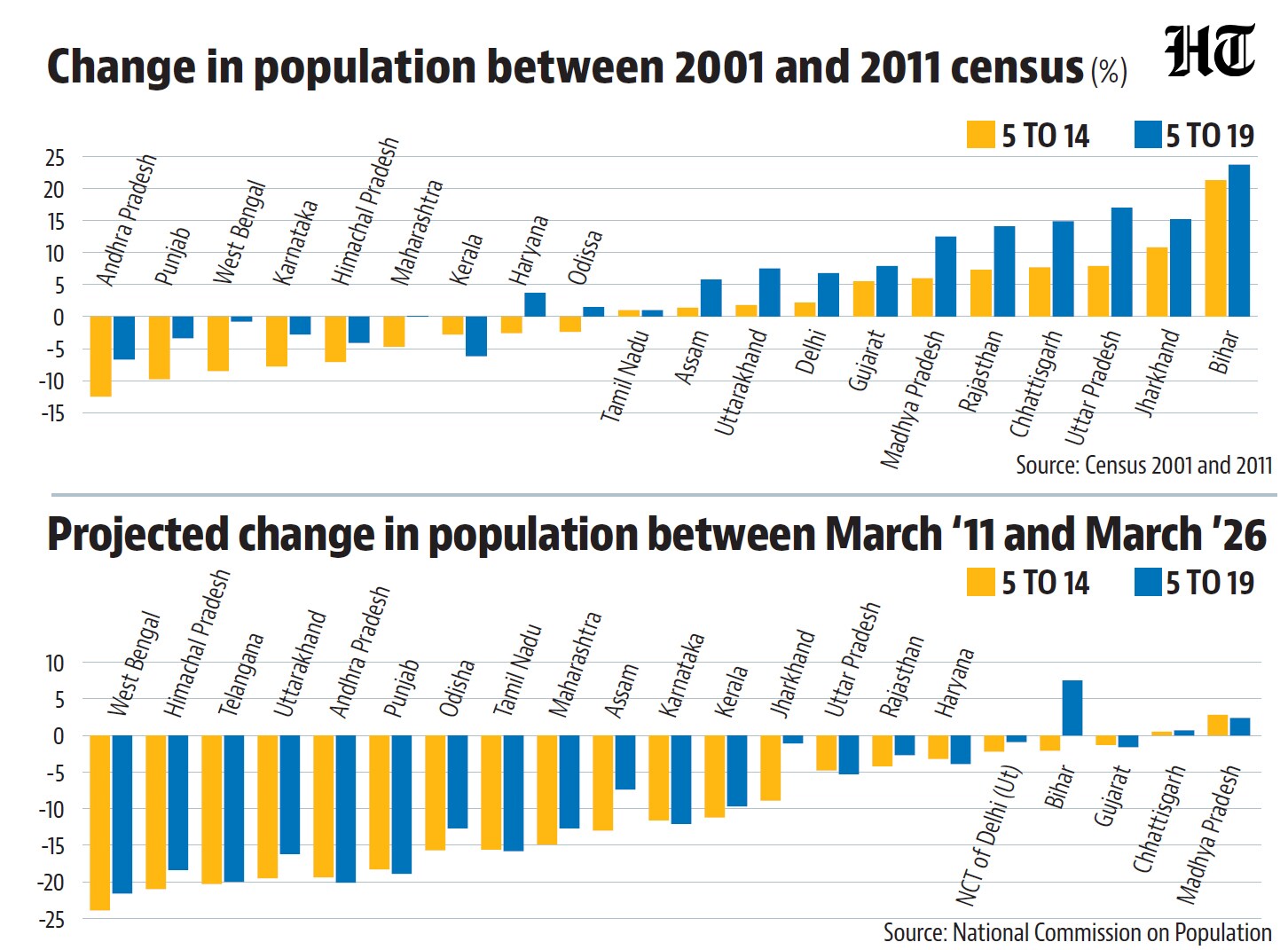
- Population of children declined in nearly half the big states even in the 2011 censusWhile there was no decline at the national level in the 5-14 age group between the last two census years, nine of twenty big states recorded a decline. Even in the 5-19 age group, six states recorded a decline. To be sure, seven of the nine states that recorded a decline in the 5-14 age group had a total fertility rate under two in 2011, which means that even their broader population was already on the way to a decline. However, the population of some age groups can decrease even if the overall population is increasing. For example, the 0-4 age group declined in Uttar Pradesh between the 2001 and 2011 census although the total population didn’t. State-wise age-group projections by the National Commission on Population suggest that the size of the 5-14 age group will decline between 2011 and 2026 in 19 of the 21 big states (Telangana counted as separate from Andhra Pradesh here). Chhattisgarh and Madhya Pradesh are the only two states where the population of this age group is expected to increase. The 5-19 age group is also expected to shrink in all states except Bihar, Chhattisgarh, and Madhya Pradesh.
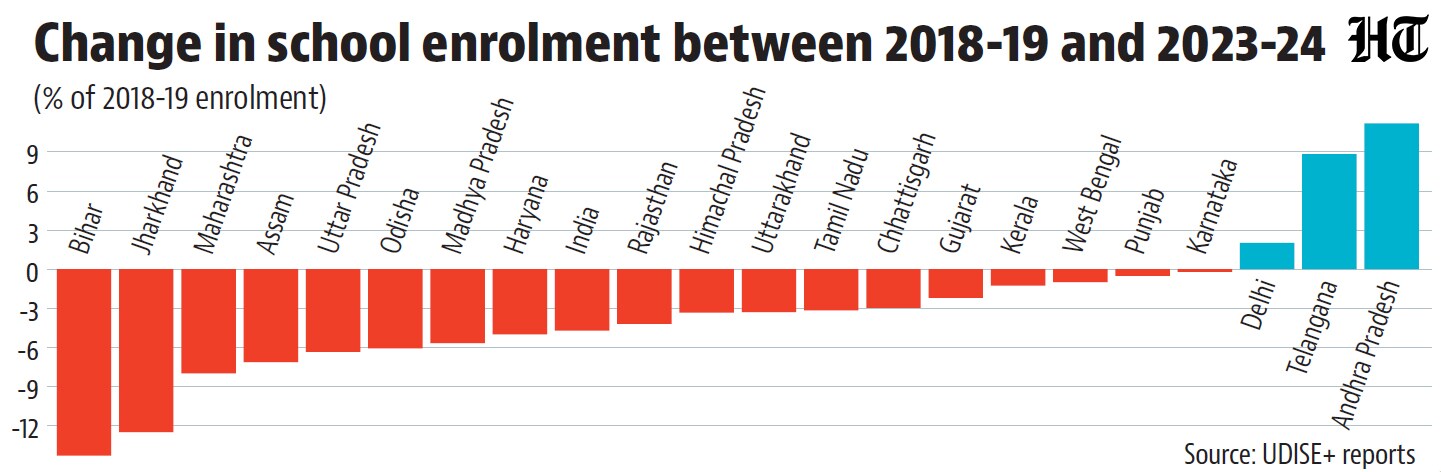
- School enrolment decreased in the past five years across most statesAs the discussion above suggests, it is not surprising that there are schools with low enrolment in Uttar Pradesh. The Unified District Information System (UDISE) data – it is the source of all school education statistics of the education ministry – also shows that school enrolment is falling in most states. 18 of 21 big states recorded a decline in school enrolment between 2018-19 and 2023-24, which is the period of the improved version of UDISE called UDISE+. While most of this change is because of pre-primary and primary levels, some states including Chhattisgarh and Punjab recorded a decline in middle or secondary and higher secondary level. UDISE+ data also shows that school enrolment may not always be correlated with the population of children. The only places where enrolment increased in this period were Andhra Pradesh, Telangana, and Delhi, where the population of children is projected to decrease.
- While closing schools should not be a decision based on just the number of students, India will do well to recognise that the way to better exploiting its demographic dividend might have entered a phase of qualitiative rather than quantitative expansion.