E-Paper



Number Theory: A peek inside India’s informal economy – I
.

 Prefer HTon Google


The GDP numbers released by the National Statistical Office (NSO) on Friday raise an intriguing question. The Indian economy grew at 9.2% in the fiscal year 2023-24, yet the incumbent Bharatiya Janata Party (BJP) lost more than 20% of its seats in the Lok Sabha in the 2024 general elections. Why did high economic growth – 9.2% is pretty good by any standard – not translate into political traction for an incumbent?

A large part of the Indian economy, in terms of number of firms and workers, actually produces very little of its GDP. This means that the fortunes of people, and perhaps political sentiment, are not really connected with the headline growth numbers. This two-part series will seek to establish this based on an analysis of unit-level data from the latest Annual Survey of Unincorporated Sector Enterprises (ASUSE). The analysis presents a sobering picture. The first part will show that India’s informal sector firms are grossly over-represented in employment, underrepresented in income and, surprise surprise, not unhappy despite their poor fortunes.
The second part will show how most of these firms are family run, provide very little quality employment, and see hardly any premium from longevity.
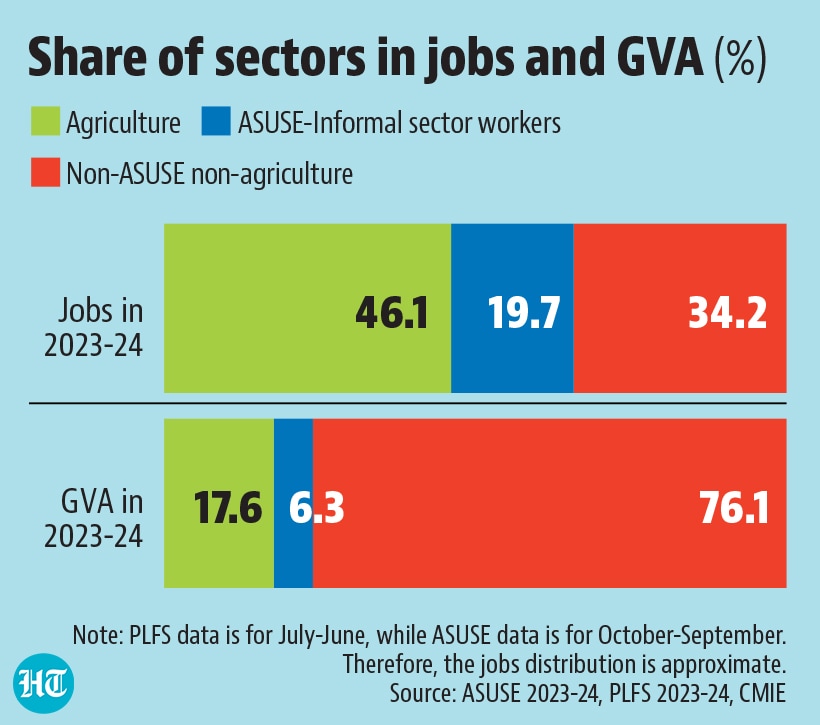
 The importance of the informal sector in India’s non-farm economyAccording to the latest Periodic Labour Force Survey (PLFS) conducted in July 2023-June 2024, 46% of India’s workers were employed in agriculture which accounted for just 14.5% of the Gross Value Added (GVA) in the corresponding period. While we do know that even the non-farm sector has a significant income-employment asymmetry, the real extent of this can be seen only when one looks at data from ASUSE. The latest ASUSE report puts the estimated value added in the non-farm informal sector at ₹18 lakh crore in October 2023-September 2024. This would work out to 7.7% of India’s nominal GDP excluding agriculture in this period. Working with estimated worker numbers from ASUSE and the 2023-24 PLFS data, informal sector firms are expected to have a share of 36.8% in India’s total non-farm workers. Adding these with numbers for agriculture, 66% of the workers in India account for just 24% of the total GVA. The GVA per worker for informal sector firms of ₹149,742 is actually lower than value added per agricultural worker which is ₹178,663.
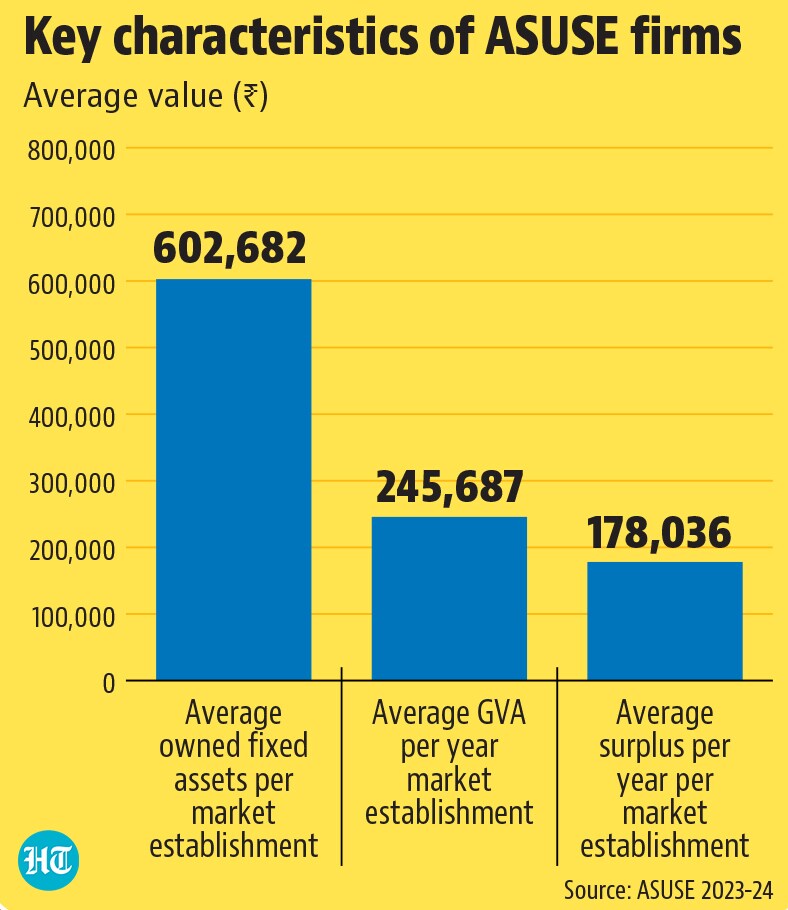
- The average informal firm has 1.64 employees, Rs6 lakh in fixed capital, and Rs2.5 lakh GVAAccording to 2023-24 ASUSE data, the average informal sector firm operating in the market had just 1.64 workers (including working owners), of which just 0.42 were hired workers. Each firm owned, on average, fixed assets of just ₹602,682 and it produced a gross value added of only ₹245,687 per year. The surplus made by an average informal sector firm – it is defined as the GVA of the firm less emoluments paid to workers and rental paid on fixed assets – was just ₹14,836 per month or ₹178,036 per year. These numbers give us an idea about the precarity of the informal economy in the country.
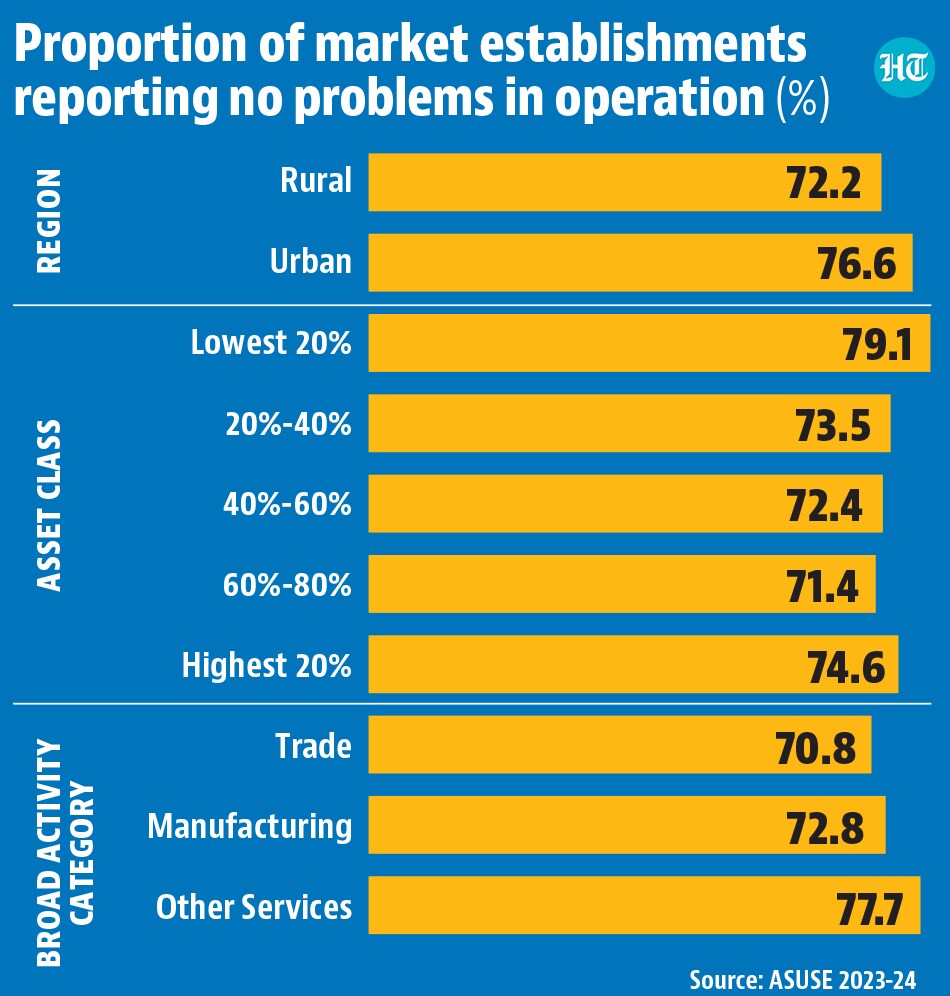
- Despite their precarious state, most of these firms report no problemsThis is the most fascinating (or depressing) insight from the data. Among the many questions asked in ASUSE, one was whether firms were facing any problems. The options include a variety of things from power cuts to high cost of credit to lack of skilled or regular labour. A massive 74% of the firms did not report facing any problem whatsoever. While the numbers do show some variation across sectors, geographies and asset class, a large majority of firms did not report any problems across sectors. This raises an interesting and troubling question about what can be done to bring more dynamism to the informal economy.