E-Paper



Number Theory: An educational explanation of Sino-Indian economic divergence - 2
.
Published on: Nov 8, 2024, 19:25:16 IST

 Prefer HTon Google
Share via


Copy link

The first part of this series underlined the role of manufacturing in the economic divergence between the Chinese and Indian economies. What explains India’s failure to give a comparable boost to its manufacturing activity? This is where a recently published paper by economists Nitin Kumar Bharti and Li Yang offers an extremely interesting answer, namely, the difference in educational policies of China and India over the last 120 years. These findings are based on a unique dataset on educational statistics which has been prepared by the authors. Here are four charts which will put their argument in context.
India China divergence
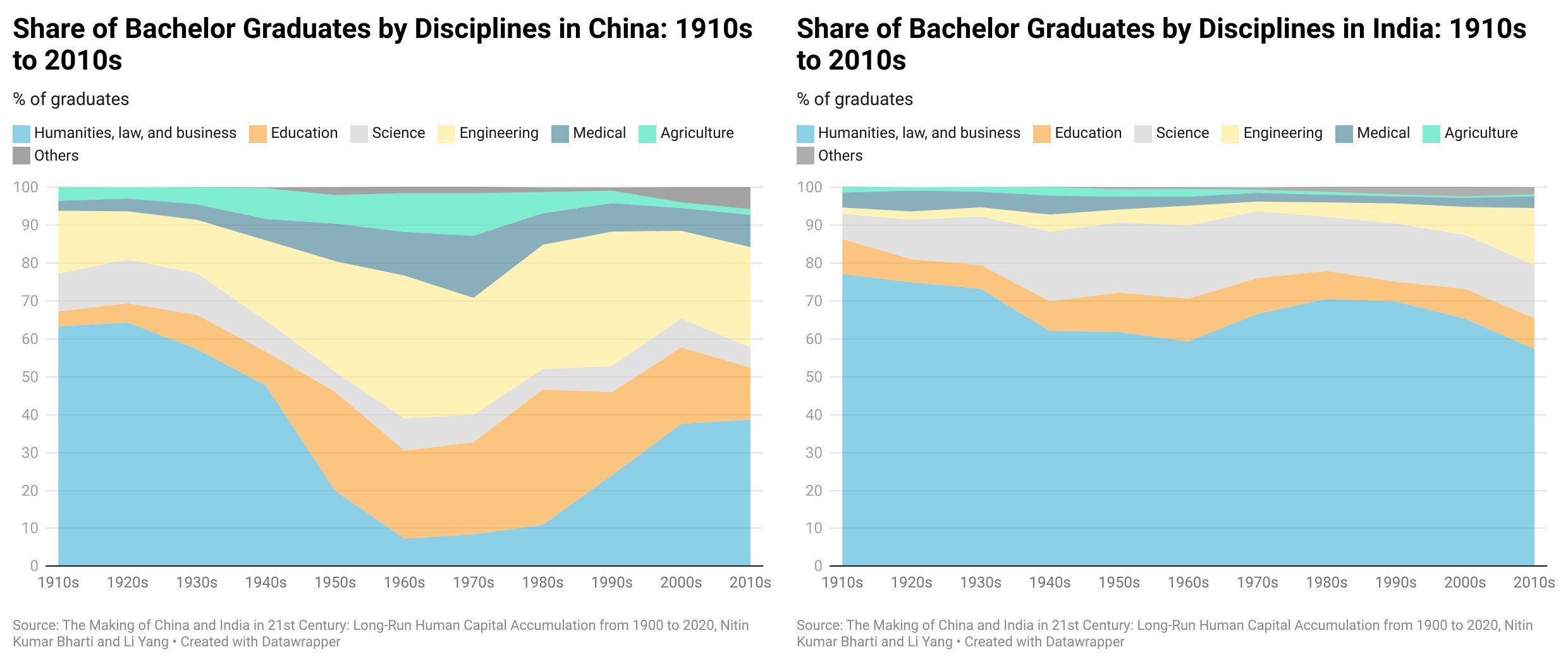
 India’s engineering boom is nothing when compared to China’sThis is the biggest reality check on the predicament facing Indian manufacturing which the paper offers about India’s skilled workforce. While a lot of Indians associate India’s post-reform period with a sharp rise in the number of engineers in the country, this is nothing when compared to the share of engineers in the Chinese educational system. “... the phenomenon of “brain drain” among top-tier engineers since the 1980s, coupled with the remarkable growth of the engineering discipline in India over the past 10-15 years, has contributed to the perception that India is a land of engineers. However, comparing engineering graduate shares over the last century, it becomes evident that China has placed a stronger emphasis on engineering education”, the paper says. India’s higher education output, the paper shows, is still overwhelmingly skewed in favour of humanities, which they rightly flag as a legacy of colonial education system which was interested in producing clerks for the British Raj.
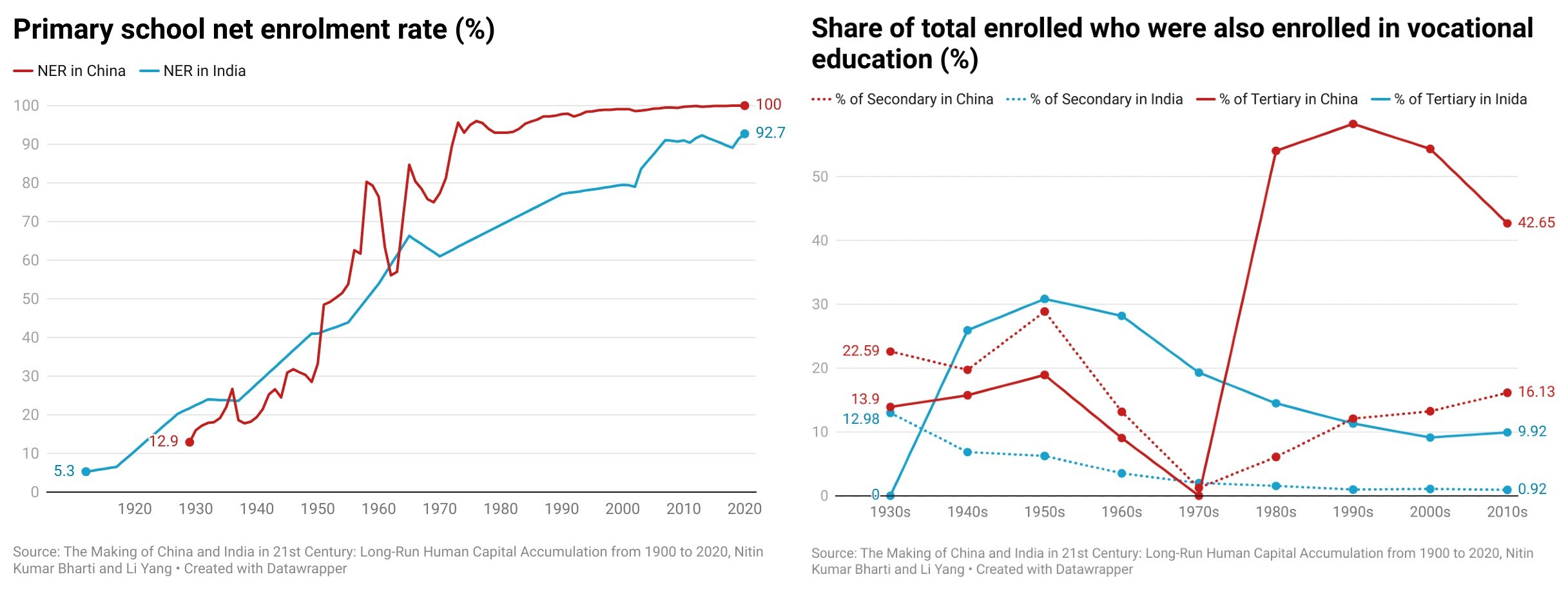
- To be sure, the seeds of Sino-Indian educational divergence might be rooted in historyOnce again, the paper adds value to our understanding by giving quantitative proof for what has often been argued anecdotally. Because pre-communist China was never fully colonised unlike British India, its education policy could be more than just a means to produce a pliant lower bureaucracy. Communist China also prioritised mass education more than newly independent India, which focused on a handful of centres of excellence such as IITs. Therefore, China had a head start in mass education over India, and it also made education more vocational than generic. It is this twin advantage which might have given China a crucial edge in creating a skilled workforce for kickstarting its manufacturing boom. To be sure, labour supply is just one side of China’s manufacturing success story as factors such as capital investment by the Chinese diaspora and market access to economies such as the US also played a major role.
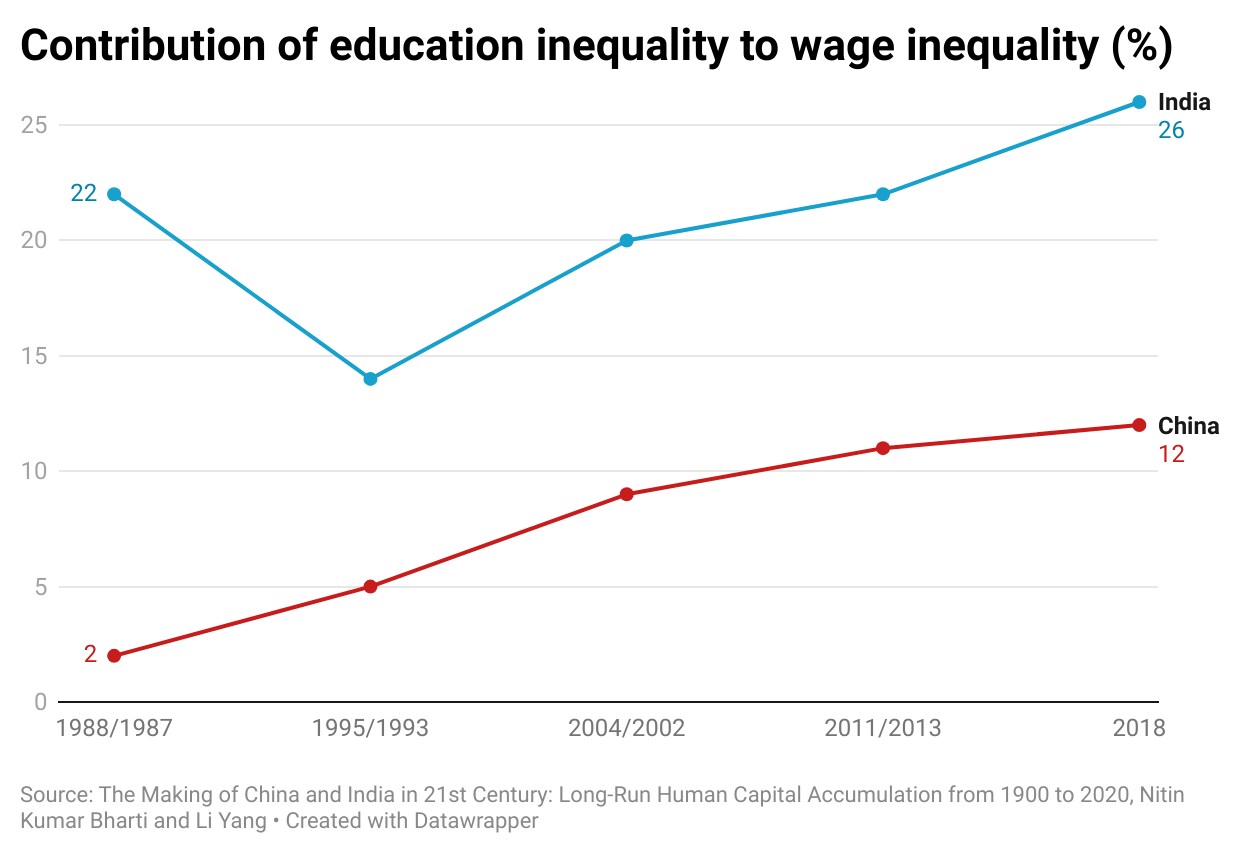
- China’s head start on mass education has helped it avoid India level of income inequalityBeyond studying education characteristics, the paper has also tried to understand their role in the different levels of income inequality in the two countries. As is expected, the correlation between wage inequality and education inequality in the workforce depends on two factors. One: how much education matters for the wages of an individual worker in a particular year. Two: the difference in the education levels of the workforce. Over time, China and India have converged in terms of the first factor. An additional year of education had a 2% and 8% rate of return to wages in China and India in the late 1980s. Both countries had converged to an 8% rate of return by 2018. However, because education inequality itself is still much lower in China – because of its history of mass education – it does not contribute to wage inequality overall as much as in India. Education inequality’s contribution to wage inequality in China increased from 2% in 1988 to 12% in 2018 because of the increasing rate of return to education. However, even in 2018, this number was much lower than the 26% contribution education inequality made to income inequality in India.