
 E-Paper



Going round in circles: Are roundabouts ‘traffic bottlenecks’? Experts weigh in
Despite the historical tendency of roundabouts to ease traffic congestion, increase in private vehicle ownership and large buses has led to traffic congestion.

 Prefer HTon Google


Every weekday morning, Rishi Kumar finds himself caught in what he calls ‘a slow-motion whirlpool of traffic’ on his way to the office in central Delhi. “These roundabouts in Lutyens’ Delhi really test my patience and my driving skills, and cause unexpected delays in reaching office,” he says. “They are beautiful, but they are also big traffic bottlenecks now.”
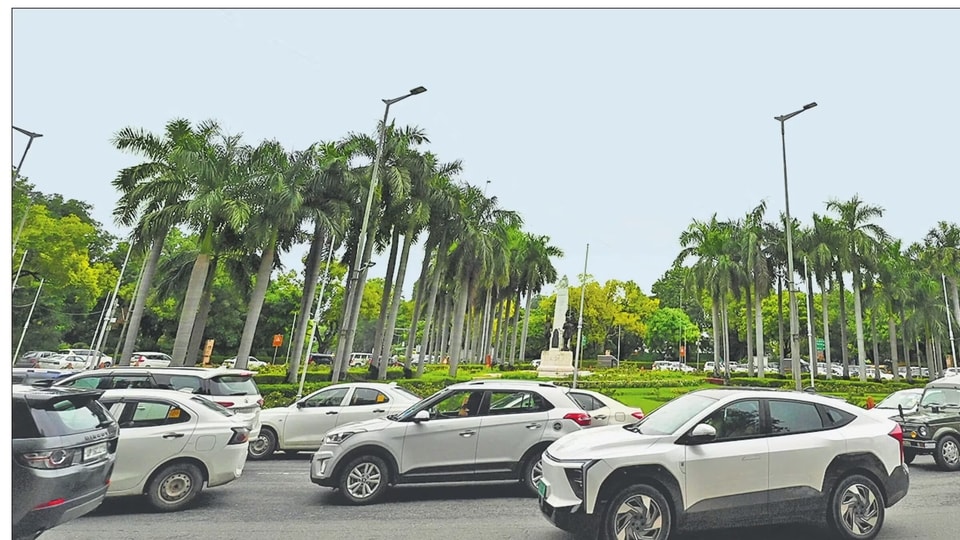
Kumar’s frustration is shared by millions of commuters who find it hard to tackle the increasingly gridlocked roundabouts across Indian cities, where cars and auto rickshaws cut diagonally across lanes, two-wheelers try to squeeze between buses, and vehicles entering the circle keep pushing forward until those already inside are forced to brake.
The basic rule of a roundabout—that the traffic already inside the circle gets the right of way—is reduced to a free-for-all, and within minutes the whole junction locks up.
It was not always so. Roundabouts once symbolised a grand idea in Indian urban planning.
The historical notion of adding roundabouts
Edwin Lutyens used them to anchor New Delhi’s grand avenues, Le Corbusier built them into the ordered road hierarchy of Chandigarh, and H. K. Mewada and Prakash M. Apte integrated them into Gandhinagar’s low-density, tree-lined grid. The roundabouts ensured smooth movement through a city, slowed vehicles without traffic lights, and gave these cities a unique identity.
When these circular junctions were laid out decades ago, private vehicle ownership was nowhere near today’s levels, and roads carried buses, bicycles, and a modest number of cars.
Last year, a survey of 39 roundabouts by traffic police in the New Delhi Municipal Council (NDMC) area found that disproportionate road widths, misaligned footpaths, oversized plantation spaces, and narrow roundabout diameters were squeezing traffic flow and creating bottlenecks at these colonial-era circles. Five roundabouts were identified as the worst affected: Teen Murti Haifa, Tughlak Road, Sunehri Bagh, Jaswant Singh (Panchmukhi Chowk), and Q-Point near India Gate.
When a roundabout gridlocks, geometry usually takes the blame, but experts say the real issue is broader: Cities have grown faster than these junctions were built to handle, and the resulting chaos is driven by a mix of urban growth, road design, driving behaviour, and surrounding network traffic.
Also Read I Delhi Master Plan 2047 explained: What it means for housing, redevelopment and NCR’s real estate market
Changing traffic volumes, stagnant design
Architect Goonmeet Singh Chauhan, who has worked on several public projects in Delhi, argues that roundabouts remain “among the most effective intersection types for cities, but says, “The problem is many of them have not evolved in accordance with changing traffic volume and pattern”.
Dikshu Kukreja, architect and urbanist, has a different perspective. “Roundabouts have unfortunately become an easy target in discussions around congestion, but I believe the issue is more nuanced,” he says.
As cities grow, he argues, some junctions will need redesigning for higher volumes and safety, but in heritage precincts the goal should be retaining spatial character while selectively improving geometry, visibility, and lane organization. “Urban identity and efficient mobility are not mutually exclusive when design is informed by evidence,” adds Kukreja.
More than a design problem
Architect Mitu Mathur points out that the transformation of the surrounding city lies at the heart of the problem.
Chandigarh’s roundabouts, she says, need to be understood within Le Corbusier’s larger planning vision, built around a clear hierarchy of movement, sector planning, and a structured relationship between built form and landscape. “The challenge today is that these junctions are now operating in a very different urban context than the one they were designed for. “
If Mathur points to changing urban form, Sewa Ram, professor of transport planning at the School of Planning and Architecture (SPA), Delhi, argues that driver behaviour is equally important.
“People don’t understand the difference between a roundabout and a rotary,” he explains. In a roundabout, he says, vehicles yield to traffic already inside and wait before merging; in a rotary, entering and circulating vehicles weave together before splitting toward their exits.
“Most of the roundabouts in Lutyens’ Delhi were originally designed as roundabouts, but because nobody follows the yield rule and nobody even knows whose right of way it is, they end up functioning like rotaries instead. That is one of the important reasons behind the chaos,” says Ram.
Also Read I Delhi man flags litter near India Gate, says ‘garbage is scattered everywhere’
A congested junction, he points out, is not an isolated problem. “Instead of looking at a single roundabout in isolation, there is a need to look at the entire network. You have to treat the area as one complete circulation plan, not fix one junction and hope it functions well,” he says.
At Teen Murti, he points out, heavy traffic converges from Akbar Road, Safdarjung Road, and the other three arms feeding the roundabout, and it doesn’t have the capacity to handle it; so some of that traffic needs to be diverted elsewhere. “But if a junction is carrying more than 10,000 passenger car units an hour at peak time, it has gone beyond its design capacity,” he says
A different way forward
Many cities such as Ahmedabad and Chennai are now redesigning their intersections, the former in collaboration with Sardar Vallabhbhai National Institute of Technology (SVNIT) Surat, using traffic simulations and peak passenger car unit analysis. Chennai, meanwhile, is redesigning junctions with wider bell mouths and better road geometry to smooth traffic flow and improve pedestrian safety.
Ahmedabad now uses three models depending on volume: high-volume junctions become conventional signalised crossings, intermediate-volume ones keep their roundabout shape but add synchronised signals, and low-volume junctions stay signal-free.
These intersections are evaluated using Level of Service (LOS) framework, says Gaurang Joshi, professor, transportation systems at SVNIT Surat. The scale ranges from LOS-A, representing free-flowing traffic, to LOS-F, where traffic movement completely breaks down.
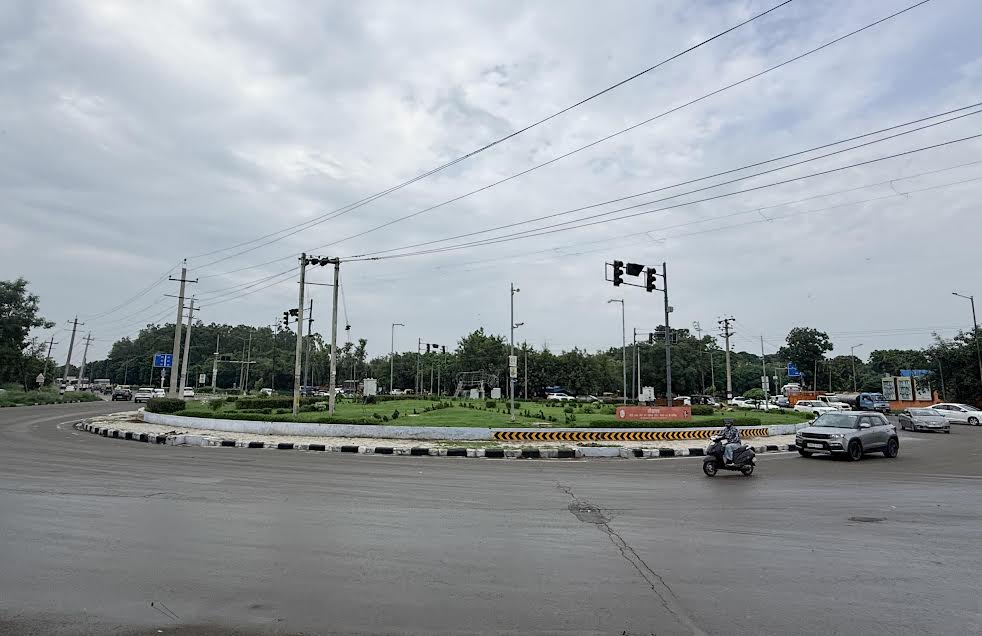
“Instead of demolishing junctions entirely, we have reduced the radius of central islands, widened circulating lanes, recalculated signal timings, and eliminated minor service roads feeding into congested circles,” adds Joshi. “Traffic studies show that these targeted redesigns have reduced average delay times by nearly 40%.”
Shreya Gadepalli, an urban mobility expert, says a well-designed roundabout can move more traffic than a signal. At a typical four-arm signalised junction, she points out, drivers spend roughly three-quarters of the cycle waiting at a red light, since only one approach gets a green at any given moment. “So the efficiency is much lower than a roundabout, which is effectively always green. It might look slower-moving, but it’s actually moving constantly.
That advantage, however, comes with a trade-off. “ Roundabouts are not pedestrian-friendly because traffic almost never stops, and so crossing on foot usually means watching for gaps and making a dangerous run for it.”
The Chandigarh lessons
In Chandigarh, the conflict between preserving urban design and managing traffic has come a full circle. Seeking to unclog arterial routes, city officials removed several of its iconic Le Corbusier-designed key roundabouts in favour of signalised intersections. The experiment backfired: free-flowing signalised junctions encouraged speeding and red-light jumping, triggering a sharp rise in high-impact collisions. Recognising that circular rotaries naturally force drivers to decelerate, the administration reversed course. It has since begun converting major signalised junctions back into rotaries, including along Vikas and Madhya Margs, halting any further removal of the city’s signature traffic circles.
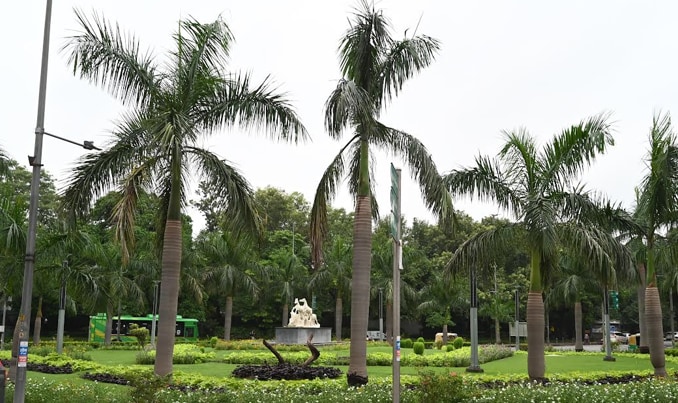
Even in heritage precincts, experts argue that major gains are often possible without altering the roundabout itself. Joshi points out, restricting one minor movement can reduce congestion substantially, without touching the circle itself. “We’ve implemented this successfully at two locations in Ahmedabad,” he says, citing cases where banning a difficult right turn and rerouting to a downstream U-turn cleared congestion while leaving the circle intact.”
Central islands in cities like Delhi, Gurugram, and Coimbatore have also turned into spaces for installing sculptures, commercial advertising or dense foliage, blocking the sightlines drivers need to navigate safely.
That raises a broader question: have roundabouts gradually become civic showpieces at the expense of their primary traffic function?
“Green landscapes, public art, and visual identity add significant value to the urban experience. A successful junction is one that balances mobility, safety, and the public realm, rather than optimising only for vehicles,” says Chauhan.
“The concern arises when the visual prominence of an element begins to affect the junction’s basic functioning. But the larger issue is the absence of an integrated approach, where urban design and traffic engineering inform each other from the beginning,” says Mathur.
Gadepalli’s makes a broader point. “We need to understand that it is also a mobility crisis, not just a design problem,” she says.
Expanding public transport, higher parking fees and introducing congestion pricing to divert through-traffic away from city centres can help reduce peak volumes on roundabouts in places like Lutyens’ Delhi. “Even a 10 to 15% reduction in traffic can dramatically improve network performance,” she says.


