
 E-Paper



Number Theory: As 2025 begins, a look at India’s demographics
.
Updated on: Jan 1, 2025, 09:13:49 IST

 Prefer HTon Google
Share via


Copy link

On the first day of 2025, it is worthwhile to underline that it has been four years since India should have had a decadal census, and this year may finally end the crucial data drought. Meanwhile, according to the UN’s population projections, India has been the most populous country in the world since 2023, and has added 189.7 million people between 2011 (when the last census took place) and 2024.
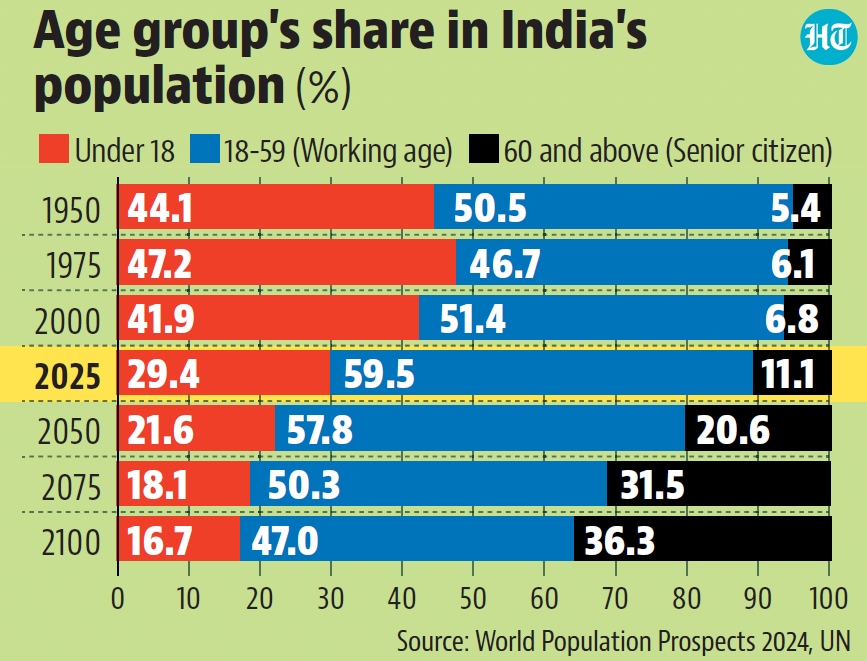
While we wait for a census to reveal a lot more data than the population head count, here are four charts based on UN population projections that place India’s demographics in the global context.
As 2025 begins, a look at India’s demographics
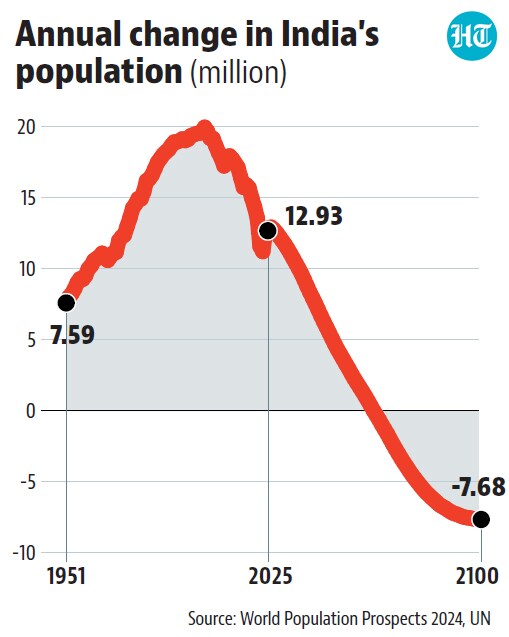
 India will add fewer people to its population every year from 2025According to UN’s latest population projections – these numbers keep changing in biennial data releases – India will add 12.9 million to its 2024 population of 1.451 billion in 2025. In absolute terms, the annual increment in India’s population peaked at 19.98 million in 2001. While this number fell almost continuously between 2001 and 2022, the pandemic’s demographic shock – it is the only plausible explanation – led to this number increasing by 1.4 million in 2023 (highest growth in this number since 1951). With birth rates and death rates reverting to normal, the uninterrupted trajectory of population increasing slowly is likely to continue from 2025 to 2100, the latest period for which we have UN projections.
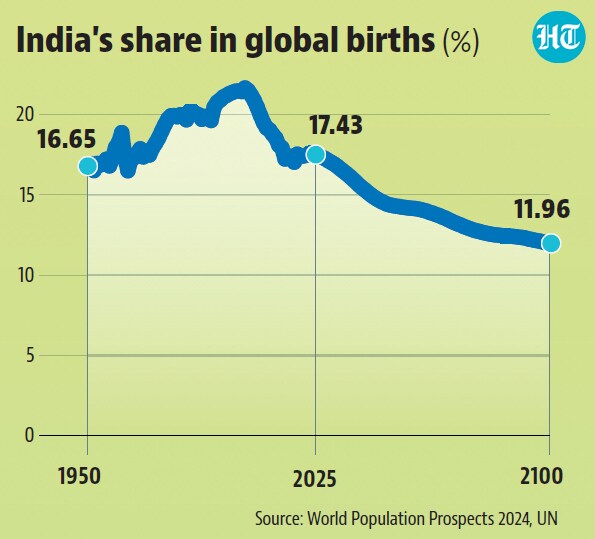
- But India will continue to have the highest share of births in the worldIn 2025, India will account for 17.4% of 132 million new births in the world. India has been ranked first on this count since 1975, and is expected to retain this position until 2100. To be sure, India’s share in global births peaked at 21.7% in 2001 and it is expected to decline to 12% by 2100.
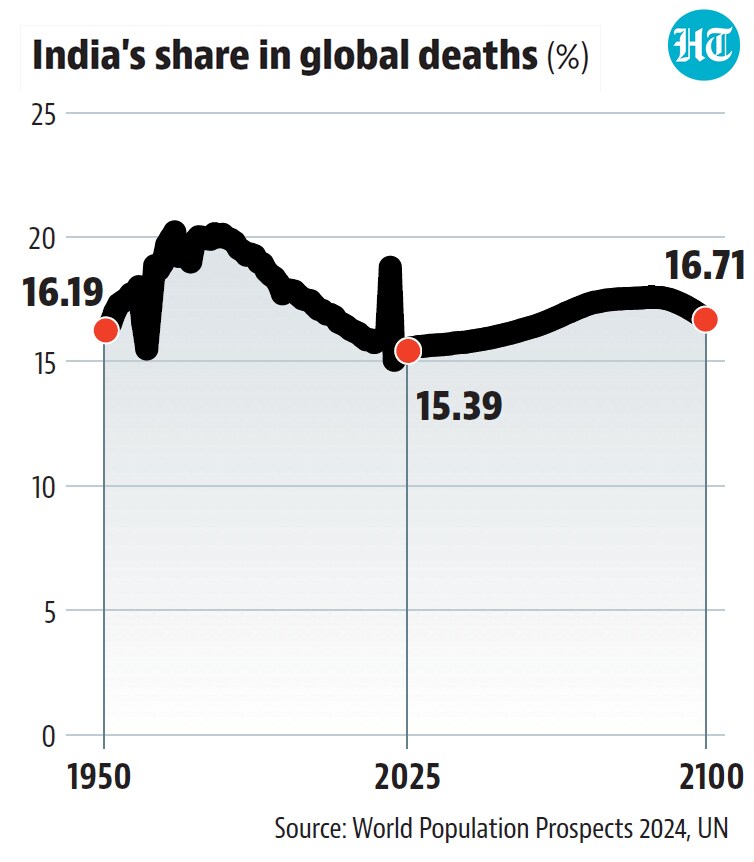
- By 2067, India will also have the highest share in total deaths in the worldOn the other hand, India’s share in global deaths is projected to increase consistently from 2025 to 2087. This follows a long period (from 1980 to 2017) when India’s share in global deaths was decreasing almost every year. The rise in India’s share in global deaths is basically a function of the ageing of the population. India’s share in global deaths is expected to overtake its share in global births consistently from 2038, which stopped being the case after 1970s. If one were to look at the entire period from 1950 to 2100, the difference between India’s share in global births and deaths is expected to range between 4.3 percentage points in 2002 to -5.2 percentage points in 2089.
- The quarter-century in which demographic dividend peaks will get over in 2025From 2000 to 2025, the non-adult population’s share will decline from 41.9% to 29.4%, the fastest decline in 25-year intervals starting 1950-1975 and ending 2075-2100. On the other hand, the share of working-age population (18-59 years) will increase by 8.2 percentage points from 2000 levels to 59.5% by 2025, the most the group’s share will increase in 25-year intervals up to 2100. The proportion of senior citizens has also increased much faster in the past 25 years than earlier.


Unlock a world of Benefits with HT! From insightful newsletters to real-time news alerts and a personalized news feed – it's all here, just a click away! -Login Now!


