
 E-Paper



Number Theory: Cleaner fuel may have added to global temperature spike
The shift, Hansen et al argue, only underlines the need for doubling down on efforts to mitigate global warming before it reaches a point of no return
Updated on: Feb 17, 2025, 10:05:24 IST

 Prefer HTon Google
Share via


Copy link

January 2025 was 1.75°C warmer than the pre-industrial average in the ERA5 data, making it one of the biggest-ever monthly deviations in temperature. This continues a trend of abrupt rise in global warming seen since 2023-24. What is the reason for this abrupt rise? A recently released paper co-authored by James E Hansen, a former NASA scientist and one of the most well-known scholars on the climate crisis, suggests that the sudden spike is a result of a shift in Earth’s energy balance rather than any fundamental shift in the larger trajectory of global warming. The shift, Hansen et al argue, only underlines the need for doubling down on efforts to mitigate global warming before it reaches a point of no return.

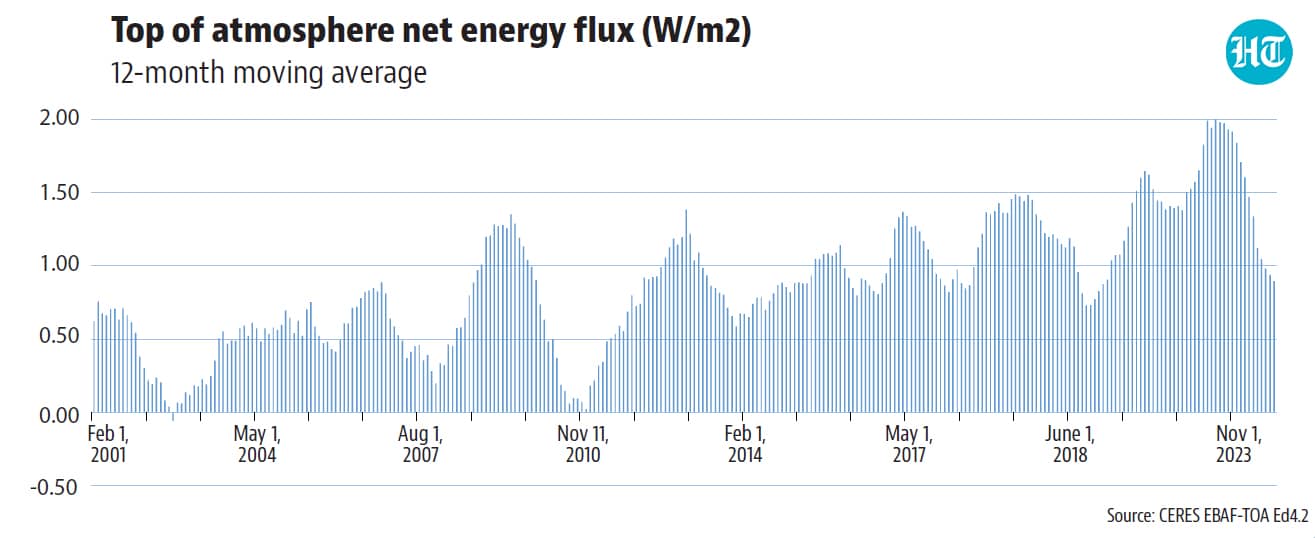
 The root cause of global warming is an imbalance in Earth’s energyTo understand the Hansen paper, one has to understand the basic science of global warming. For the planet overall, the only source of energy is the sun, which delivers energy at nearly a constant rate as far as humankind’s time frame is concerned. Earth’s energy stability – and consequently temperature stability – depends on this energy being returned back to space in the long-term, which happened for most of Earth’s history. After the industrial revolution, human beings changed this balance by accumulating Green House Gases (GHGs) in the atmosphere, primarily increasing the absorption of sun’s energy compared to the past. But there was also a secondary effect of reflecting back this energy due to GHG-created aerosols (air pollution). To be sure, the net of these two effects was still an addition to Earth’s energy stock, just a smaller addition than if there were no aerosols. The 12-month mean of net energy flow at the top of the atmosphere (this allows one to ignore the internal energy exchanges) was either positive or zero after 2002. which means the stock of energy (and eventually temperature) has been growing since then. Chart 1
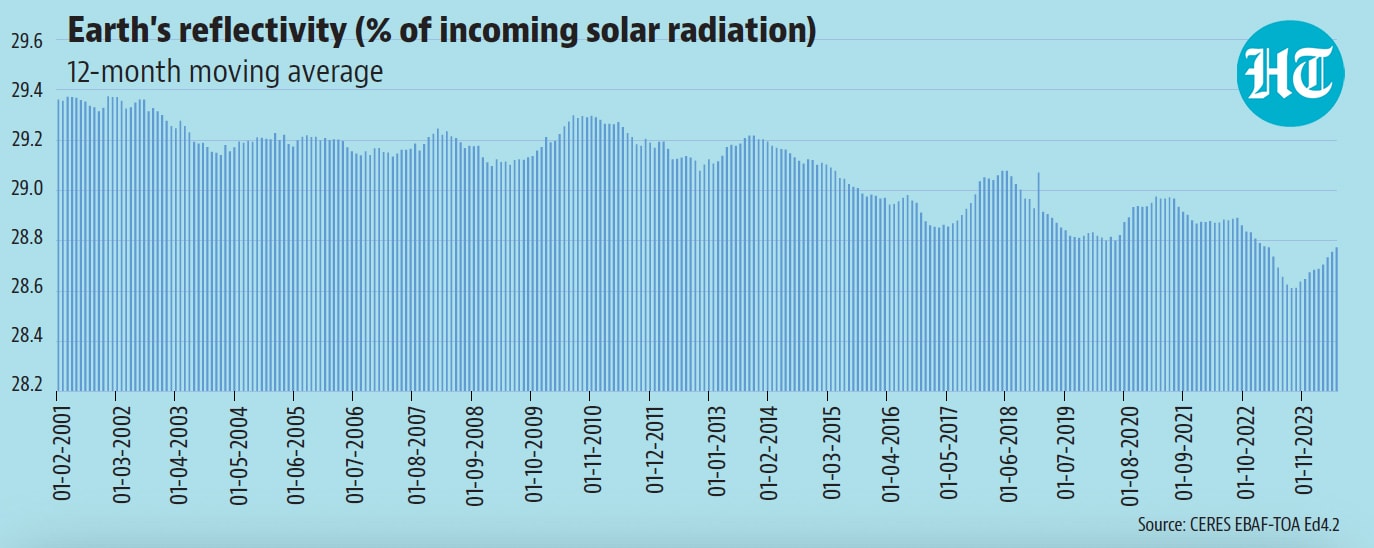
- The abrupt warming after 2020 could be because of decline in aerosol reflection due to strict pollution enforcement norms on shipsThe paper estimates that rapid growth in energy imbalance since 2010 is because of decreased reflection of sun’s energy. Compared to 29.2% of incoming solar radiation being reflected on average during March 2000 and February 2010, only 28.6% was reflected in the 12-months ending February 2024. Two-thirds of this decline is because of climate feedback: Earth’s energy gain melted sunlight-reflecting ice, making Earth reflect even less energy. But around one third of the change is because of changes in shipping fuels, which decreased aerosols gradually starting 2010, but drastically from 2020. “Aerosol offset of GHG warming is a Faustian bargain, that is, a bargain providing present benefit without regard to future consequences… as global pollution control has improved and clean energies are introduced the cooling effect of aerosols is lost: with the change of ship regulations, our first Faustian payment came due,” the paper says. Chart 2
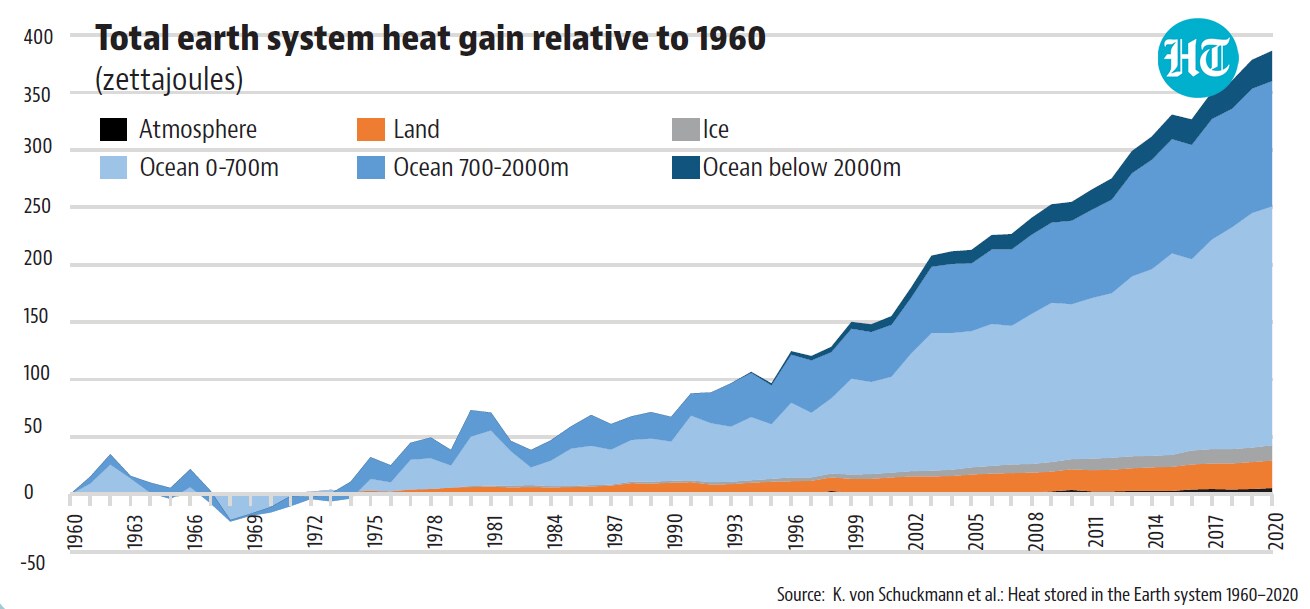
- Only a fraction of this rising energy stock has reflected itself in rising temperatures so farTemperature data basically captures the temperature of the air. Atmosphere is not the only part of the planetary eco-system which has absorbed this rising energy stock because of GHG emissions. In fact, it has accumulated the lowest part of this stock, just 1.4% for the 1960-2020 period. The oceans, land, and cryosphere (frozen parts of the earth) have shares of 89%, 6.2%, and 3.2%. While this explains why we aren’t quite at furnace-like temperatures despite the massive energy gain, it is hardly a cause for complacence. As far as climate change is concerned, Earth’s energy gain is far more important. Melting glaciers and ice-sheets, a higher sea level and warmer oceans, extreme rain – these are all results of Earth’s energy gain. Some of these effects, such as melting ice-sheets, accelerate the pace of air’s warming, and can trigger climate extremes after some thresholds are breached. Melting ice sheets, for example, appear to be weakening the Atlantic Meridional Overturning Circulation (AMOC), which regulates temperatures by distributing heat from the tropics to the northern latitudes. An AMOC shutdown would mean extreme heat in the tropics and extreme cold in northern latitudes. See Chart 3
- As is clear from the discussion above, controlling global warming will entail a sharp reduction in current and future GHG emissions – the benefits of this will take time to materialise given the already existing stock of GHGs in the atmosphere – rather than hoping for a resurrection of second-order energy reflection factors such as aerosol-based pollutants which are not only not capable of solving the global warming problem but also have other negative externalities.

Unlock a world of Benefits with HT! From insightful newsletters to real-time news alerts and a personalized news feed – it's all here, just a click away! -Login Now!


