E-Paper



Number Theory: Twists, turns and quirks of the American election
.
Published on: Nov 5, 2024, 08:35:35 IST

 Prefer HTon Google
Share via


Copy link

The US will vote today, November 5, to elect its 47th president. This election, among the most polarised in the country’s history, has already seen many twists and turns and could rewrite existing wisdom on politics in the country. Here are four charts which highlight some unique facts about this election.
Twists, turns and quirks of the American election
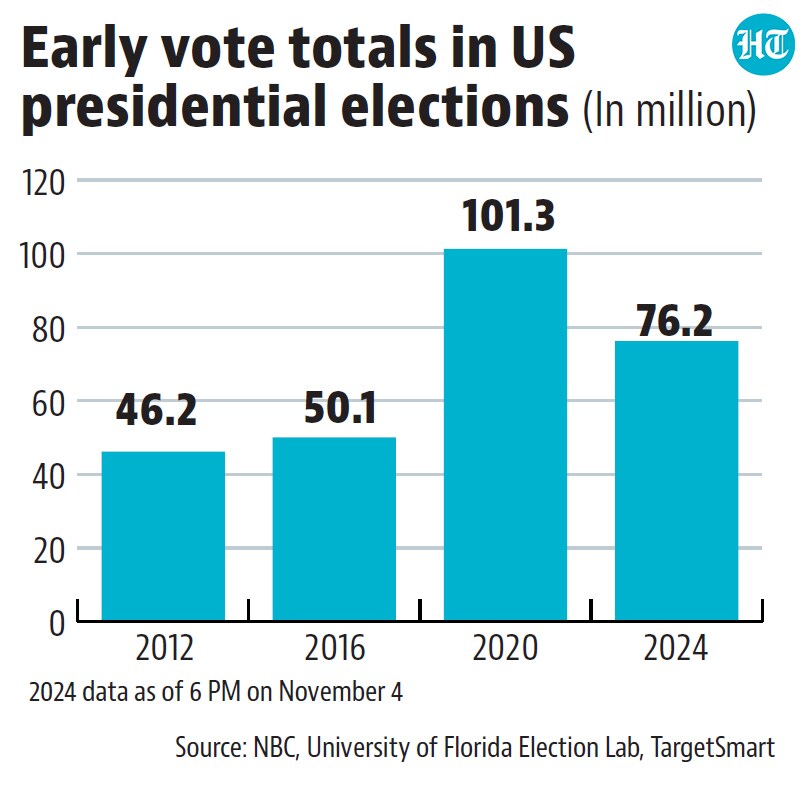
 At least 36% of the eligible population has already votedMore than 76 million Americans, or 36% of the eligible voters, have already voted in this election through mail ballots and early in-person voting. This is the second-highest after the 2020 presidential elections which when as much as 101.3 million (63% of all votes cast) Americans voted early. To be sure, the 2020 elections were held in a very different context when social distancing norms were still in place because of the pandemic. Early voting data collated by NBC News and TargetSmart shows that 44% of those who have already voted are registered Democrats, while 30% are Republicans. Moreover, data from University of Florida states that as many as 54% of the early voters for whom data is available – there are 16.5 million such voters – are female, while 43.6% are male.
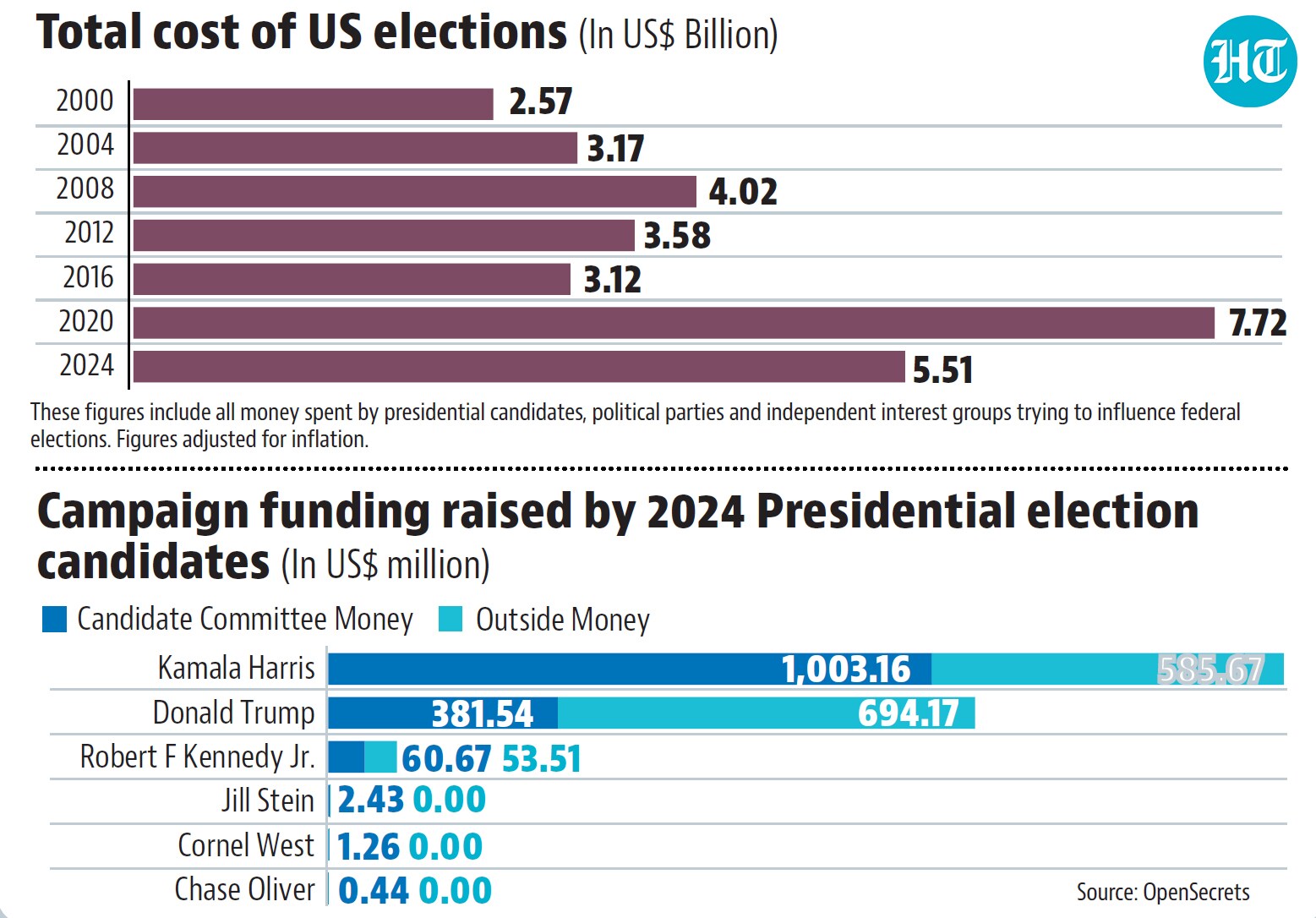
- 2024 could end up behind 2020 elections in terms of spending thoughAccording to data from OpenSecrets, a non-partisan watchdog, the 2024 election campaign has already seen spending of $ 5.5 billion if one were to include money spent by candidates, parties, and independent interest groups trying to influence the elections. Democratic candidate Kamala Harris has raised nearly $1.6 billion, out of which more than one billion was raised through her own official campaign committee. Donald Trump, who has raised nearly $1.1 billion, is more dependent on contributions from super PACs (Political Action Committees) and billionaires, with nearly 65% of the funds raised coming from outside his official campaign committee. Elon Musk-owned-SpaceX, for instance, has contributed nearly $75 million to Trump’s campaign, while billionaire Timothy Mellon has given a total of $125 million. In terms of spending comparisons with previous elections, 2024 is unlikely to end up as the most expensive in the US. The 2020 elections saw a combined spending of $7.72 billion, adjusted for inflation.
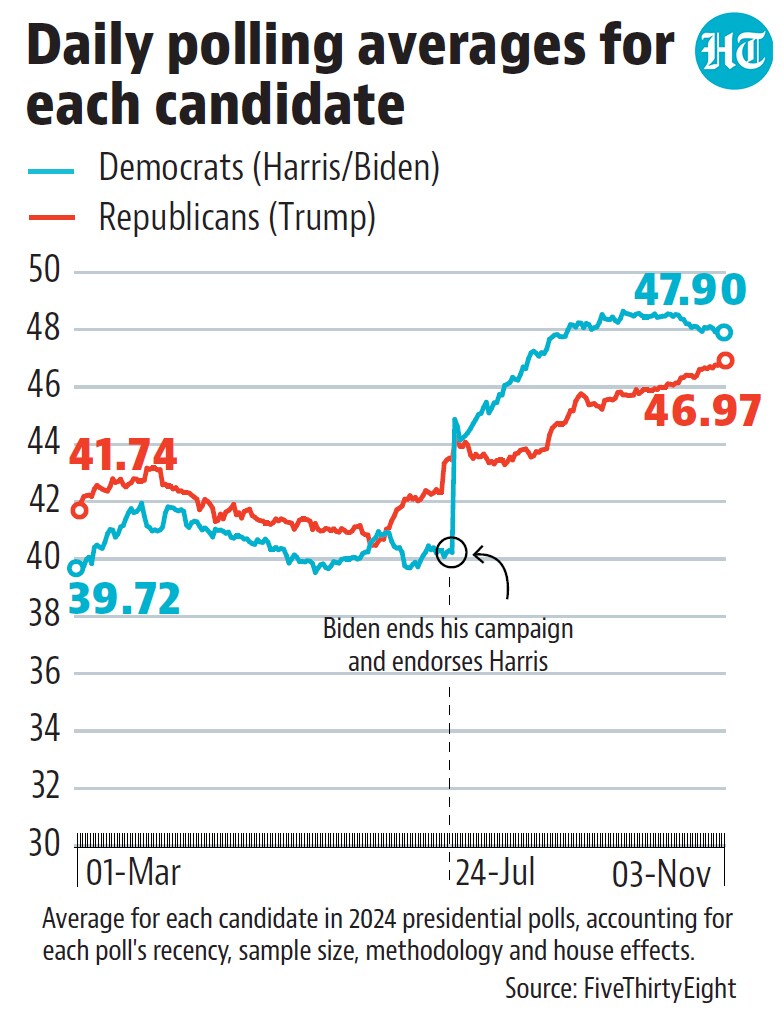
- Pollsters have gone from advantage Trump to advantage Harris and are now predicting a statistical dead heatDaily averages of opinion polls from polling aggregator FiveThirtyEight shows that the Democrats were trailing the Republicans when President Joe Biden was their nominee. On July 21, the day in which Biden ended his re-election campaign and endorsed vice president Kamala Harris as his successor in the race, he was trailing Donald Trump by 3.2 points. The announcement of Harris as the Presidential nominee gave the Democrats a huge spike in approval, bringing them ahead of Trump. Harris’ lead over Trump went as high as 3.5 towards the tail end of August. However, Trump has managed to narrow the gap since then, with latest figures showing the two contestants being just 0.93 points apart, making it too close to predict. To be sure, polls have struggled as far as accuracy is concerned since the emergence of Donald Trump on the scene. For example, Biden had an 8.4-point lead over Trump in opinion polls just before the election in 2020. The actual margin was 4.4 percentage points. Hillary Clinton, who won the popular vote in 2016, despite losing the election on the basis of electoral votes, had a 3.9-point lead over Trump in 2016.
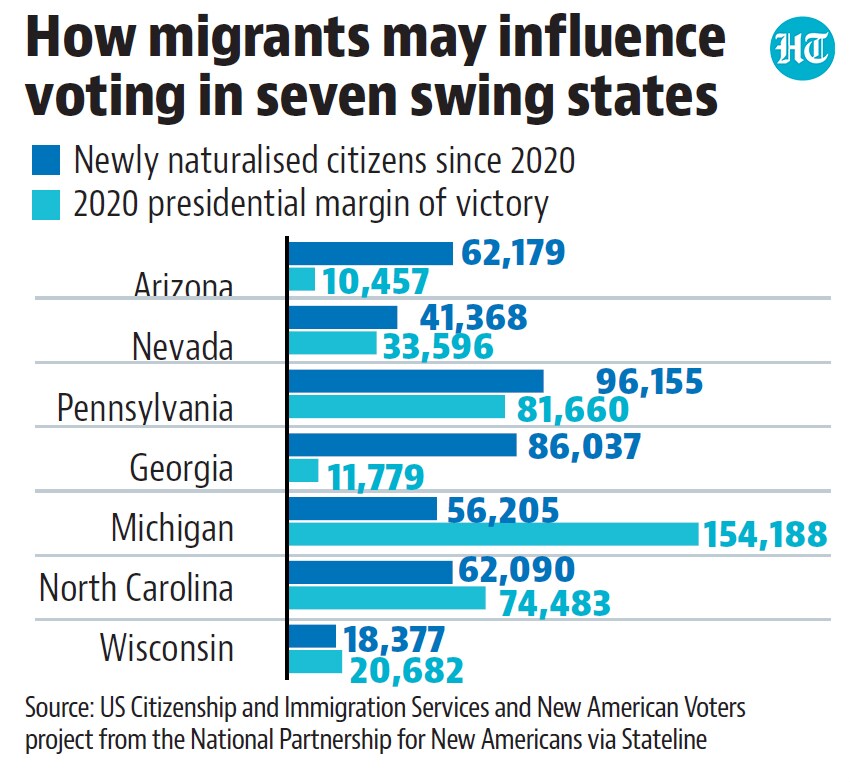
- Migration could be an additional factor complicating pollsters’ calculationsWhile there are many reasons, including poor and skewed response rates and risk averse reweighing of samples by pollsters given their 2016 and 2020 experience, even migration could have complicated the math in a bunch of critical swing states. Data from the US Citizenship and Immigration Services and National Partnership for New Americans, which has been collated by Stateline, shows that the number of naturalised citizens – who are more likely to be from a different ethnic demographic –in at least four out of seven swing states is more than the victory margin in these states in the 2020 elections. Such change in voter composition along with theories of Trump managing to increase his support base among the non-white population could further complicate what is already been seen as an extremely tight contest.