
 E-Paper



The economic fallout of terror attacks in J&K | Number Theory
.
Published on: Apr 25, 2025, 22:51:10 IST

 Prefer HTon Google
Share via


Copy link

The Pahalgam terror attack on 22 April is one of the worst ever terror incidents in the history of Jammu and Kashmir. What makes the attack even worse is that it is only one of the few where tourists have been targeted. The attack, which came in peak tourist season is likely to lead to a large fall in tourist arrivals in the state and will hurt the tourism industry in Jammu and Kashmir, which has been on an upward trajectory, although it still lags many other states in India.
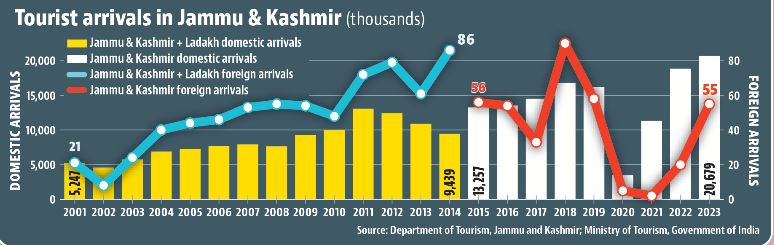
Tourism was on a path of recovery in Jammu and Kashmir
 Tourism was on a path of recovery in Jammu and KashmirTourism suffered a body blow in Kashmir after the outbreak of the militancy in the 1990s. The kidnapping of six foreign tourists from Pahalgam in 1995 was a watershed event. However, things started improving after a let-down in violence from the 2000s. This can be seen in rising tourist footfall in Jammu & Kashmir after the 2000s. While the number fell in 2013 and 2014, the trend reversed soon after and tourist footfall in 2022 and 2023 reached a record high. However, Kashmir could do better. Footfall of foreign tourists has not completely recovered to the level seen in 2018, the year before Jammu and Kashmir was separated from Ladakh. While official numbers are not yet available, the current tourist season was being described as a record year for tourism in Jammu and Kashmir.
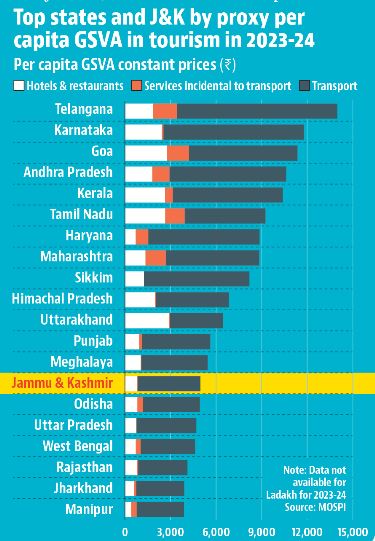
- Jammu & Kashmir underperforms its peers in tourism economy output“Tourism is deeply ingrained in the culture and economy of Jammu & Kashmir,” chief minister Omar Abdullah, who also serves as the union territory’s (UT) finance minister, said in his budget speech this year. While the first part of his statement might be true, there is reason for scepticism on the second. Proxies of tourism’s per capita income in the UT is much below that in other states and UTs that serve as tourist destinations. While an exact comparison is not possible because tourism is not an official category and has second-order impact on other industries, HT checked this using three aggregated sub-sectors in the Gross State Value Added (GSVA) classification: hotels and industries; hotels and industries including services incidental to transport; and hotels and industries including the entire transport sector (including incidental services). It is important to check all three groups because transport can possibly add value to the economy even in states with low tourism potential. Per capita income of all three groups of industries is relatively low in Jammu and Kashmir. The UT is ranked 19th, 22nd, and 18th among 33 states and UTs for which this data is available for 2023-24, and far below other tourist destinations such as Uttarakhand, Himachal Pradesh, Goa, Kerala, Tamil Nadu, Karnataka, Sikkim, Puducherry, and even Andaman and Nicobar Islands. To be sure Jammu and Kashmir’s per capita GSVA in all three groups is close to Rajasthan’s, which is also a tourist hotspot.
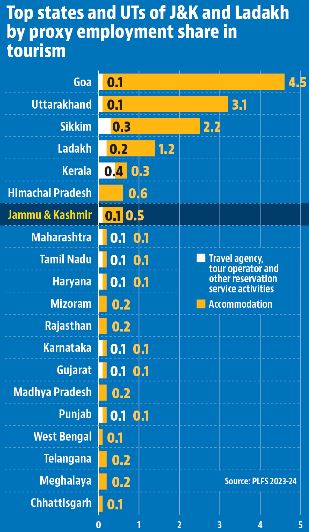
- This also shows in tourism’s importance in employment generationJammu and Kashmir trails other tourism destinations in employment generation from the sector. In the Periodic Labour Force Survey (PLFS) conducted in 2023-24, 1.6% workers in the UT were employed in what could be described as tourism-related industries compared to 3.8% in the neighbouring UT of Ladakh. In fact, Jammu and Kashmir was ahead of only some north-eastern states, Gujarat, Madhya Pradesh, Chhattisgarh, Uttar Pradesh, and Bihar. To be sure, most of the difference between states on this count is because of food and beverage services, another sector that can have high employment share without a high tourist footfall. If one were to count only those employed in travel agencies, tour operation, and accommodation services as a proxy for the tourism sector, the rank of Jammu and Kashmir improves relative to other states, but not in comparison to other popular tourist destinations, such as Goa, Uttarakhand, Sikkim, Ladakh, Puducherry, and Himachal Pradesh.
- Given the fact that Jammu and Kashmir is a lot more dependent on tourism earnings than other states because of the lower level of development of other sectors such as industry or commercial services, the headwinds to tourism from the Pahalgam attack will hurt the state even more. This will likely mean a backlash against terrorism, something which can already be seen in widespread protests against the attack. To be sure, ending the violence will require a coordinated and consistent security effort rather than just mass sentiment turning against it.



Unlock a world of Benefits with HT! From insightful newsletters to real-time news alerts and a personalized news feed – it's all here, just a click away! -Login Now!


