E-Paper



The Goldilocks lock on the budget | Number Theory
An HT analysis of relevant statistics shows that India’s current low inflation environment is not an unambiguous blessing for economic policy at large

 Prefer HTon Google


If there is one phrase which has stuck as far as the current state of the Indian economy is concerned, it is the RBI Governor’s description of the Indian economy in his statement after the December 2025 Monetary Policy Committee (MPC) meeting.

”Inflation at a benign 2.2% and growth at 8.0% in H1:2025-26 (the first half of the current financial year) present a rare Goldilocks period”, Governor Sanjay Malhotra said. This is a state where the economy is neither too hot (to trigger inflation) nor too cold (where growth has collapsed), much like the porridge in the fairy tale. While the characterization of the Indian economy holds well when one is talking about real numbers, there is a good reason to apply some caution when it comes to analysing the economy before the budget, which is an exercise based on nominal numbers. An HT analysis of relevant statistics shows that India’s current low inflation environment is not an unambiguous blessing for economic policy at large. Here is why.
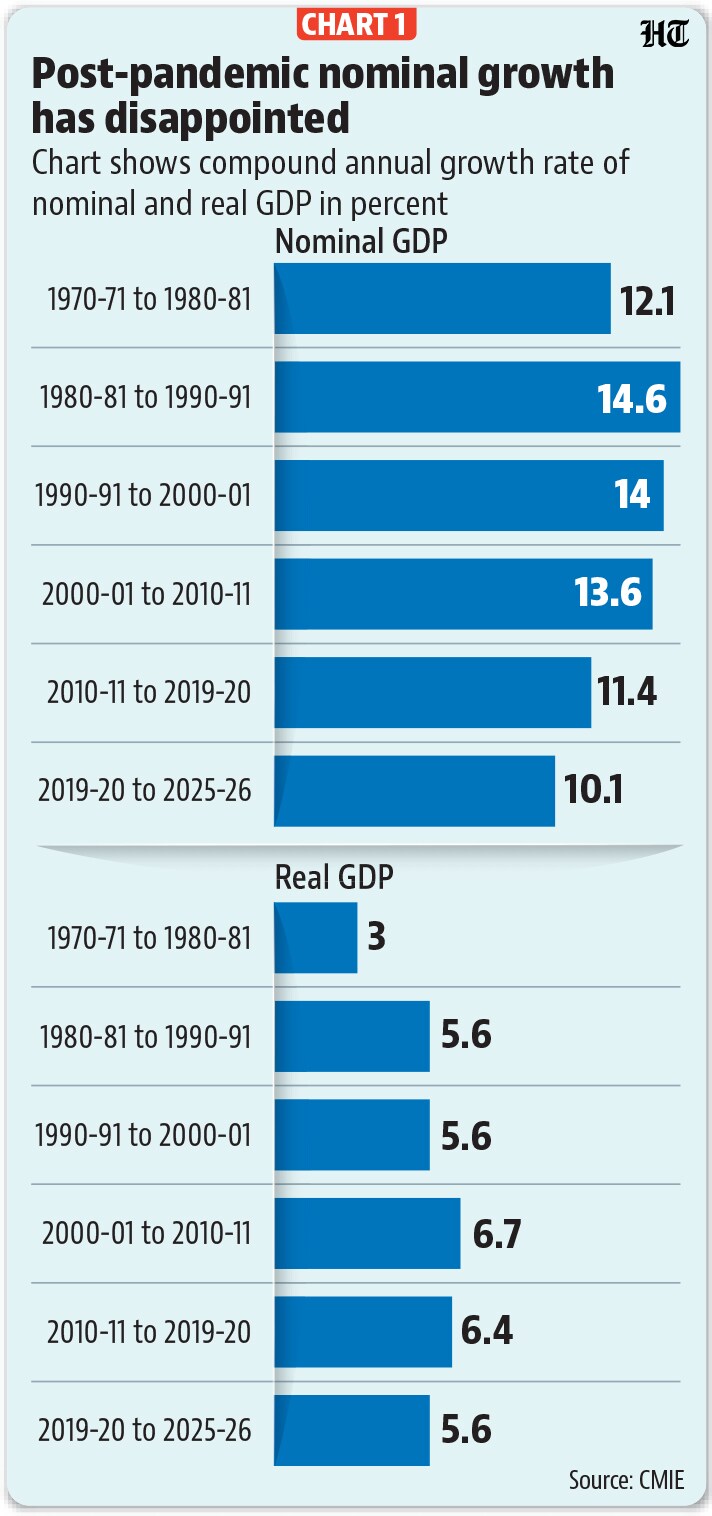
 2025-26’s underwhelming nominal GDP growth is not a one-offWhile India’s GDP is expected to grow at a healthy 7.4% in 2025-26 in real terms, nominal growth is likely to be just 8%. To be sure, given the fact that the nominal GDP level in absolute terms is marginally higher than what the 2025-26 Budget assumed, there is unlikely to be a large fiscal crisis. For context, nominal GDP serves as the base of revenue calculations and a major shortfall can trigger a larger than expected deficit unless spending is squeezed. What is important is that low nominal GDP growth is not a one-off problem which has appeared in 2025-26. HT compared the long-term trend in real and nominal GDP growth for India and found that the post-pandemic period has seen the lowest nominal GDP growth since the 1970s despite real growth not doing so badly.
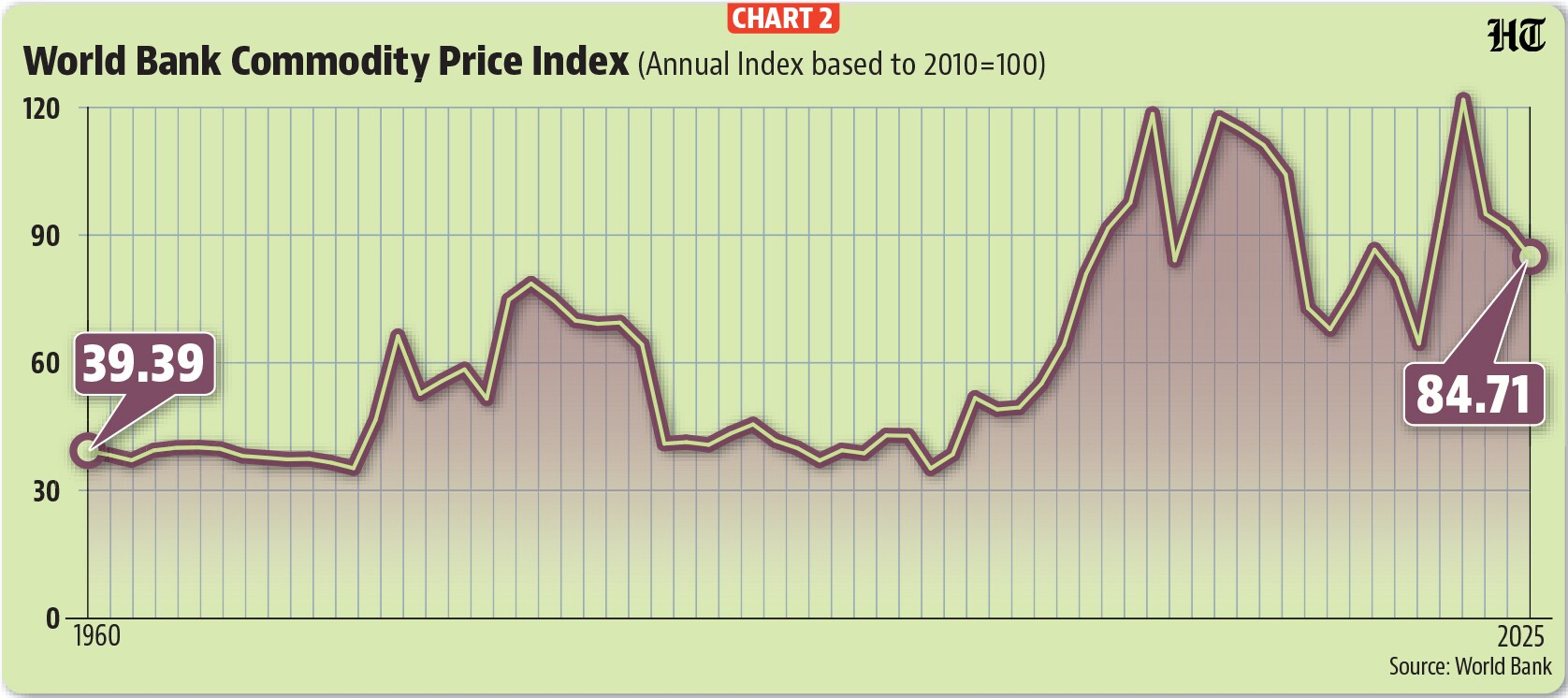
- Some of the low nominal growth situation is on account of benign global commodity pricesWhat really explains the low nominal growth component post-pandemic despite real growth not doing so badly? Before one gets to looking at things within the economy it is important to appreciate the larger economic environment. Global commodity prices, as seen in the World Bank’s commodity price index, reached their peak just before the 2008 Global Financial Crisis and then peaked once again in 2022 when the global economy was dealing with the twin shocks of the Russia Ukraine war and China’s zero-Covid policy , both of which disrupted global supply chains. Since then, it has been a downward trend. Commodity prices play an important role in producer price inflation and therefore have a bearing on the nominal growth component of the Indian economy as well. While the data shown here might not capture it, the world is also dealing with the deflationary impact of China sitting on massive excess capacity in manufacturing. Put together, there is very little in terms of tailwinds for producer price inflation globally. To be sure, advanced economies have been dealing with higher-than-average inflation in the aftermath of the pandemic, but that is mostly a by-product of large fiscal stimulus and its labour market impact. India’s pandemic response was more invested in monetary policy rather than a fiscal stimulus. While this has protected the fiscal situation, the recovery was largely profit led rather than wage led.
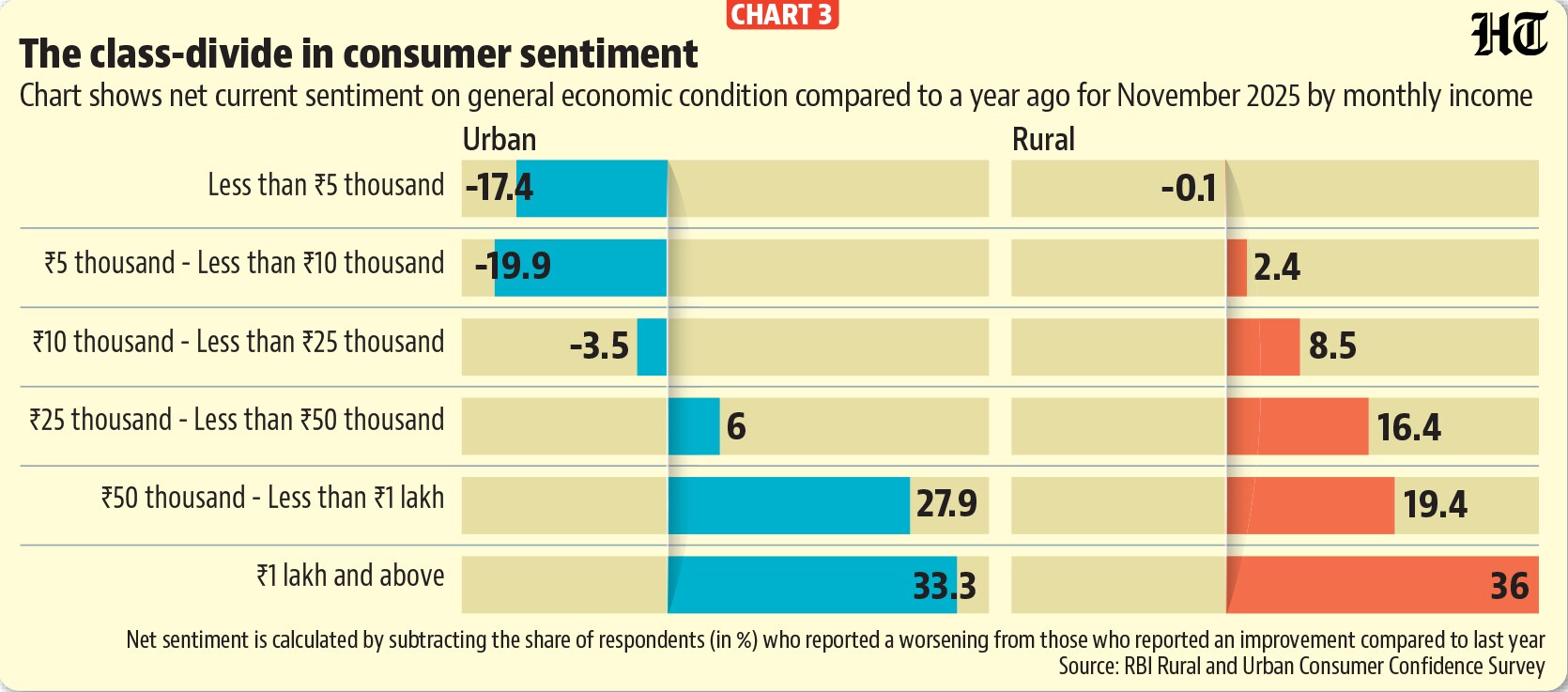
- Is low inflation an unambiguous good?Inflation is often described as a tax on the poor because it eats away their earnings and more importantly savings. Does it mean that the poor necessarily stand to gain from a prolonged low inflation environment? Answering this question requires appreciating that nominal growth is what matters for incomes and wages in the current period, especially in an economy where a large number of workers do not have indexed incomes, save very little and mostly consume what they earn. When seen from this prism, a low inflation environment could be good news for a high-income saving household but not so much for a low-income consuming household. A class-wise divergence in consumer sentiment from RBI’s Consumer Confidence Survey supports this line of reasoning where the rich seem to be doing better than the poor. The inflation dynamics discussed above are in addition to the squeeze low nominal GDP growth puts on the spending pool of the budget via a revenue squeeze and servicing the national debt. The short point is, the real economy’s Goldilocks moment can act as a lock on the budgetary exercise. The problem, however, is triggering inflation for the sake of inflation via a fiscal splurge can be counterproductive for an economy. Ideally, India should have a higher inflation driven by a tighter labour market on account of growing productivity. One of the best ways for this to happen would be a rejuvenation of labour-intensive manufacturing, something which was discussed in these pages on Wednesday.