Kickstarting manufacturing has been a long-standing goal of India’s economic policy. The recent surge in protectionism in economies, especially the sanctions imposed by the Trump administration have given the challenge a new dimension. This 3-part series will explain India’s manufacturing challenge from a holistic perspective by situating Indian manufacturing in international, sub-national, and sector-wise (formal and informal) contexts.
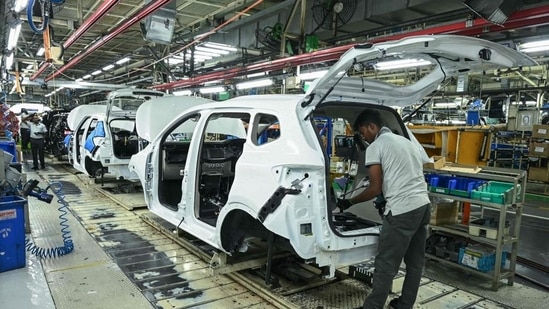
An employee works in a car assembly line at the joint manufacturing facility of Renault Nissan Automotive India, in Oragadam, an industrial suburb of Chennai (AFP FILE)
The first part will explain the importance of manufacturing in India’s economic standing internationally and its long-term growth. The second part will
Manufacturing’s contribution to India’s economic growth has remained steady over time
Manufacturing’s contribution to India’s economic growth has remained steady over time
The Centre for Monitoring Indian Economy (CMIE) database has industry-wise Gross Value Added (GVA) data from 1965-66 onwards. If one were to divide it into three broad periods: pre-reform (1965-66 to 1990-91), post-reform till the Global Financial Crisis (1990-91 to 2008-09) and post Global Financial Crisis (2008-09 to 2024-25), a striking pattern emerges as far as manufacturing’s contribution to economic growth is concerned. It has remained broadly stable – the 1990-91 to 2008-09 period is the best by a small distance – in the three periods, unlike agriculture, which has seen a large fall, and services, which has seen a sharp increase. Manufacturing’s GVA share has remained steady between the 15%-20% mark since the 1980s in India.
How does India compare in terms of manufacturing economy globally?
The most commonly heard statistic about India’s international economic standing is that it will become the third-largest economy in the next three years or so. However, what is more important for living standards in a country is not its overall GDP level but its per capita GDP. On this count, India is ranked pretty low if one were to take the world’s top 50 economies by GDP size in current dollars. The question to ask about the importance of manufacturing is this: how important is manufacturing in boosting a country’s per capita GDP? The chart below shows that there are many countries which have a higher per capita GDP than India but a lower share of manufacturing in their value added. However, the example India should be looking at carefully is China, the only country which is comparable to India’s population size. China’s per capita GDP (in purchasing power dollars) and manufacturing share in GVA are both almost double that of India.
Why increasing manufacturing’s share is important for India
While per capita GDP is a useful metric to compare countries internationally, it can be a misleading indicator about the well-being of the population at large within a country. This is because the income generated as captured in GDP data can be distributed in an unequal manner across sectors. A comparison of output and employment share of key sectors in the Indian economy shows this clearly. Sectors such as agriculture employ a disproportionately large share of people than their share in output, while sectors such as financial services employ very few people and produce a much larger share in output. Manufacturing is one of the more equal sectors in terms of share in value added and employment in India, which suggests that any increase in its output share will also lead to some sort of trickle-down benefits to people who work there. If such people are drawn from the ranks of those working in agriculture, it can help significantly in solving India’s inequality problem. This data underscores manufacturing’s critical role in boosting China’s per capita GDP.
While the data given above underlines the importance of manufacturing in boosting India’s economic (especially living standards) prospects, it needs more context to give an insight into the exact nature of challenges which need to be taken into account to give a boost to manufacturing in India. The second and third parts of this data journalism series will do exactly that.
Roshan Kishore is the Data and Political Economy Editor at Hindustan Times. He heads the newsroom's data journalism team, which produces Number Theory, a daily data-driven feature for the print edition and the HT app. Number Theory uses data analysis and story-telling based on it to add value to the newsroom’s daily coverage by putting stories in a larger context on a range of issues, including politics, macroeconomy, markets, global affairs and climate. Under his leadership HT’s data journalism work has established itself as a niche product in Indian journalism and pushed the boundaries of marrying academic rigour with news sense and speed. Along with writing and editing data stories, he has also been writing a weekly political economy column called Terms of Trade for HT Premium. A trained economist with an MPhil degree from Jawaharlal Nehru University, Kishore has also been a visiting fellow at the Centre for Advanced Studies of India (CASI) at the University of Pennsylvania. Along with his journalistic work, his writings have also appeared in journals such as the Economic and Political Weekly and working papers for CASI and UNESCAP.
Abhishek Jha is Assistant Editor-Data at Hindustan Times. He uses statistical programming to generate newsworthy insights from large datasets. He is part of the team that produces Number Theory, a daily data story feature of the paper’s print edition. Since March 2024, he has been writing Weather Bee, a weekly column for the Hindustan Times website. He is a chemical engineer by training, who specialises in stories related to weather, climate, and the environment. Jha has been at HT since 2018, where he offers data-driven perspective and analysis on politics, environment, weather, climate, economy and society. His work includes data coverage of elections in India and abroad, including the 2019 and 2024 Lok Sabha elections; the disasters and extreme weather resulting from changing climate, such as floods, droughts, heat waves, cold waves, and dwindling snow cap in the Himalayas; the factors that drive poor air quality in northern India; the changing patterns of land use; the Covid-19 pandemic and its impact on labour market conditions; the changing pattern of consumer spending seen in the new consumer spending surveys; and social norms seen in the surveys such as the National Family Health Survey.
Unlock a world of Benefits with HT! From insightful newsletters to real-time news alerts and a personalized news feed – it's all here, just a click away! -Login Now!
Unlock a world of Benefits with HT! From insightful newsletters to real-time news alerts and a personalized news feed – it's all here, just a click away! -Login Now!
Home/Editors Pick/Understanding India's manufacturing challenge | Number Theory
{{^htLoading}}
Advertisement
{{/htLoading}}
SHARE THIS ARTICLE ON
{{#usCountry}}{{/usCountry}}
Notifications
Get breaking alerts directly from the newsroom
Notifications are on!You'll be notified when news breaks