
 E-Paper



Number Theory: Does underreporting obscure scale of violence against women?
Violence against women may be misleading because of various factors. Is there a way to pinpoint the extent of such misreporting in India?

 Prefer HTon Google


The first part of this series explained how official statistics on violence against women may be misleading because of various factors and lead to misreading of differences in such statistics across places or time. Is there a way to pinpoint the extent of such misreporting in India?
A recently published paper (https://tinyurl.com/y3u8uysv) in the Economic and Political Weekly by Kanika Sharma and Aashish Gupta -- the former is a PhD student at Emory University and the latter a post-doctoral fellow at University of Oxford -- has used data from the National Family Health Survey (NFHS) and National Crime Records Bureau (NCRB) to ascertain the level and trends of incidence and reporting of violence against women in India. Here is what their analysis shows.
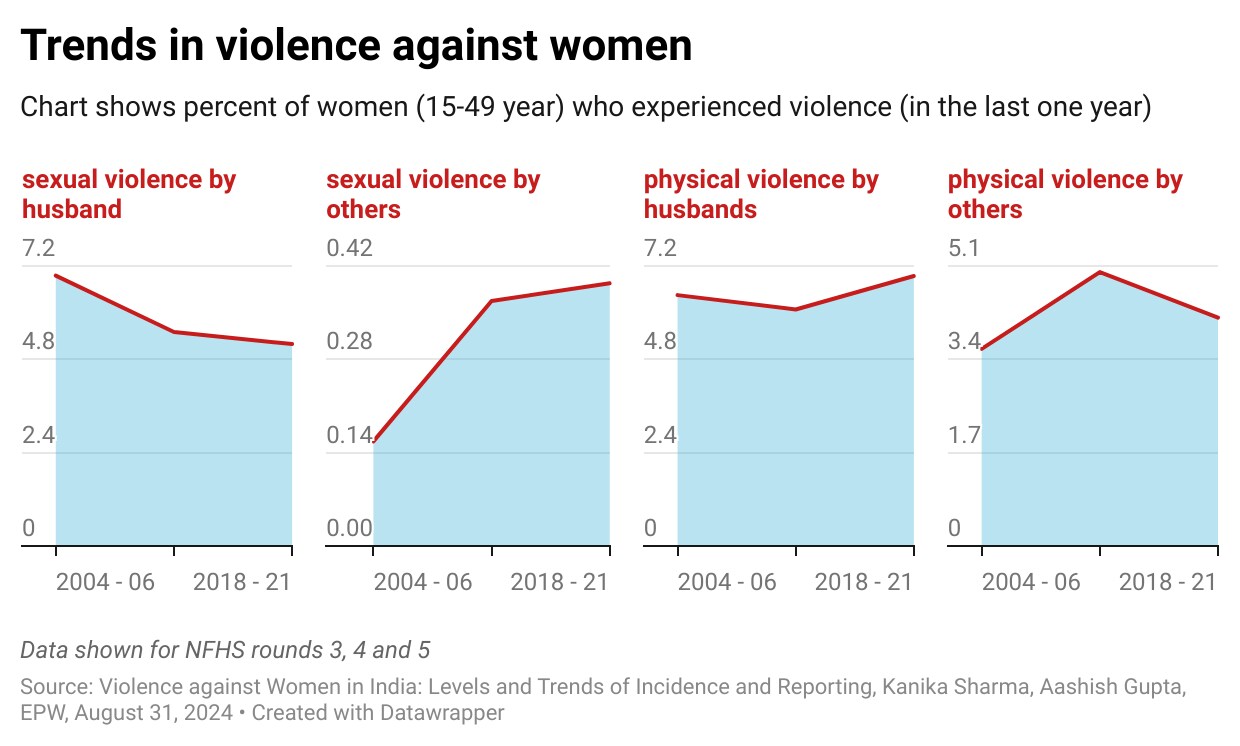
 What is happening to violence against women in India?To measure incidence of violence against women in India, the paper takes data from various rounds of the NFHS and classifies them into four sub-categories: physical violence by husband and others and sexual violence by husbands and others. The data shows that both physical and sexual violence by others in the latest NFHS round (2018-21) was higher than what it was in the 2004-06 round. As is to be expected, the incidence of physical violence by others was significantly (almost ten times) higher than sexual violence by others in every round. While the data shows that physical violence by husbands has increased in the latest NFHS round, it shows a fall in sexual violence by husbands in the latest round. To be sure, the authors add a caveat that the NFHS could also be prone to under-reporting of violence by women. See Chart 1: Figure 1 of EPW paper
- Using NFHS data to measure the extent of underreporting of violenceThe paper uses NCRB data on crime against women to compare reporting and incidence of violence. It classifies various IPC sections to calculate the reporting of crime against the four sub-categories of violence against women. “Rape” (Section 376, IPC) and “attempt to rape” (Section 511, IPC) is recorded as sexual violence by others. For physical violence by others, “Kidnapping” (Section 366, IPC), “assault with intent to insult her modesty” (Section 354, IPC), “insult to the modesty of women” (Section 509, IPC), and “cruelty by husbands and relatives” (Section 498A, IPC) is included in physical violence by others. “Unfortunately, it is not possible to identify “cruelty” by husbands and relatives separately from NCRB reports. By including these crimes under physical violence, we are overestimating reporting”, the paper says. Because sexual violence by husbands is not criminalised in Indian law, the paper assumes that “some cases of sexual violence by husbands may have been reported under “cruelty by husbands or relatives”, or “because sexual violence may have been accompanied by other violence, we take a conservative approach and classify cases registered under these statutes as the maximum possible number of cases of sexual violence by husbands reported to the police”. Finally, the paper classifies “cases registered under “cruelty by husband and relatives” (Section 498A, IPC), dowry deaths (Section 304B, IPC), and under the Dowry Prohibition Act, 1961 as those that involve physical violence by husbands”. The paper measures the extent of reporting or underreporting of these crimes by calculating the proportion of incidents that were reported to the police by fist calculating the incidence and reporting of such crimes per unit population. “Reporting of sexual violence by others has declined both between 2004-06 and 2014-16, as well as between 2014-16 and 2018-21. Reporting of physical violence by others has increased since 2004-06, but remains abysmally low, with less than 1% of cases of these incidents reported to the police. Physical and sexual violence by husbands, the most common form of violence faced by women, are also the least reported. There also do not appear to be large increases in the reporting of these forms of violence, especially between the 4th and 5th rounds of the NFHS”, the paper says. “Contrary to expectations, and despite rising concern against violence against women, reporting of violence against women has not increased substantially for any form of violence”, it adds. See Chart 2: Figure 3 of EPW paper
- There are significant state-wise differences in underreporting of violence against women.The paper also finds significant difference between the extent of underreporting of violence against women across states in India. While it notes that the “NFHS data sets are not statistically powered to examine the regional variation in the incidence of sexual violence by others”, it compares share of cases reported to the police for physical violence by others and physical and sexual violence by husband categories. The latest NFHS data shows that Kerala and Himachal Pradesh have the best possible outcome of low incidence of crime and high reporting in the physical violence by others category while states such as Bihar, Tamil Nadu and Karnataka perform the worst. When it comes to physical and sexual violence by husband, Kerala is once again the best performer and Bihar and Karnataka among the worst. Kerala has also seen an improvement in terms of fall in violence as well as better reporting over time. “It is interesting to note that variations across states in the prevalence of sexual violence has declined between 2004–06 and 2018–21”, the paper notes. See Chart 3: Figure 5 of the paper


“The worrying findings in this paper highlight the urgent need for social and legal changes (including the criminalisation of sexual violence by husbands) to address violence against women. They also show the value of measuring the incidence of violence in large-scale survey efforts such as the NFHS, and the unreliability of reported crime data as reported by the NCRB”, it says.
This is the last of a two-part series on reliability of official statistics on crime against women. The first part of the series explained why state-wise and overtime differences in official statistics of violence against women should be read carefully.


