E-Paper



Young graduates and the search for employment | Number Theory
.

 Prefer HTon Google


India has more than 360 million young people aged 15-29, comprising nearly one-third of the working-age population. As the State of Working India 2026 highlights, converting our demographic dividend into an economic dividend through education, skilling and employment is crucial. While India’s performance in increasing gross enrolment rates at all levels of education (including college) has been remarkable, high unemployment among educated youth indicates that the transition from education to employment remains a challenge.

Little is known about this transition, in part due to lack of data that allows us to track young people as they complete education and begin their job search. In this article we use data from the Periodic Labour Force Survey (PLFS) and the Consumer Pyramids Household Survey (CPHS) to explore the nature of this transition.
------------------------------
This is the first of a three-part special data journalism series on India’s young workers and the challenges facing them. The 2nd and 3rd parts will look at the issues of changing patterns of youth employment and young men in the labour market.
Amit Basole and Bhargavi Shanigarapu (the third author) work ar Azim Premji University; Mrinalini Jha works at OP Jindal Global University. Views expressed are personal.
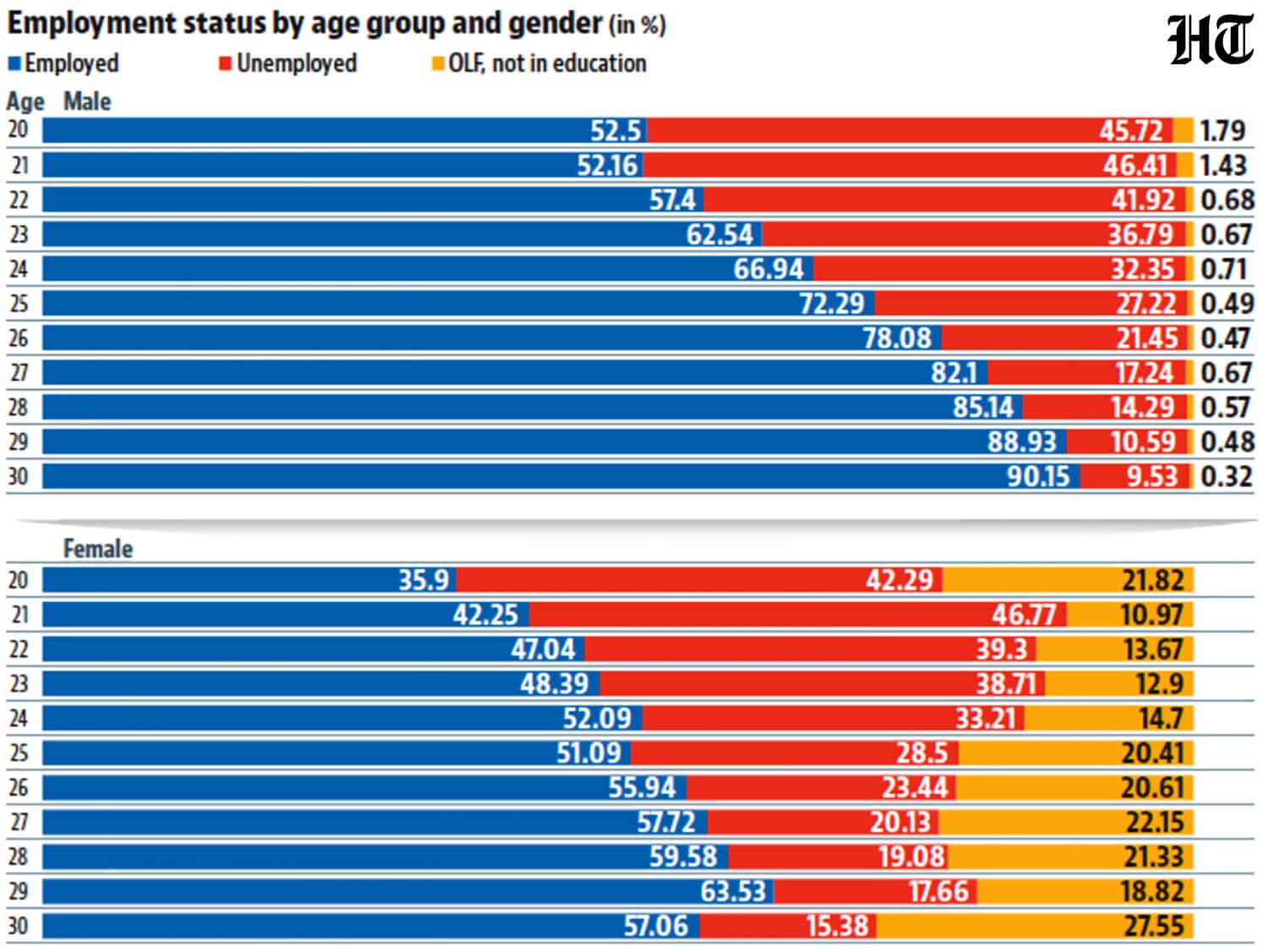
 Unemployment rate falls sharply as young workers become olderPLFS data show that the problem of open unemployment among young men in their 20s is a temporary one. Unemployment rates fall steadily with age. This offers indirect evidence for the rate at which young workers find employment. But it does not tell us whether the fall in unemployment is a result of finding the desired job or accepting whatever is available due to an inability to wait any further.
- But it can fall for different reasons for young men and womenFor example, young men are likely to get married in this period and with marriage comes the responsibility to earn an income. For women, the story is different. Like men, women in their early 20s are likely to report high rates of unemployment. But unlike men, over the course of their 20s, instead of finding employment, women withdraw from the labour force. Once again, marriage and social expectations of undertaking domestic care work are likely to play a role. It is clear from the high reported rates of unemployment in the early 20s that educated young women do wish to be employed. However, this aspiration, as of now, is largely unrealised. PLFS data do not allow us to track individuals over time. For this, we turn to data from the CPHS. We follow a sample of young men between the ages of 17 and 24 years, who are out of the labour force, with at least a high school degree, and track them for up to three years from the time they openly declare themselves as unemployed. Our attempt is to capture fresh graduates who are likely to move into employment.
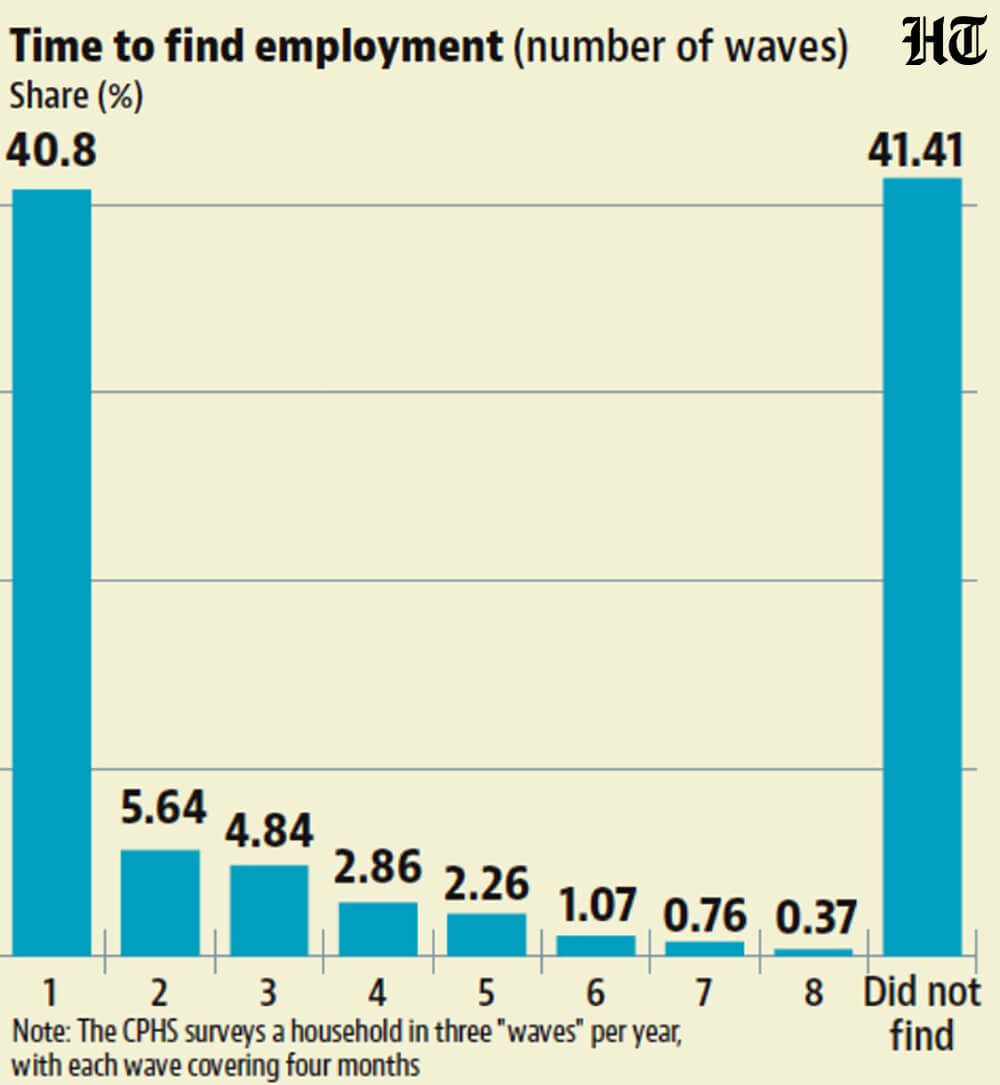
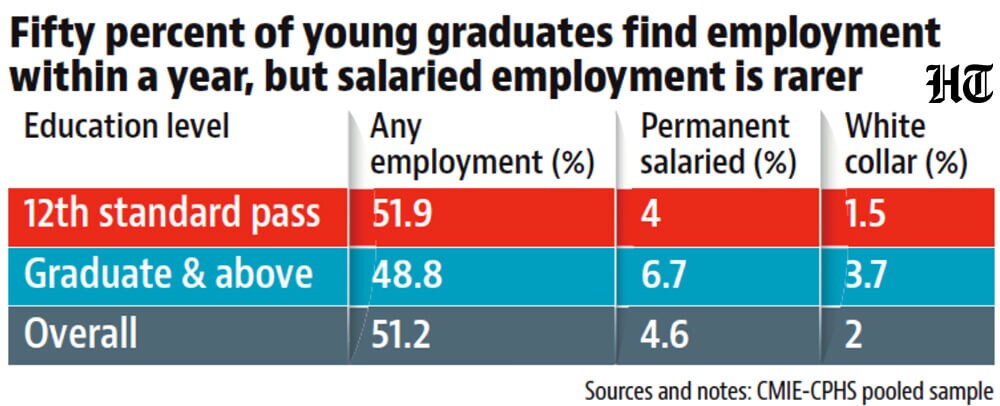
- Finding a job is much easier than finding a salaried or white-collar salaried job for a young workerWe find that around half of high school and college graduates find employment within one year of looking for it. (Table 1) In fact, 41% find employment in less than 4 months. (Figure 2) However, only 6.7% of college graduates find a permanent salaried job, and less than 4% secure a white-collar job within a year. These numbers are even lower for high school graduates without a college degree. Lastly, 41% of these young men are not able to find employment over the entire three year period that we follow them. It should be noted that our analysis does not allow us to capture how long they retain the job once they find it.
- Conlcusion...India is not unique in having high rates of open unemployment among youth. Globally, youth unemployment rates are almost twice that for the non-youth. We also see that the problem of youth unemployment is a temporary one, in the sense that the majority of men find some form of employment in a few years. But three problems remain. First for men, the time to secure employment is still longer than it should be. Second, the type of employment found is generally not aspirational. And third, women tend to leave the labour force all together as they become older and get married. Three clear policy challenges emerge from the foregoing. First, ensuring quicker and better matches between workers and jobs. Second, enabling the creation of salaried jobs in larger numbers. And third, specifically for women, enabling them to remain in the labour market and take up paid work outside the home.