
 E-Paper



Younger, polarised: How Assam differs from Kerala | Number Theory
.
Updated on: Apr 9, 2026, 08:25:26 IST

 Prefer HTon Google
Share via


Copy link

All of Assam and Kerala will vote to elect a new assembly today. In Assam, the primary contest is between the Bharatiya Janata Party (BJP) and the Congress. In Kerala, it is the Communist Party of India (Marxist) or CPI(M)- led Left Democratic Front (LDF) versus the Congress-led United Democratic Front (UDF). These pages, in the run-up to the elections, have discussed in detail the social, economic and political dynamics of these two states. On polling day, here are four charts which underline key differences in the nature of the electorate and political contest in these two states.
Younger, polarised: How Assam differs from Kerala
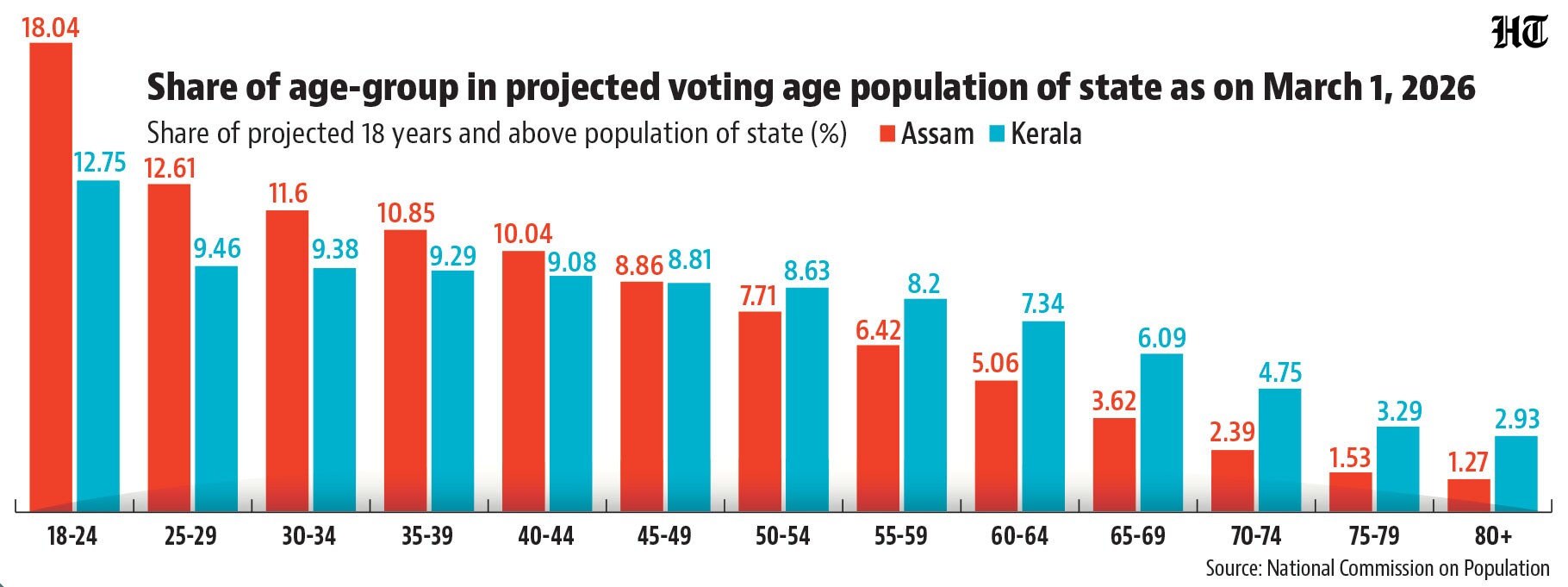
 Assam’s electorate is younger than Kerala’sThe Election Commission of India (ECI) does not give a granular break-up of electors by age. Census figures are in India are significantly dated. However, it is possible to get an idea of the age-composition of the electorate using government’s population projections. Assam’s voting age population is significantly younger than Kerala’s in this comparison. Almost 31% of Assam’s voting age population is below 30-years compared to 22% for Kerala. In Kerala, 24% of the voting age population is in the 60-years or above age group compared to 14% for Assam.
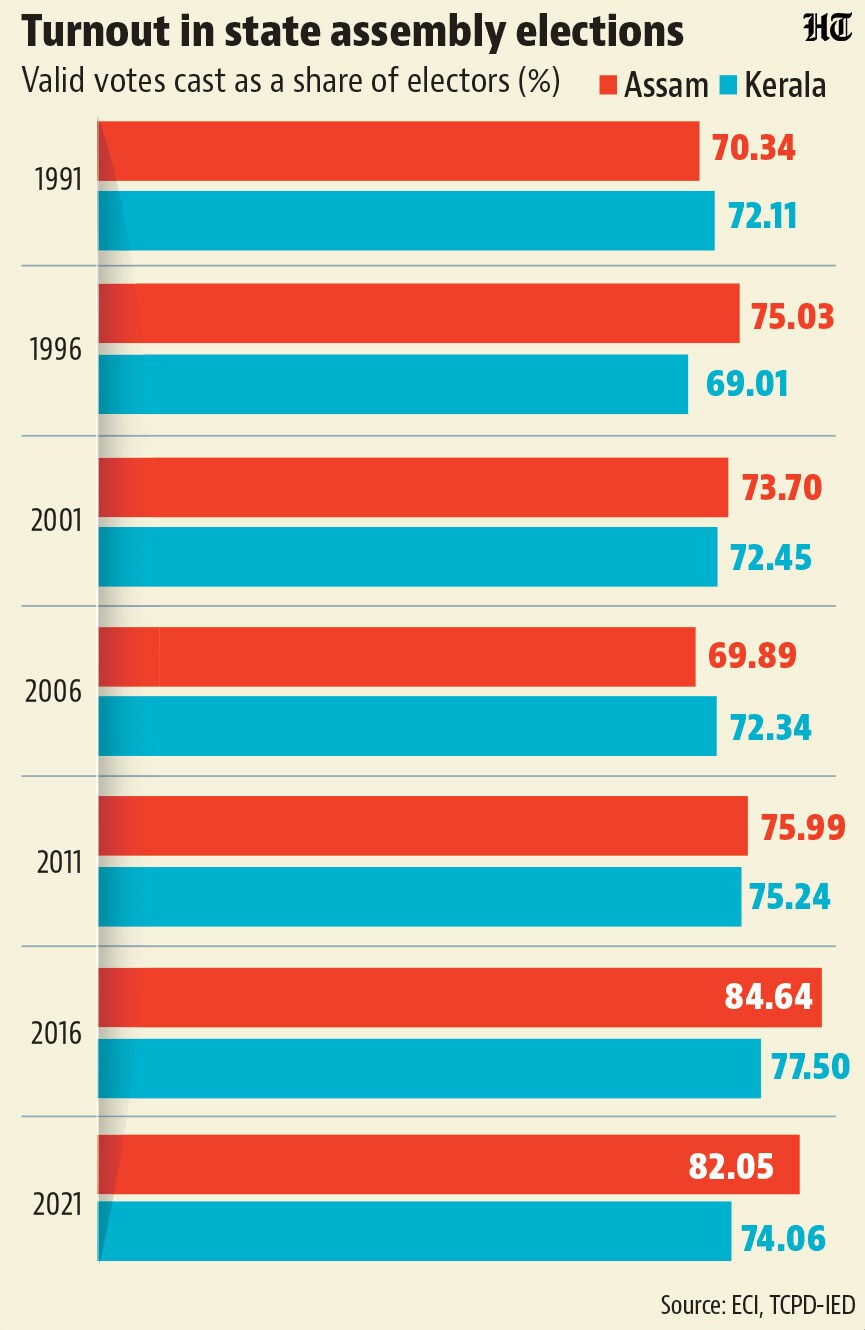
- Assam has seen a large increase in voter turnout in the last decadeAssam and Kerala have gone to polls in the same election cycle since 1991. Until 2011, they were largely in sync in terms of voter turnout. This seems to have changed since 2016 thanks to an increase in voter turnout in Assam, with the number going above 80% in both 2016 and 2021. Given the fact that both Assam and Kerala have not seen a significant deletion in elector counts under the Special Revision (for Assam) and Special Intensive Revision (for Kerala), it is unlikely that these states will see a large statistical bump in voter turnout in these elections, as was the case in Bihar.
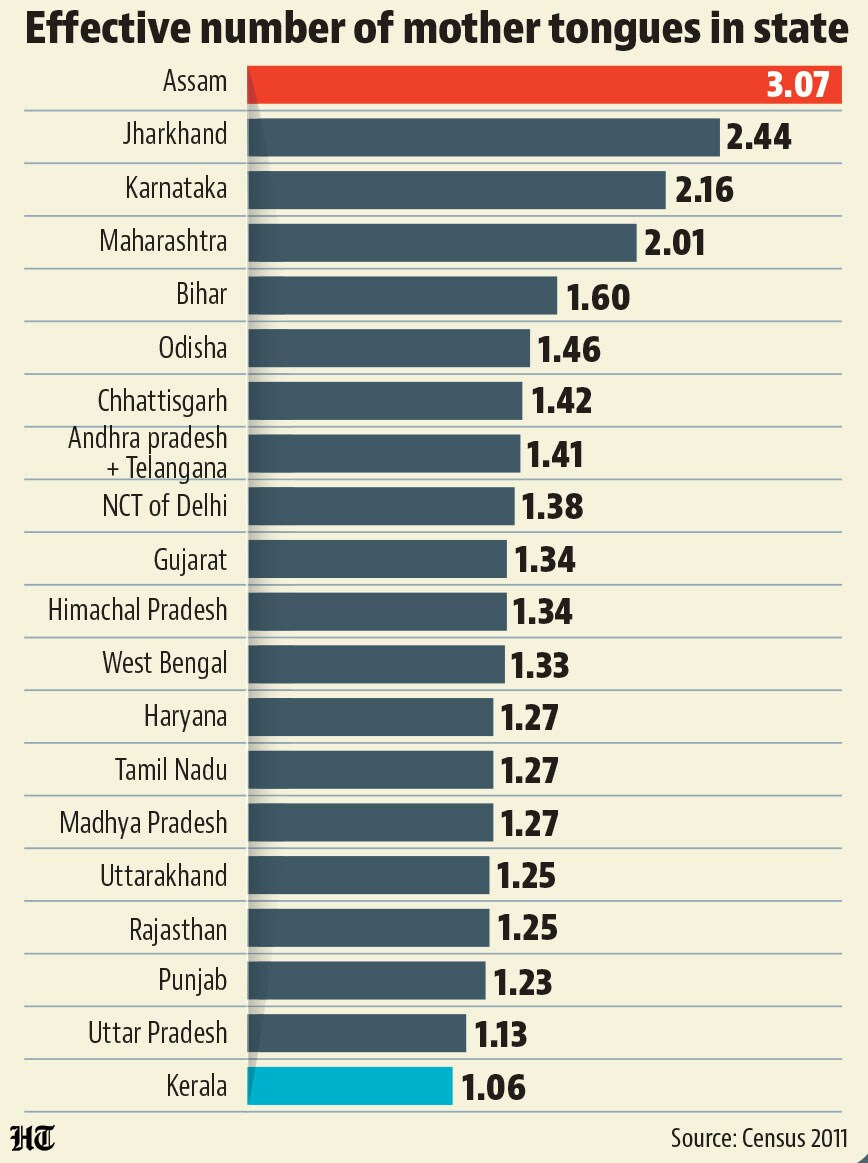
- Assam and Kerala are at the extreme ends of linguistic diversity in IndiaThis is an under-appreciated fact about these two states. While both Assam and Kerala -- the latter more than former -- have significant religious diversity, they are very different when it comes to the diversity or lack of it in the mother tongue their populations. Assam has a large number of people who speak Bengali, in addition to a large Assamese-speaking population, and many other indigenous groups which speak another language. Kerala, on the other hand, is a state with the highest homogeneity in terms of mother tongue of its population. This is best seen in the effective number of mother tongues spoken in India’s major states, as seen in the 2011 census. It has been calculated by taking the reciprocal of sum of squares of the share of the speakers of each mother tongue in the state’s population.
- Assam’s politics has also seen a growing polarisation in the last decadeWhile Kerala has been a largely bipolar contest between the LDF and the UDF for a long time, the BJP-Congress binary in Assam is a relatively recent development. This also shows in a recent fall in the median – it is the middle value in an arranged list of numbers -- value of Effective Number of Participants (ENOP) in Assam, so much so that it fell below Kerala’s in the 2021 elections. ENOP is the reciprocal of the sum of squares of the vote share of individual candidates in a constituency and a higher value denotes a fragmentation of political support. For example, if a constituency has four candidates and each candidate polls 25% of the votes, the ENOP for the constituency will be four. If two candidates get 50% votes each and the other two candidates get zero votes, the ENOP for the constituency will drop to two.




Unlock a world of Benefits with HT! From insightful newsletters to real-time news alerts and a personalized news feed – it's all here, just a click away! -Login Now!


