
Sign in

Bad year for Muslim students, they lag in earning govt scholarship

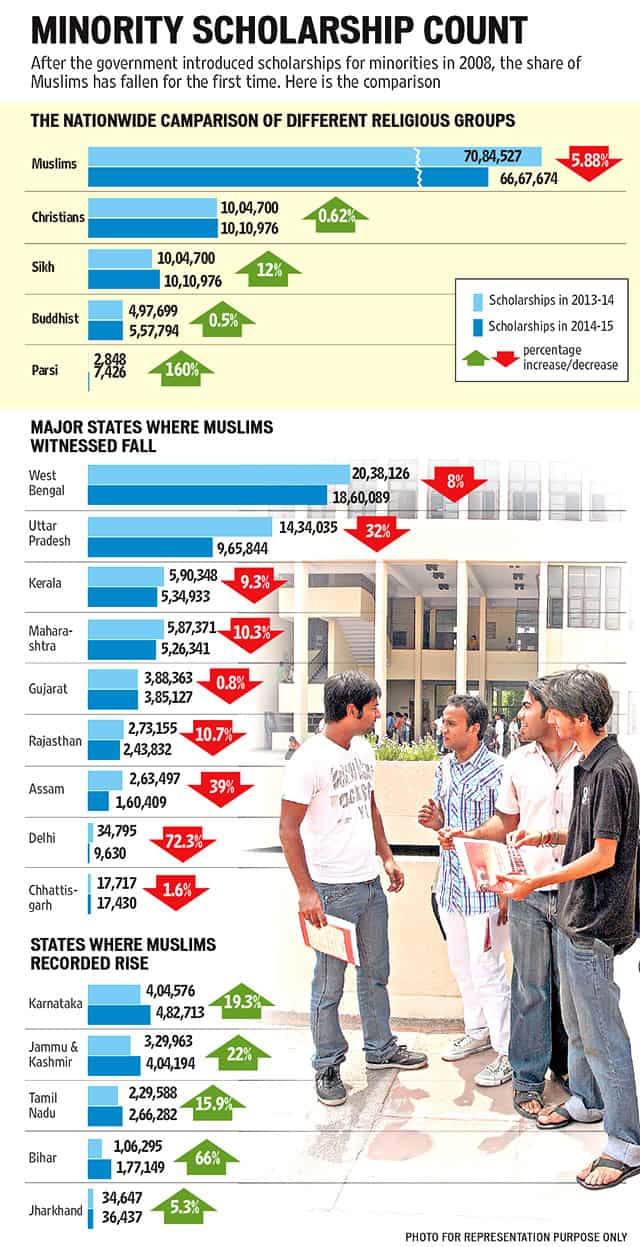
The number of Muslim students availing government scholarships fell in the first year of the NDA regime after having risen for five years, data placed before Parliament show, with the decline attributed to the mandatory use of Aadhaar.

Updated on: Aug 7, 2015, 02:03:17 IST
Hindustan Times | By , New Delhi
Share
Share via
  • facebook
  • twitter
  • linkedin
  • whatsapp
Copy link
  • copy link

The number of Muslim students availing government scholarships fell in the first year of the NDA regime after having risen for five years, data placed before Parliament show, with the decline attributed to the mandatory use of Aadhaar.

CBSE's dress code to check copying may force some Muslim girls to sit out AIPMT test. (HT Photo)

Scholarships availed by all other minority groups -- Christians, Sikhs, Buddhists and Parsis -- increased in 2014-15 whereas those obtained by Muslims fell by about 400,000 in the same period, leading to a government promise to streamline the process involved.

"The decline could also have been because of the general elections in 2014. The process is being streamlined so that more students can benefit from the scholarships," Mukhtar Abbas Naqvi, minister of state for minority affairs, told HT.

The ministry has now issued a clarification saying Aadhaar was optional for availing scholarships.

The UPA government introduced three scholarship schemes -- pre-matric, post-matric and for meritorious students -- in 2008 primarily to uplift Muslims described as “most deprived” among minorities by the Sachar panel.

In 2014, minority affairs minister Najma Hebtullah wrote to all chief ministers, making Aadhaar-linked DBT (direct benefit transfer) mandatory for transfer of scholarship money to students from minority community in the interest of transparency.

She asked the states to ensure full Aadhaar enrolment of all minority community students so that bank accounts already existing or being generated through the Prime Minister’s Jan Dhan Yojana could be linked with the unique identity numbers.

That possibly led to the exclusion of Muslim students in high minority concentration states such as Uttar Pradesh, West Bengal, Assam and Maharashtra where penetration of the 12-digit biometric Aadhaar number is low. Not more than 60% of the population in these states had an Aadhaar number as of the end of the last financial year.

The Sachar panel in its report in 2006 said only 4.5% of Muslims, who constituted 13.4% of India’s population in 2001, had bank accounts. It was almost half the financial inclusion percentage for other minority religious groups that were just 5.4% of the population in 2001. The government did not generate financial inclusion data on religious grounds after that. A religion-wise break-up of the 2011 data has not been released.

Expressing concern over the fall in scholarship numbers, Zoya Hasan, a member of the high-level committee to examine the Sachar panel report on deprivation of Muslims, sought an investigation and said data showed the DBT was not a “workable proposition” as it could lead to exclusion of the deprived.

“The government’s financial inclusion is not working for Muslims and the deprived,” she said.

The ministry said in the financial year 2015-16 the procedure to award scholarships was being streamlined and students could apply online through a dedicated web portal www.scholarships.gov.in.
Article image
  • Chetan Chauhan
    ABOUT THE AUTHOR
    Chetan Chauhan

    Chetan Chauhan is the National Affairs Editor looking into all aspects of news and features from across India. A Chevening scholar with over three decades of experience in reporting and news management, Chetan has extensively covered all important aspects of the social sector, political economy, environment and climate change nationally and internationally. He did a journalism course at the Reuters Institute of Journalism in Oxford and Digital Media training at Nanyang Technological University in Singapore. He started as a reporter with The Statesman in 1996 and joined the Hindustan Times in 2000 in the metro bureau covering environment, crime and Delhi politics. He covered hot local news, from the Jessica Lal murder case to the rebellion of Delhi Congress MLAs against then Chief Minister Sheila Dikshit, to the replacement of toxic vehicle fuel with cleaner compressed natural gas (CNG) in the national capital. Some of his stories on air pollution became part of the Supreme Court’s landmark MC Mehta versus Government of India case in the National Capital Region (NCR), forcing the government to take corrective measures. As part of the national political bureau since 2004, he covered important central sectors such as environment, education, social justice, labour, rural development, water resources, renewable energy, agriculture, broadcasting and the Planning Commission for more than a decade producing several exclusive and investigative breaking stories. His specialisation is the environment, having covered at least a dozen United Nations global conferences on climate change, biodiversity and wildlife including climate summits in Paris, Copenhagen and Bali. He also covered India’s two five-year plans ---11th and 12th and reported on drafting and execution of right based laws such as Right to Education, Right to Information and rural job guarantee law, MG-NREGA, now being introduced in new format as VG-RAM-G Act. He has in-depth knowledge of social sector issues. He was one of the first to report on tigers vanishing from Sariska and Panna wildlife reserves in 2004 and 2008, respectively, leading to the setting up of the National Tiger Conservation Authority (NTCA) and the introduction of stringent penal provisions for poaching. He has written extensively on the rising human-animal conflict in India and the degradation of India’s biodiversity hotspots because of mining and other activities. Since 2004, Chetan has covered Parliament comprehensively and participated in training on the nuanced coverage of Parliament proceedings. He has travelled extensively across India to cover national and provincial elections since 1998, especially in the Hindi heartland states, considered India’s road to power. He writes a regular column for Hindustan Times, Ecostani, on important national politics, economy, Himalayan ecology and environmental issues. His other responsibilities include providing inputs for edits and edit page articles for the publication, apart from managing news flow from across India.Read More

Stay informed with the latest updates on Education News also check CBSE Class 10 Result and Find tips to help you succeed in your academic journey and career planning on Hindustan Times.