
 E-Paper



NCERT books optional in CBSE bylaws, private publishers make hay
“The school shall put a list of prescribed books on its website with the written declaration duly signed by the manager and the principal to the effect that they have gone through the contents of the books prescribed by the school, and own the responsibility,” a section of the bylaw reads.


Private publishers are making the most of the confusion prevailing in the education ecosystem of tricity about whether the National Council of Educational Research and Training (NCERT) textbooks are mandatory in schools or not. While the academic session 2019-20 has already started in schools across the region, there was no clarification issued by the UT education department or the Central Board of Secondary Education (CBSE) on the issue.
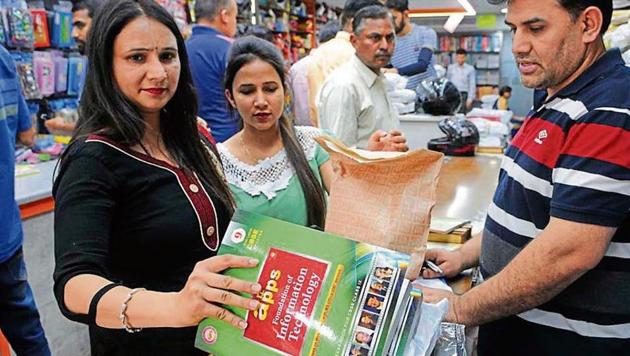
According to a judgment by the Madras high court on May 29, 2018, schools affiliated to the CBSE were directed to use NCERT textbooks. However, the board, in its bylaws released on October 18, 2018, contradicted the order under Section 2.4.7 by saying that “the school may prescribe NCERT textbooks in the classes and subjects in which these have been published by the NCERT. Extra care should be taken in the selection of books of private publishers so that there is no objectionable content that hurts the feeling of any class, community, gender or any religious group in the society.”
The section further reads, “The school shall put a list of prescribed books on its website with the written declaration duly signed by the manager and the principal to the effect that they have gone through the contents of the books prescribed by the school, and own the responsibility.”
Manoj Kumar, a parent who is a Punjab and Haryana high court advocate, said, “In the bylaws, the word ‘may’ makes the entire difference. It makes NCERT syllabus for schools optional.”
The high court had passed the order on a petition filed by one M Purushothaman for directions to the CBSE for prescribing NCERT books. The court’s order had emphasised that “it has every reason to believe that there is a hidden agenda between CBSE officials and private book publishers, .... which is why even a directive to use NCERT books alone is being appealed by the CBSE.”
The court in its order had said, “The CBSE is bound to follow the NCERT syllabus, which has been prescribed by experts.”
Following the order, district education officer (DEO) Anujit Kaur on September 3, 2018, had written to all the principals and heads of all government-aided as well as private recognised schools in Chandigarh for compliance with the order.
Later on October 5, the Ministry of Human Resource Development (MHRD) department of school education and literacy wrote to all the states and UTs asking the directorates to ensure compliance with the order.
The MHRD’s letter had also given the governments of states and UTs to form special squads to inspect the schools and prevent the use of non-prescribed books.
However, the Chandigarh education department had never formed any such squad or inspection team to visit schools, said an education department official requesting anonymity.
UT education secretary BL Sharma said that the schools must abide by the instructions issued by the MHRD in letter and spirit, or else become liable for penal action.
CBSE regional director S Dharini Arun said, “I am not aware of the circular and its contents. We follow the instructions that we receive from CBSE Delhi.”
The CBSE Delhi and the MHRD did not respond to this correspondent’s queries.


