Sign in

What makes electoral politics in Kerala unique?

Kerala is not the only state where political power changes hands regularly. Tamil Nadu had this tradition for 32 uninterrupted years, until J Jayalalithaa led the All India Anna Dravida Munnetra Kazhagam (AIADMK) to a consecutive victory in the 2016 elections.

Updated on: Mar 20, 2021, 06:32:18 IST
By , , Hindustan Times, New Delhi
Share
Share via
  • facebook
  • twitter
  • linkedin
  • whatsapp
Copy link
  • copy link

If the Communist Party of India (Marxist) or CPI(M)-led Left Democratic Front (LDF) manages to secure a majority in the Kerala elections scheduled for April 6, it will create history. Kerala’s voters have rotated power between the LDF and the Congress-led United Democratic Front (UDF) since 1982.
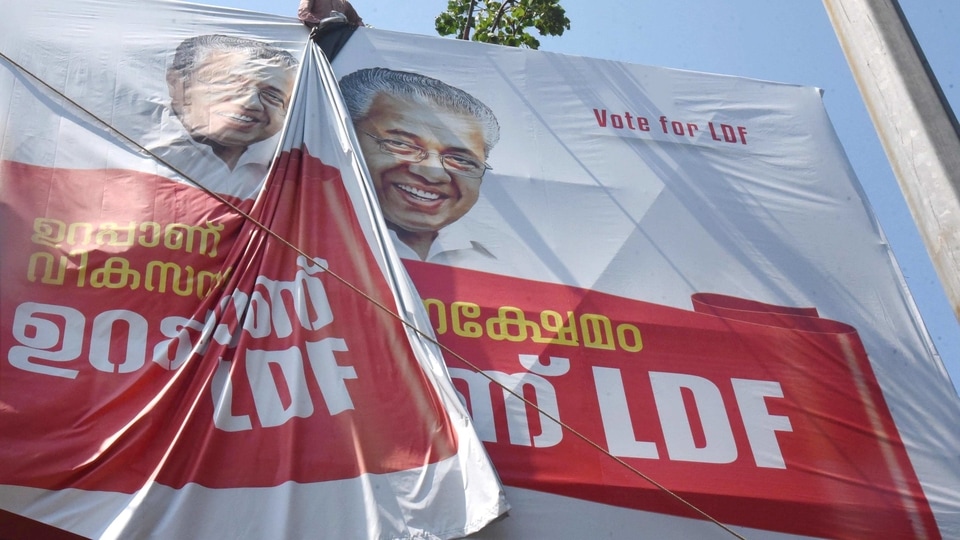
A worker puts up an election campaign banner of Kerala Chief Minister Pinarayi Vijayan, ahead of the Assembly polls, in Kochi. (PTI Photo)

To be sure, Kerala is not the only state where political power changes hands regularly. Tamil Nadu had this tradition for 32 uninterrupted years, until J Jayalalithaa led the All India Anna Dravida Munnetra Kazhagam (AIADMK) to a consecutive victory in the 2016 elections. Rajasthan too has been electing a Congress and Bharatiya Janata Party (BJP) government in turn since 1993.

In Karnataka, the Congress and BJP have won alternate assembly elections since 2004. To be sure, the BJP was the single largest party but failed to secure a majority of its own in the in 2018 elections.

What makes Kerala’s polity unique is the fact that neither the CPI(M) nor the Congress, the leading parties of the two major political formations, enjoy the kind of political dominance which their counterparts (or units) in Tamil Nadu or Rajasthan do.

An HT analysis shows that the reasons for this are to be found in the state’s uniquely multicultural society and entrenched pockets of support for various political actors in different parts of Kerala. Here are four charts which explain this in detail.
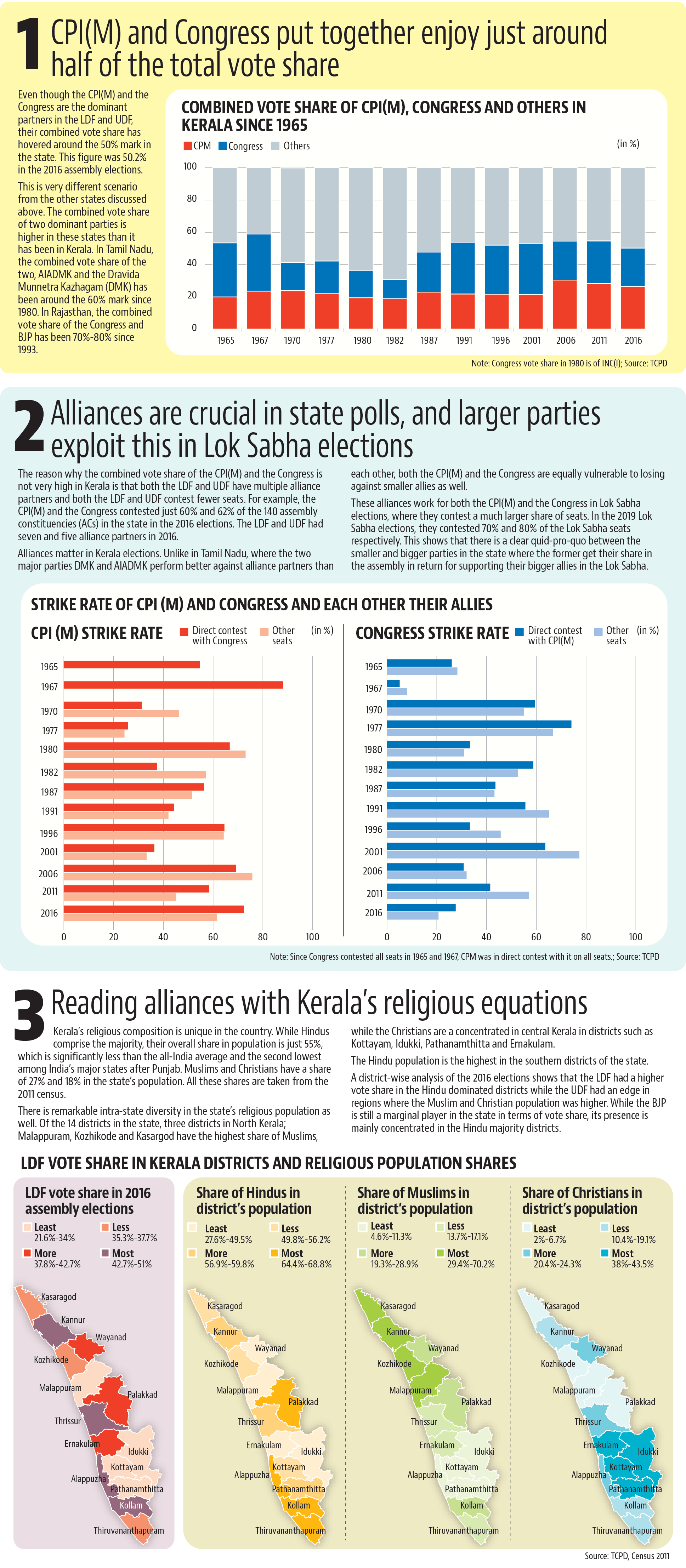
What makes Kerala’s polity unique is the fact that neither the CPI(M) nor the Congress, the leading parties of the two major political formations, enjoy the kind of political dominance which their counterparts (or units) in Tamil Nadu or Rajasthan do. (HT Illustration)
  • Roshan Kishore
    ABOUT THE AUTHOR
    Roshan Kishore

    Roshan Kishore is the Data and Political Economy Editor at Hindustan Times. He heads the newsroom's data journalism team, which produces Number Theory, a daily data-driven feature for the print edition and the HT app. Number Theory uses data analysis and story-telling based on it to add value to the newsroom’s daily coverage by putting stories in a larger context on a range of issues, including politics, macroeconomy, markets, global affairs and climate. Under his leadership HT’s data journalism work has established itself as a niche product in Indian journalism and pushed the boundaries of marrying academic rigour with news sense and speed. Along with writing and editing data stories, he has also been writing a weekly political economy column called Terms of Trade for HT Premium. A trained economist with an MPhil degree from Jawaharlal Nehru University, Kishore has also been a visiting fellow at the Centre for Advanced Studies of India (CASI) at the University of Pennsylvania. Along with his journalistic work, his writings have also appeared in journals such as the Economic and Political Weekly and working papers for CASI and UNESCAP.Read More

  • Abhishek Jha
    ABOUT THE AUTHOR
    Abhishek Jha

    Abhishek Jha is Assistant Editor-Data at Hindustan Times. He uses statistical programming to generate newsworthy insights from large datasets. He is part of the team that produces Number Theory, a daily data story feature of the paper’s print edition. Since March 2024, he has been writing Weather Bee, a weekly column for the Hindustan Times website. He is a chemical engineer by training, who specialises in stories related to weather, climate, and the environment. Jha has been at HT since 2018, where he offers data-driven perspective and analysis on politics, environment, weather, climate, economy and society. His work includes data coverage of elections in India and abroad, including the 2019 and 2024 Lok Sabha elections; the disasters and extreme weather resulting from changing climate, such as floods, droughts, heat waves, cold waves, and dwindling snow cap in the Himalayas; the factors that drive poor air quality in northern India; the changing patterns of land use; the Covid-19 pandemic and its impact on labour market conditions; the changing pattern of consumer spending seen in the new consumer spending surveys; and social norms seen in the surveys such as the National Family Health Survey.Read More