The Monk and the Gun review: A bracing and lively political satire from Pawo Choyning Dorji
The Monk and the Gun review: After the Oscar nominated Lunana A Yak in the Classroom, Pawo Choyning Dorji retuns with a charming Bhutan-set political satire.
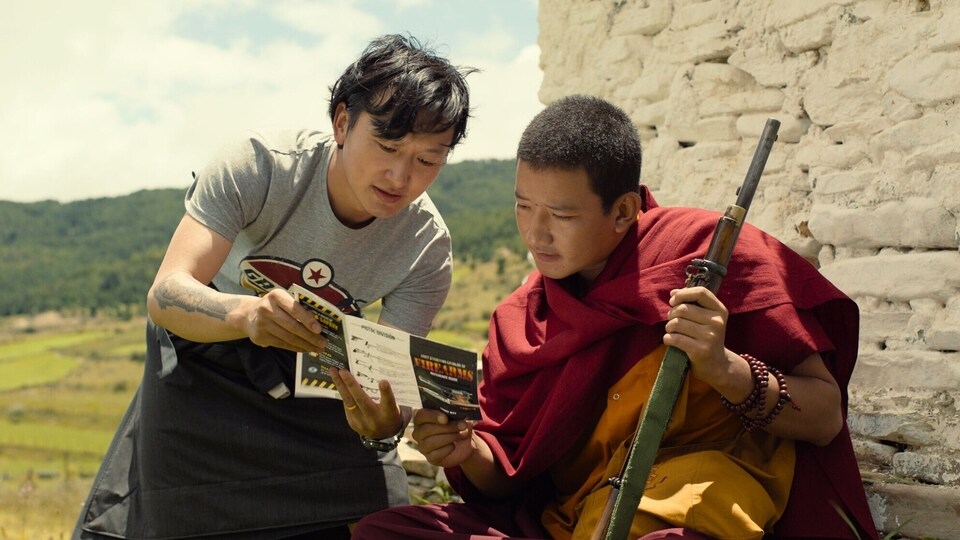
Pawo Choyning Dorji's sophomore feature, after the Oscar-nominated Lunana: A Yak in the Classroom, is a far more ambitious affair. This is a film of charming simplicity that paves the way for a vivid political satire about a land and its people. It is 2006. Bhutan is about to become the world’s youngest democracy. But what is democracy to its people? They think they don't need it in the first place. The road ahead will bring a lot of advancements- cellphones, television, a mock election and yes, a gun.
The Monk and the Gun is currently streaming on Mubi.
The premise
The film starts off gently, setting the scene in the gorgeous village of Ura. The inhabitants live in an interconnected, pragmatic fashion, which is orchestrated wonderfully in the opening scenes. As the news of the upcoming election creeps its way inside the walls of the huts, a slow chasm opens. First, it is Lama (Kelsang Choejey) who breaks his meditation and sends the young monk (Tandin Wangchuk) in search of guns. Why? We don't know yet.
There are parallel tracks that keep up the pace of the sprawling narrative. Tsering (Pima Zangpo Sherpa) is bound by duty to oversee the mock elections before the final day. A local villager Chephel (Shoeing Jatsho) makes up his mind to show his support to a specific candidate to get away from the place for good- which does not sit right with his wife Tshomo (Deki Lhamo). Then there's an American arms dealer, Ronald Colman (Harry Einhorn), who is also lurking for motives that will be defined in the course of the brisk 107-minute runtime.
Suffice to say, there are a lot of elements to track and fill in this quiet little film. Dorji, however, moves along these characters and their concerns with a lightness of touch, and a lot of nuance. His positioning is languid yet confident, where the smallest of details and wry humor add up to the collective reasoning along the way. Working with editor Hsiao-Yun Ku, Dorji cuts through the central thematic conceit around tradition and modernity with a breezy confidence.
What works
The Monk and the Gun works because Dorji is not concerned with setting a cautionary tale about anti-democracy, or bringing in a heavy dose of scepticism to reflect a nation standing at the brink of a transition. The tone here is wonderfully balanced and considerate, seeking everyday lessons from the varied bunch of people who have their own reasons to go about living, which might be selfish to some, duty-bound to others. That's about it, there's no moral headwringing on it.
The ensemble group of actors are all natural on screen, adding authenticity to the manner in which each of them faces an unforeseen circumstance differently. However, the film also slows down because of its relatively considerate and benevolent approach to the subject(s). Dorji's positioning of tradition and ethnic nationalism has bite, and all it needed was a little more chaotic foresight. It still remains amply charming, emerging out as a whimsical crowd pleaser that lingers like a smile long after the end credits roll.
Santanu Das is a Senior Content Producer at Hindustan Times with over 5 years of experience, writing on films, pop culture and film festivals. He has a keen interest in writing about South Asian independent films and has covered several film festivals, including Sundance and CPH: Docx. He also brings a sharp perspective to the monthly column called The Fault in Our Stars, where he writes about a recent film/series and what stops the ‘good’ from becoming ‘great’.
A gold medalist from Banaras Hindu University, Santanu completed his postgraduate studies in English from Jadavpur University. He is also a Rotten Tomatoes-certified film critic. When not watching films or speaking to celebrities, Santanu can be found reading a book. Some of his favourite films are Aparajito, Ponyo and The Double Life of Veronique. His favourite books include The Corrections, The God of Small Things and A Room of One's Own.
Santanu continues to write passionately about films and celebrity culture. He brings a relatable, as well as critically informed, lens to entertainment and culture for a wide audience.
Find him on LinkedIn: santanudasfilm
Instagram: @santupechaRead More

 E-Paper