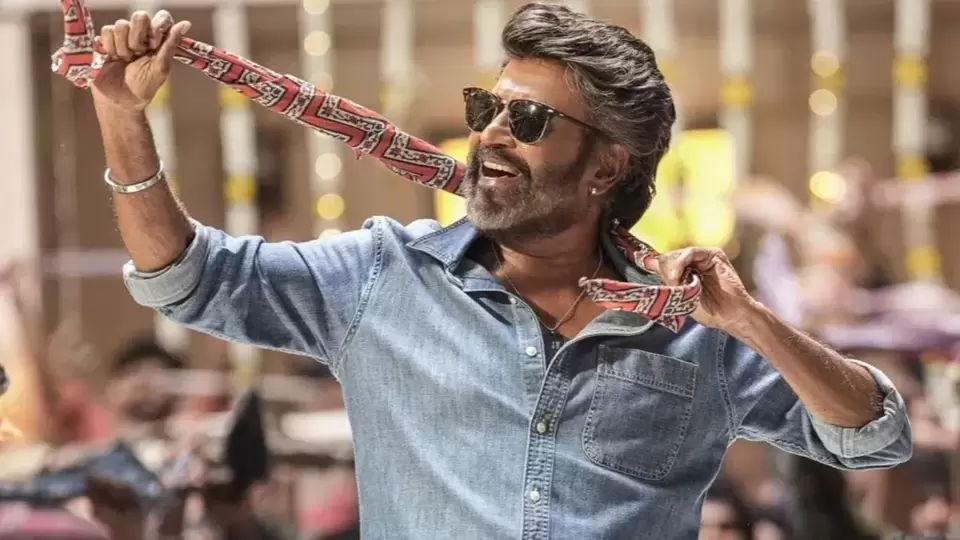
The coming together of Rajinikanth, arguably the biggest mass star in Indian cinema since Amitabh Bachchan, and Lokesh Kanagaraj, one of the few directors in Tamil cinema to have mastered this new-mass grammar, was widely anticipated. Having given Vijay and Kamal Haasan their biggest hits, Lokesh was considered the perfect candidate to bring back 'vintage' Rajinikanth to the screen. That the superstar still had it was evident with Jailer's success. Perhaps it was that heavy burden of expectations, or simply Lokesh's lofty ambitions, but Coolie does not simply fall short, but stumbles and staggers its way along that route. It is a confusing film, as much as it is confused, lifted largely by Rajinikanth's undimmed aura, Anirudh's masterful score, and some brilliantly shot fight sequences.
Coolie review: Lokesh Kanagaraj's film answers a question - can Rajinikanth's swag save an average film?
Deva (Rajinikanth) runs a hostel in a mansion in Chennai. But, he has a dark past, one that threatens to return after his old friend Rajashekhar (Sathyaraj) is killed. Deva must now protect his friend's daughters (although we focus largely on Shruti Haasan, ignoring the other two), and infiltrate the gang of Simon (Nagarjuna), who may hold the key to his friend's death. But hounding him is Simon's lackey, the unpredictable Dayal (Soubin Shahir), leading Deva to wonder if he has bitten off more than he can chew.
Let us first address the elephant in the room. An ageing man with a dark past is spurred into action due to the death of a loved one, and now he must dismantle a criminal enterprise led by a mercurial villain. And oh, there is a bigger baddie somewhere played by a superstar. This is the plot of both Vikram and Coolie. The difference is merely in the presentation. But while in Vikram, Lokesh was very much in command of the narrative, in Coolie, one can feel he has let the reins go a little too much. The film meanders in all directions, ending up as almost a diluted version of his 2021 hit. And sadly, it lacks many of the things that made Vikram so enjoyable - cohesion, crispness, and direction.
Rajinikanth is the heart and soul of the film. At 74, the ageing superstar still lords over the screen, drawing loud cheers and whistles even at the twitch of an eyebrow. Very few actors can manage this connect with the audience across cultures. Even in a film as uneven as Coolie, Rajinikanth's presence and persona are among the saving graces. From meta references to signature cigarette twirls, Rajinikanth excels in everything he does on screen. His presence alone is enough to make the film exponentially watchable.
Nagarjuna's villain is menacing and ruthless, but not very impactful.
The flashback sequences featuring a de-aged Rajini are also done well, blending nostalgia with mass for an audience who has not seen Rajinikanth prime on the big screen in this manner.
But, to me, the real star of the film is Anirudh. The young composer has been proving himself time and again, be it Vikram, Jailer, Jawan, or Leo. In Coolie, he may not have set the internet on fire with a definitive track (think Rolex Theme, Jawan whistle, or Hukum). But with his score, he elevates the film in its dull moments. At any moment when Coolie threatens to cling to the tropes and go to templates, Anirudh saves the day. Anbariv's action, presented beautifully by Lokesh, adds to that audio-visual charm. The combine yet again gives you action that is slick and does invite a gasp or two. But after a while, you do feel, if Lokesh is settling into a pattern, which is less of a signature and more of a type.
Nagarjuna, playing a rare negative role in a commercial film, does well. But again, he cannot match up to some of the memorable villains that this genre of cinema has given in the last half a decade alone. A mass actioner's hero shines only because he is fighting a memorable villain. Despite the superstar's best attempts (and a decent performance), the script does not allow him to be memorable. He is convincing, just not impactful. That job is done by Soubin Shahir. He has the more fleshed-out role, better-written scenes, and a character that most actors would kill for. To Soubin's credit, he makes it his own. If his dance was the talk of the town before the release, his scenes and dialogue will flood the internet now.
Soubin Shahir gives the most memorable performance of Coolie.
Shruti Haasan has done well with the role she has, even matching Rajini in certain confrontational scenes. Rachita Ram also leaves an impact. But the two superstarry cameos are very uneven. Upendra gets more to do on screen than just be. Everything from his entry to fight scenes has fan service written all over it. But Lokesh proves again that if done right, that is not a bad thing to do. He and Rajinikanth fighting in tandem, like a tag team of wrestlers in a battle royal, is a visual treat and something that fans of both actors will cherish. On the other hand, Aamir Khan's Dahaa is confusing to say the least. If Lokesh wanted a Rolex 2.0 with this, he failed here. Aamir does brilliantly as the unpredictable gangster, but the presence of the character adds very little to the narrative. With Rolex, there was a promise of a payoff. But with Dahaa, it is just an attempt at 'pan-Indiaing' this film, which feels very inorganic.
Coolie is not a bad film. Far from it! But it certainly is a squandered opportunity. The combination of Rajinikanth and Lokesh should have given the viewers much more than what it is.
Abhimanyu Mathur is Deputy Editor, Entertainment at Hindustan Times. With almost 15 years of experience in writing about everything from films and TV shows to cricket matches and elections, he inhales and exhales pop culture and news. Currently, he watches movies and TV shows and talks to celebrities for a living, while occasionally writing about them as well.
A journalism graduate of Delhi College of Arts and Commerce, Delhi University, Abhimanyu began his career with Hindustan Times at the age of 20, swapping classrooms for newsrooms at an early age. He began his journey in the early days of digital journalism, later switching to the madness of print journalism.
Work has led him to far off places like Japan and Jordan, as well as to the interiors of Haryana and the Indo-Pak border. He dabbled in city reporting in places like Meerut, Gurgaon, and Delhi, covered the Olympics and Cricket World Cups, before finding his calling in entertainment and lifestyle during the pandemic. A Rotten Tomatoes Certified Film Critic, he is equally at home covering stories on ground as he is interviewing celebrities and studios, and sometimes prefers to shepherd teams in delivering traffic through the day.
Even as his role has evolved from reporter to supervisor over the years, his first love remains writing (and of late, talking on camera). With a good understanding of cinema and its trends, and a keen eye for detail, he continues to spark conversations around showbiz for readers around the world.Read More

 E-Paper