E-Paper



Donald Trump’s war on renewables
A not-quite-total eclipse of the solar


 Prefer HTon Google


TAG ALONG with Mary Powell on a field visit to San Jose, California, and you might think you are looking at the bright future of clean energy in America. Sunrun, the residential solar firm she heads, helps consumers manage energy services in 22 states. One of her California customers, a hard-nosed engineer in Silicon Valley, shows off solar panels and batteries leased from Sunrun. A greater attraction for him than greenery, he says, is that the kit keeps his lights on during outages: and it works out cheaper than getting power from the local utility.
Sunrun’s “solar as a service” customers get cheap electricity in return for letting the company install solar panels and batteries on their property. By networking those systems together into “virtual powerplants” the company can also sell power to local grids at times when they need it most; it says it has helped forestall blackouts in states and territories including California, New York and Puerto Rico.
The company exemplifies the potential of solar energy. Solar panels have become cheap—very cheap, when the tax credits offered by the Inflation Reduction Act (IRA) of 2022 are included—and easily installed. That is why they accounted for over three-fifths of new-electricity-capacity installation in America in 2024. But they offer more than that. Coupled with ever cheaper batteries, they are also spurring the development of new business models which could help bring wholesale change to the energy system.
The One Big Beautiful Bill (OBBB) signed into law on July 4th is an attempt to stop all that. It is not as bad for the solar sector as it might have been. A tax specifically aimed at solar and wind introduced by Senate Republicans did not make it into the final bill, and the IRA’s tax credits for solar, wind, “green” hydrogen and associated manufacturing investments are being phased out by 2027-28, not killed immediately. Its shortest-term effects are now the removal of tax credits for buying and using electric vehicles (EVs). These will end in September—bad news for, among others, the companies that took advantage of the IRA’s tax credits to invest in the EV supply chain.
On top of this the OBBB provides new largesse to fossil-fuel firms, making it easier and cheaper to drill on federal land and expanding the area of such land available—though the question of how much, if at all, they make use of these options will be decided by prices in the global oil and gas markets. Car makers that were buying credits from EV makers to improve their fleet-efficiency figures will no longer need to do so, because the relevant regulations will no longer be enforced.
Get your gigawatts out
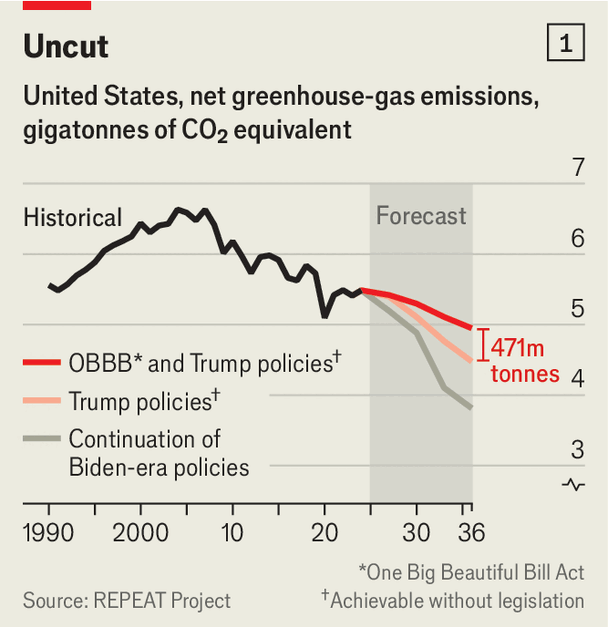
Researchers at Princeton University reckon that under the OBBB America’s greenhouse-gas emissions in 2035 will be 470m tonnes of carbon-dioxide equivalent above what they might otherwise have been under President Donald Trump’s policies (see chart 1). The Rhodium Group, a research company, has a similar number for the excess: 315m-574m tonnes. At the low end that is a bit larger than Britain’s carbon-dioxide emissions in 2023; at the top end, a tad less than Germany’s. When the Princeton researchers add in the effect of policies Mr Trump can enact without legislation—such as ending greenhouse-gas regulation by the EPA and scrapping both fuel-economy standards for motor vehicles and energy-efficiency rules for industry—the excess emissions in 2035 compared with those that could have been expected under the IRA reach 1bn tonnes or more.
Waiting for the killshot
Does the OBBB sound the death knell for the transition away from fossil fuels? No. Enthusiasts for green energy whose horizons are broader than just wind and solar can see grounds for optimism: nuclear and geothermal energy keep their IRA benefits. More controversially, so do schemes to remove carbon dioxide from the atmosphere. Some such “direct-air capture” is necessary for any net-zero endgame; it provides the negative emissions with which to net out the hardest real emissions to abate. At the same time it is tellingly popular with the fossil-fuel industry, which wants to use the carbon dioxide some such schemes produce to squeeze more oil out of ageing wells.
What is more, America needs electricity. Demand is rising quickly, and the titanic amounts of power some AI boosters see as crucial to their transformation of the world could see the rise increase sharply. That suggests investments in already cheap and well established renewables, especially solar, will return. By the end of the decade they may be rising at rates not unlike those of the past few years years—if from a lowered base.
Counterintuitively, the very near term prospects for wind and solar may also be good. Jeh Vevaina of Brookfield, a Canadian investment goliath with over $50bn invested in America’s clean-energy sector, says he expects a brief boom. The new rules mean that developers who start wind and solar projects before next July and complete them rapidly will still earn the IRA tax credits, so companies with the wherewithal are accelerating investments.
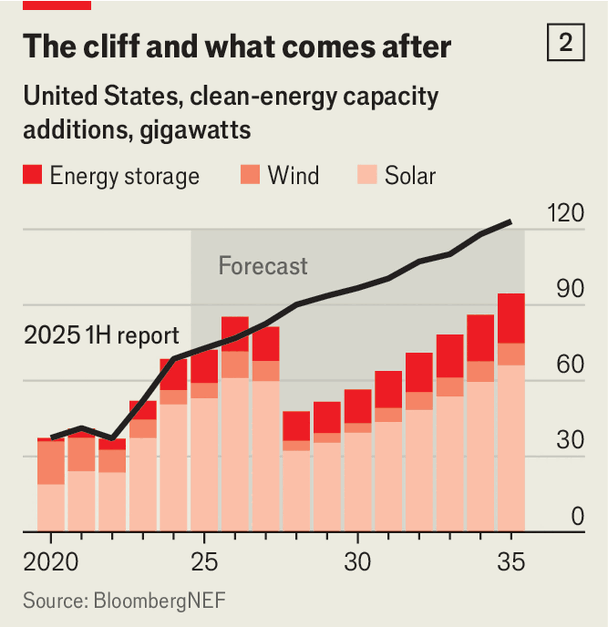
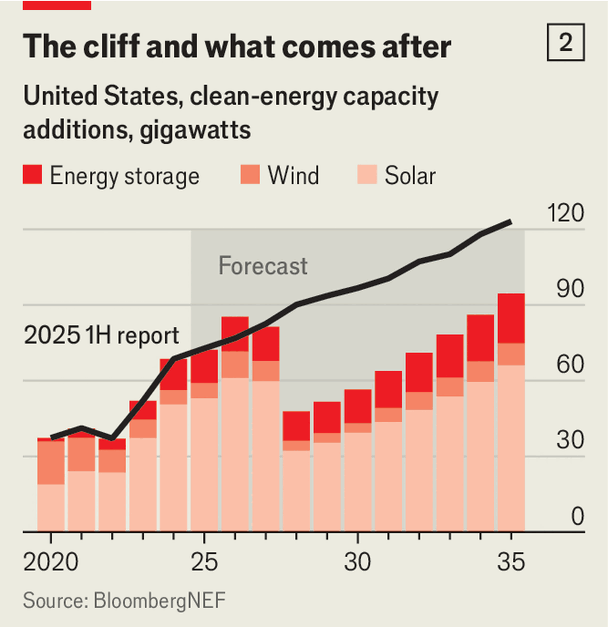
This is one of the reasons why BloombergNEF (BNEF), another research firm, expects more than 50GW of solar installation in both 2026 and 2027. After that, in the words of another big developer, things fall off a cliff (see chart 2). Rhodium expects clean-energy generation additions between 2025 and 2035 to be 57% to 62% compared with what would have happened under IRA policies.
Kevin Smith of Arevon Energy, a renewables developer, reckons $100bn or more in planned American solar and battery manufacturing investment “will not happen”. The researchers at Princeton reckon that $500bn which might have been invested in renewables will go elsewhere.
Mr Vevaina insists the shake-out will see good projects still getting built, but smaller developers and those with long construction periods may not survive. Abigail Hopper of the Solar Energy Industries Association, a trade group, sees firms quickly adapting supply chains, investment strategies and business models. Because the OBBB maintains IRA tax credits for batteries, she reckons solar firms will “reorient product lines along storage”. Sunrun is one of those already doing so. Emphasising storage and other less “political” options is a way of realising what Nat Eng of Apricus Generation, a solar and storage developer, says is the industry’s new mantra: “Stayin’ alive till ’29.”
After the crash, though, BNEF sees new annual additions of solar and onshore wind starting to climb again, with 94GW of additional renewable generation and storage added in 2035—more than any year to date. And the revival would be more sustainable, supported purely by cost advantages and sharper business models.
Unfortunately, there is no evidence that a more sustainable and efficient industry is what Mr Trump wants; he would like the strictures tightened. Three days after he signed the OBBB, Mr Trump issued an executive order directing the Treasury to issue guidance within 45 days on implementing the OBBB with the express intent of ending “the massive cost of taxpayer handouts to unreliable energy sources”. The next day he was fulminating on the subject: “Wind is a very expensive form of energy, it’s very bad…the other one is solar…very, very inefficient and very ugly too.” He returns to the subject obsessively. On July 25th, after seeing the wind farms now visible from his golf courses in Scotland, Mr Trump said their spread was, alongside immigration, Europe’s biggest problem: “You’re ruining your countries. I really mean it, it’s so sad. You fly over and you see these windmills all over the place, ruining your beautiful fields and valleys and killing your birds. And, and they’re stuck in the ocean, ruining your oceans.”
Despite the presidential animus, Jason Grumet of the American Clean Power Association, a trade group, says he is “optimistic that the executive order will be interpreted in a way that does not create price shocks.” Perhaps. But many in the industry are quietly panicking. The worry, they say, is that the Treasury guidance becomes a “killshot” much more lethal than the OBBB’s staged phase-out.
Ways to make things worse for wind and solar could include increasing the amount of capital spent, or the number of parts ordered, or the level of development at the site by a certain date needed for a project to qualify for credits. The idea that new limits might conceivably be applied retrospectively adds to the uncertainty.
Because large parts of the supply chains for solar, batteries and EVs still rely on Chinese inputs, another avenue for mischief is the “foreign entity of concern” (FEOC) provision which limits the access to supply chains of countries seen as adversaries. These issues are always tricky. Keith Martin of Norton Rose Fulbright, a law firm, argues that, at present, the “FEOC maze is manageable enough, based on the statute”. The question is whether officials will limit their actions to the statute’s expressed intent.
The Treasury’s guidance is not the only way to turn the screws. On July 10th Mr Trump appears to have told his energy secretary to cancel a $5bn federal loan guarantee for the Grain Belt Express, a transmission line designed mainly to benefit midwestern wind farms. On July 17th an extraordinary memo informed staff at the Interior Department that almost 70 different types of normally routine paperwork for wind and solar projects would now need a personal sign off by the secretary. This will impose new delays on projects desperate to scrape under the wire. Even the sober Mr Martin thinks “The jury is out on whether projects can move forward.”
Nutter zero
If the only victims of such shenanigans were renewable-energy investors and the global temperature, such trickery would seem bound to continue. But it also raises problems closer to home. Analysts broadly agree that the OBBB will raise American energy prices and household bills. Bureaucratic jiggery pokery designed to nobble renewable projects under way, or almost so, will exacerbate that effect, and bring it forward. Mr Grumet takes comfort in the idea that the administration will not want to fuel even higher prices; it may be the most compelling reason to think the ugliest scenarios will not come to pass.
Energy Innovation, a think tank, reckons that even without added vindictiveness wholesale electricity prices will rise by 25% by 2030 and 74% by 2035. This comes as energy markets are already seeing rising demand and constraints on supply. In the first half of this year, utilities requested $29bn in rate increases, a big rise on last year’s level. On July 22nd a power auction held by PJM Interconnection, an east-coast regional grid, indicated electricity prices are headed even higher.
Mr Trump’s supporters may hope that old-fashioned types of power plant will replace the hundreds of gigawatts of new renewable capacity that the OBBB has nixed. They do so in vain. Existing nuclear plants take far too long to build; new smaller and more advanced designs, including those using fusion rather than fission, are only just making it into the prototype stage. The manufacturers of the turbines that new gas plants need have backlogs of four years or more.
Industry insiders report that the hostile White House stance is leading big investors, especially climate-focused European groups, to start shifting resources to greener pastures, such as Europe and the Middle East. If the Treasury guidance is fair, some of the investment may be saved. But the OBBB still looks like an obstacle to the president’s oft-trumpeted goals of “energy abundance” and “AI dominance”.
Some rocks are still hot
In the longer term, it is possible to see some silverish linings. If you look beyond wind and solar, “The law is favourable,” says Mr Vevaina of Brookfield, which invests across almost all energy technologies all around the world. Zachary Bogue of California’s DCVC, a leading “deep tech” venture fund, goes further. The new law “is fantastic for the long-overdue nuclear renaissance and for advanced geothermal…we are bullish on this space.” Such technologies have the advantage that they can provide power day and night, winter and summer in a way renewables never can. A largely wind and solar future with no room for carbon emissions is going to need such power.
Jigar Shah is a pioneering solar-energy entrepreneur who ran the Biden administration’s gargantuan energy-loan programme. He spent four years lending over $54bn to schemes involving everything from hydrogen and sustainable aviation fuels to carbon capture and lithium extraction. He takes a certain provocative pleasure in suggesting that the OBBB’s support for its protected subset of low-carbon technologies may in time see it remembered as “America’s second-most-important climate law”. Jeremy Harrell of ClearPath, a clean-energy advocacy group influential among Republicans, goes further. After years of politicised, stop-start policies, he believes the OBBB represents a valuable and durable bipartisan endorsement. “Investors can now have confidence out to the mid-2030s.”
An OBBB which gives confidence to investors taking the long view on the energy transition and pushes up prices in a way which will eventually reincentivise investment in wind and solar is not what its backers want. But that is what they look likely to get. That, and a world where China’s dominance in EV markets and many other renewable technologies is unassailable. And, on top of it all, an atmosphere containing a few billion more tonnes of carbon dioxide.