E-Paper



Industries outside NCR have major influence on Delhi’s air quality: New study
TERI’s analysis found that in 32 pollution monitoring stations, there was an average reduction of 43% and 61% in PM2.5 and NOx concentrations respectively in 2020 during the lockdown period

 Prefer HTon Google


An analysis of air pollution levels in Delhi during the Covid -19 lockdown period between March 25 and May 31, 2020, has revealed that Delhi’s air quality is significantly influenced by air pollution sources outside the National Capital Region where most industries have not shifted to natural gas yet.
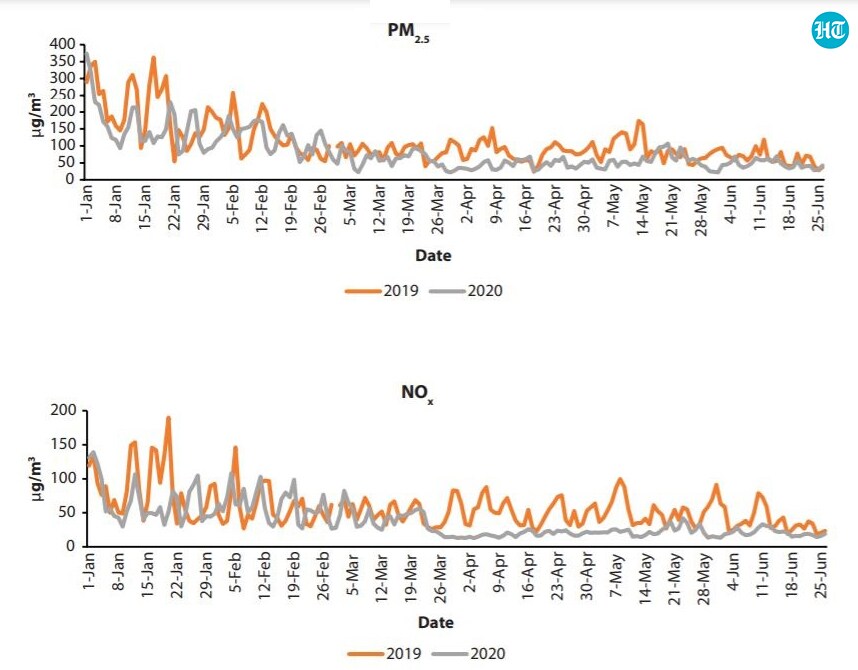
The analysis titled “Assessment of air quality during lockdowns in Delhi” by The Energy and Resources Institute (TERI) released on Tuesday found that in 32 Central Pollution Control Board monitoring stations, there was an average reduction of 43% and 61% in PM2.5 and NOx concentrations respectively in 2020 during the lockdown period compared to the pre-lockdown period in 2019 despite adverse meteorological conditions like reduced wind speeds.
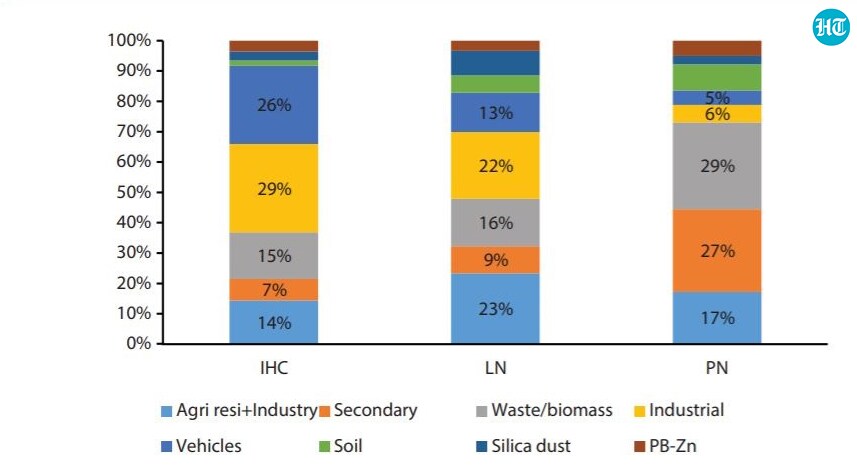
The TERI team also focused on three air quality stations –India Habitat Centre (IHC), Laxmi Nagar, and Patel Nagar from April 22 to June 5 where chemical speciation of pollutants was also conducted to decipher the sources of air pollution during lockdown.
The team found that PM2.5 levels violated the daily national standard of 60 micrograms per cubic metres 31-60% times at the three locations despite reduced emissions during the lockdown.
Also Read | ‘Habitual offender’: Centre, Haryana blame Delhi for polluting Yamuna
IHC at Lodhi road showed 29% contribution to PM 2.5 from coal combustion like industrial activities. While there are no industries nearby, the contributions are expected to be from outside of Delhi city as the monitor was placed at a height of 25-30m which can capture regional sources, the analysis said. Contribution from the transport sector was also high -- 26% -- which may be due to government offices in the area remaining partially open during the lockdown.
Districts upwind of Delhi like Jind, Panipat, Rohtak, Jhajjar, Sonipat etc; influence the air quality of Delhi considerably, the report said.
At Laxmi Nagar and Patel Nagar, both residential areas, contribution from region sources was also seen. At Patel Nagar, there was more influence of long-range secondary particulates (not emitted directly from a source but pollutants which form in the atmosphere due to chemical processes) (29%) and waste and biomass-based sources (27%) were recorded. Laxmi Nagar had significant pollution contribution from regional coal-based industrial activities (22%) and also vehicles (13%). Overall, the average air pollution contribution in the city during the lockdown was from coal combustion (20%); waste and biomass burning (19%); and vehicles still contributed to about 15% of PM 2.5 emissions.
“Industrial activities were also affected during the lockdown, and hence in absolute terms, the emissions and contributions must have decreased from the source. However, in relative terms, this still accounted for a significant share in Delhi’s PM2.5 concentrations. While most Delhi industries have shifted to gas, contributions from outside of NCR seem to be high. Share of biomass, agricultural residue and waste burning were enhanced than typically observed in Delhi, mainly due to restrictions,” the analysis has concluded.
The report underlines that an airshed-based approach needs to be adopted to reduce severe air pollution in Delhi. Despite restriction on the local sources of emissions, contributions from upwind locations kept the pollution levels high.
“Unless we tackle regional sources with equal or more intensity, we will not achieve air quality standards in Delhi. State governments need to come together and contribute,” said Ajay Mathur, Director General, TERI and member of the Commission for Air Quality Management in National Capital Region and Adjoining Area formed last year to tackle air pollution in the region.
Also Read | Plastic pens covered under Plastic Waste Management Rules, says NGT
The analysis was reviewed by scientists at Paul Scherrer Institute, Switzerland, IIT Delhi, and other scientists at TERI.
“During the lockdown, emissions from several local sources reduced significantly but biomass burning continued, power plants were also functioning. There are 11 power plants in 300 km radius of Delhi. We don’t know if any industrial activity was also continuing in the neighbouring districts. The findings once again drive home the fact that we need a strategy for the entire Indo-Gangetic Plains region and that we need a clean fuel transition. Industries need to move to natural gas or electricity,” said Anumita Roy Chowdhury, executive director, Centre for Science and Environment.