
 E-Paper



At India Art Fair 2026, MAP uses technology to ask what it means to be human
MAP brought art and technology under one roof to create an immersive community experience and bring to light the pressing questions around human existence.

 Prefer HTon Google


As newspapers were being prepped to put to bed and reporters were rushing to file their last stories of the day, another narrative was building at the NSIC Exhibition Grounds in Okhla Phase III, New Delhi. On a moonlit 5th February evening, the city wasn’t moving towards a wedding or a festival, yet the streets told a different story. A sea of cars, cabs, bikes, and rickshaws, and packed metro trains ferried people from across regions and age groups, heading towards the India Art Fair.
From February 5 to 8, 2026, the 17th edition of India Art Fair transformed the capital during a smoky winter week, drawing collectors, artists, curators, and visitors from India and around the world. The art on display leaned towards immersive, contemporary expressions; large outdoor installations made from natural and recycled materials; sculptural forms engaging with ecology and memory; and mixed-media works blending textiles, metal, soil, and craft traditions. Inside the halls, galleries presented layered paintings, tactile installations, and design-led objects that moved between art and architecture.
Against this backdrop—glass of white wine in hand, culinary indulgences, and art unfolding in every direction—the evening felt cinematic.
Mapping MAP’s creations
Walking across the maidan in search of art—sometimes on foot, sometimes hopping onto the golf carts ferrying visitors between halls—the Museum of Art & Photography (MAP), Bengaluru, emerged in the Institutional area at Booth O02. Amid the fair’s constant movement and visual abundance, MAP’s space took art and tech to the LiDAR (Light Detection and Ranging) level.
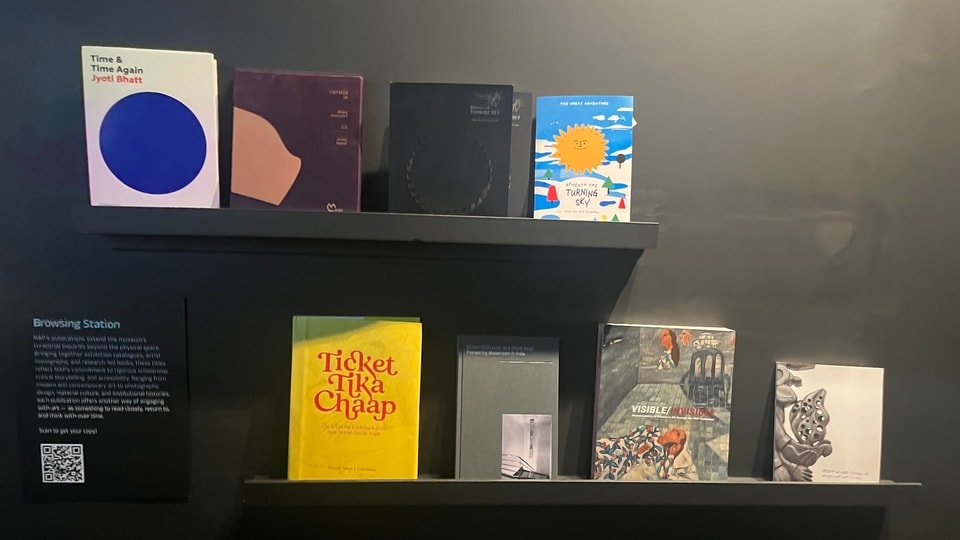
This year, MAP’s booth at India Art Fair is anchored in its second permanent exhibition, Beneath the Turning Sky, on view at the museum from January 17, 2026, to December 3, 2028. The exhibition translated questions such as “Where do we situate ourselves within an ever-unfolding world, and how do our choices shape the earth, our communities, and our own lives?” into contemporary, technology-led modes of communication.
“We were supposed to open at the India Art Fair during the pandemic, but that, of course, couldn’t happen. What it did leave us with, however, was a crucial learning—that people want to connect, not exist in silos or have their artistic expressions boxed in.
Art is deeply relatable; it opens up multiple windows into the worlds around us. We’ve also observed that people under 35 are actively seeking connection while bringing with them high expectations. We see this as a positive challenge, and through this exhibition, we’re glad to create a space where people can come together—physically, with a shared sense of purpose,” said Arnika Ahldag, Director, MAP.
Notable pieces

Within Beneath the Turning Sky, individual works asked questions on how humans have long sought meaning in their relationship with the natural and cosmic world. The sunburst textile Mata Hari carries the “eye of the day,” evoking ancestral belief systems where textiles were not just objects of use but vessels of protection, continuity, and celestial alignment. Jitish Kallat’s Infinitum transforms the cyclical phases of the moon into the form of daily bread, collapsing the distance between the cosmic and the corporeal and reminding us that nourishment, loss, and renewal are governed by rhythms far older than us.
In Benode Behari Mukherjee’s landscape, labour and rest unfold in harmony with seasonal time, revealing the relationship between land, time, and human endurance. Jangarh Singh Shyam’s Barasingha emerges as a forest spirit, drawing from Gond cosmology to show how myth once served as a guide for coexistence, embedding ethics, ecology, and imagination into everyday life. In stark contrast, Ronny Sen’s Jharia presents a lone tree rising from a scarred, industrial terrain, an image of survival in the Anthropocene, where nature adapts and persists even as human activity reshapes the ground beneath it.
30 stories captured in one Hillscape

Mantu Das’s Hillscape anchors the tech core of MAP’s booth, consolidating more than thirty interwoven scenes drawn from everyday life in Assam. The painting captures moments shaped by politics, labour, desire, violence, and care, revealing how individual lives are inseparable from the landscapes they inhabit. Through its layered narrative structure, Hillscape shows us multiple viewpoints and offers constellations of stories that reflect social hierarchies, ecological pressures, and acts of resilience, making visible the complex rhythms of life lived close to the land.
At the booth, Hillscape is reimagined using LiDAR technology, where visitors, by stepping on marked circles on the floor, trigger different stories told in Das’s voice. By combining painting with spatial sensing, the experience allowed Das’s layered storytelling.
“I have been observing Assam since my childhood, and not just through the news, but also from stories that were building around me. More than a multidisciplinary artist, I am a story collector. Painting and tech have given me the platform to express these stories. Although it took me 6 months to complete the painting, excluding the tech part of it, it’s close to my heart, and I want people to live with these stories in an immersive way,” said Das.
Imparting knowledge, receiving gratitude

At India Art Fair 2026, MAP Academy formally unveiled that in March, they will name it IMPART, signalling a renewed commitment to breaking down barriers to engaging with art. Designed to make art history and cultural knowledge less intimidating and more accessible, MAP Academy currently hosts over 2,500 jargon-free articles, more than 7,200 visually animated images, and four free introductory courses aimed at helping first-time learners navigate art without the pressure of knowing where to begin.
The tech-forward vision of ‘Beneath the Turning Sky’ was grounded by a blackboard with chalk for visitors to write their thoughts, questions, and reflections. The board witnessed visitors from various age groups, geographies, and backgrounds, a reminder that connection, at its core, remains profoundly human.


