
 E-Paper



Can Student-Led Startups Help Solve India's Social Challenges? Nasscom Foundation and Ciena Think They Can
TechForChange, a collaboration between Nasscom Foundation and Ciena, fosters youth-led social innovation by providing mentorship, funding, and training.

 Prefer HTon Google


When Nasscom Foundation joined hands with Ciena, the vision was bold: to create a structured ecosystem where college students could not just learn about innovation but lead it—through real-world problem-solving, guided mentorship, and technology-backed solutions aimed at societal good. That vision took shape as TechForChange, a program that has since become one of the most promising launchpads for youth-led social innovation.
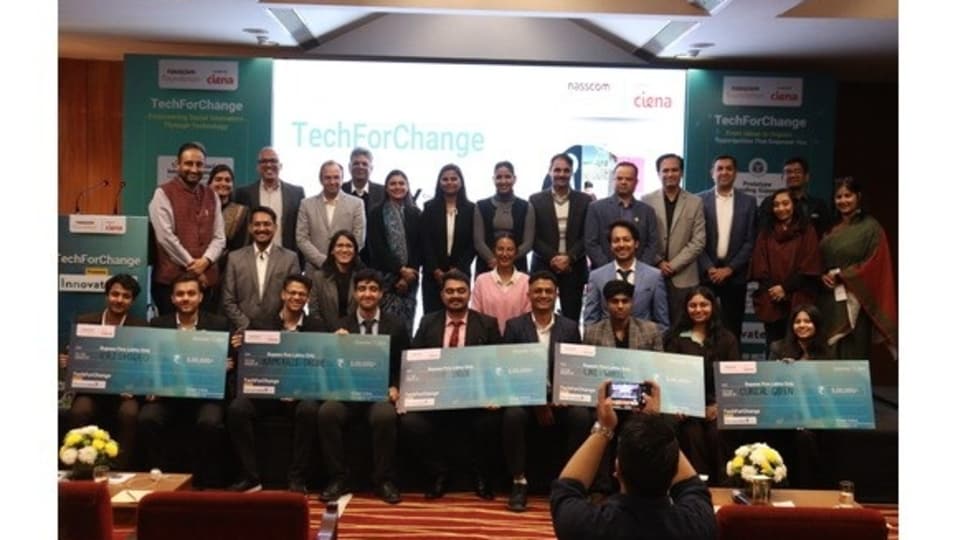
“Social innovation needs to be more than an afterthought—it must be the lens through which our youth approach technology,” says Jyoti Sharma, CEO of Nasscom Foundation. “TechForChange was built to provide them with the structure, support, and space to do just that.”
Spanning 18 months, the program serves as what the Foundation describes as a “geek playground”—a place where experimentation is encouraged, failure is part of the process, and learning leads to lasting change. Through a four-stage model—Ideation, Product Development, Business Model Development and Startup Incubation—students from institutions like IIT Delhi, Jamia Millia Islamia, and DTU build impactful ventures with hands-on training in AI, machine learning, design thinking, and business modeling.
But beyond skill-building, TechForChange addresses one of the biggest gaps in India’s social innovation ecosystem: early-stage support. Each cohort sees the top five teams receive seed funding of ₹5-6 lakh, enabling them to transition from prototype to product.
“We believe in tech with a conscience—technology that serves not just commerce, but community,” says Vineet Vohra, Vice President Software Development at Ciena India. “Programs like TechForChange don’t just support innovation, they support inclusion.”
That inclusion is visible not only in the program’s focus on rural challenges, education, agriculture, and health—but also in its commitment to gender diversity, with 30% women participants in its latest cohort.
Turning Ideas into Impact
Take the story of Shivam Gupta, for instance. Armed with a drone-based idea to support defense and agriculture sectors, he credits TechForChange for helping him navigate product development, investor pitching, and startup registration. Today, his venture House Technologies is not just an idea, but a registered company with seed capital and a growing impact footprint.
Stories like his illustrate the program’s broader mission: to translate academic potential into market-ready social innovation.
At InnovateX, the program’s annual showcase, student teams present their solutions to experts, ecosystem leaders, and policymakers—gaining both visibility and validation. Previous participants have developed AI-driven learning tools for visually impaired students, low-cost robotics for sanitation, and mobile-first healthcare tools for underserved communities.
Filling Critical Gaps in India's Innovation Ecosystem
India’s grassroots innovation story is compelling—but not without gaps.
Over 65% of rural areas still lack reliable internet, with rural penetration at just 35% as of early 2025 (TRAI). Despite PMGDISHA certifying over 47.8 million individuals, only 38% of households have a digitally literate member (NSS 78th Round, 2022). Moreover, early-stage social enterprises often struggle to attract commercial capital, making philanthropic and corporate-backed incubation programs like TechForChange critical to their survival.
By providing a blend of mentorship, funding, and ecosystem access, TechForChange enables student entrepreneurs to overcome hurdles that typically halt progress at the ideation stage.
It also complements India’s national priorities—from Digital India and Startup India to its commitment to the Sustainable Development Goals. With an emphasis on building scalable, tech-led solutions for real-world problems, the program supports the vision of a Viksit Bharat by 2047.
What’s Next? A New Generation of Changemakers
With 16 startups already launched and hundreds of students trained, the ripple effect is just beginning. Alumni are going on to raise additional funding, partner with NGOs, and build solutions that impact communities far beyond their college campuses.
“We’re not just nurturing startups—we’re nurturing responsibility,” says Vineet. “These students are the future architects of equitable, tech-driven development in India.”
As more corporates look to contribute meaningfully to social progress, TechForChange offers a powerful blueprint—a model where technology, mentorship, and purpose converge to shape the next generation of changemakers.
Note to readers: This article is part of HT's paid consumer connect initiative and is independently created by the brand. HT assumes no editorial responsibility for the content, including its accuracy, completeness, or any errors or omissions. Readers are advised to verify all information independently.
Want to get your story featured as above? click here!


