
 E-Paper



From industrial legacy to corporate centre, the rise of Ahmedabad
With lower operating costs and a strong talent pool, Ahmedabad is becoming a preferred location for long-term operations and GCCs.

 Prefer HTon Google


Million Minds Tech City Anchors Ahmedabad’s Corporate Growth
Ahmedabad is no longer waiting for its moment, outgrowing its reputation as a cautious, industry-first city. Over the past few years, the city has undergone a noticeable transformation, evolving from a textile and trading hub into a growth centre supporting conversations around innovation, infrastructure upgrades, policy incentives and the evolving needs of domestic and global occupiers. Gujarat drew over ₹10,245 crore in FDI in the first quarter of FY2026, ranking among the top five FDI destinations in India. More recently, Ahmedabad has emerged as a key GCC hub outside India’s Tier-1 cities, hosting over 35 GCCs and Global In-House Centres (GICs), more than 25 service providers and over 60 startups. Over the years, global players like Infineon Technologies and Technip Energies have entered the non-financial services segment, joining established names such as Google, Oracle, IBM, Capgemini, Infosys, TCS and Wipro. Adding to the city’s investment activity, Lulu Group has announced plans for a $480 million Mall in Ahmedabad, expected to create around 3,000 jobs, indicating demand for quality workplace infrastructure to support the growing corporate ecosystem. Together, these developments position Ahmedabad not just as an emerging alternative, but as a developing business destination in India’s growth story.
Why enterprises are choosing Ahmedabad
Companies are now looking at Ahmedabad not just as a manufacturing base or a back-office location, but as a city where they want to build long-term operations. GCCs, regional headquarters, technology centres, and large-scale IT operations are all being considered.
Ahmedabad offers room to grow, without paying a premium for it. Operating costs run 30–40% lower than metros, without sacrificing the quality of the talent pool. The city’s universities like IIM and Nirma produce a steady pipeline of management and technology graduates that GCCs can hire from.
What makes Gujarat further distinct is the policy architecture built around this. The Gujarat GCC Policy 2025–2030, one of the more structured state-level GCC frameworks in the country offers eligible CAPEX (Capital Expenditure) and OPEX (Operating Expense) incentives covering lease rental, bandwidth, cloud, power, and R&D expenditure among others.
Million Minds Tech City, a commercial development aligned with this growth
As the conversation around setting up businesses and Global Capability Centres (GCCs) is maturing, global companies are not just choosing cities but ecosystems. This is precisely the context in which Million Minds Tech City, developed by Ganesh Housing has gained attention.
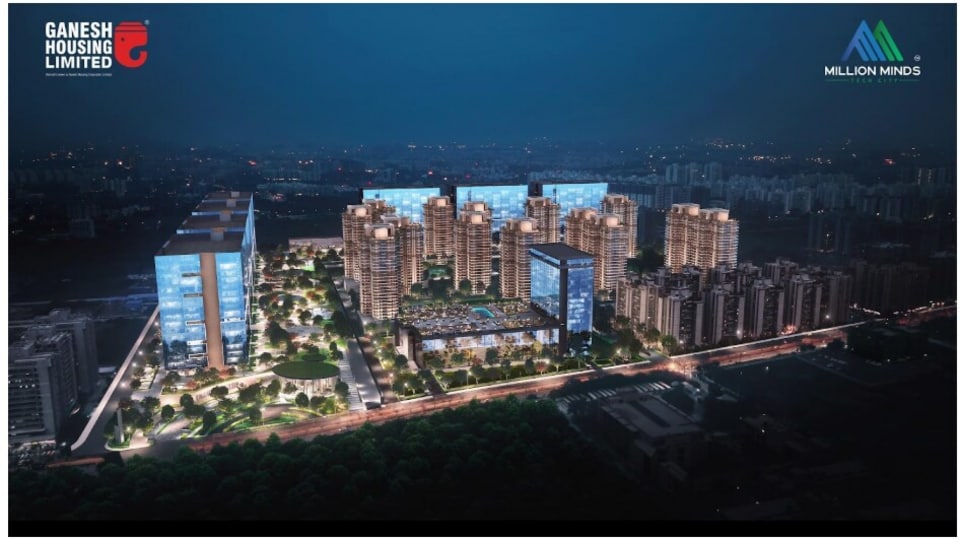
Set across 65 acres at Vaishnodevi Circle, Million Minds is an integrated commercial and lifestyle district built for IT, ITeS, Pharma, Retail and Global Capability Centres. Phase 1 — M One — is operational and ready for fit-outs. It is also Gujarat’s first and only Platinum-rated SEZ IT Park under the IGBC New Building Rating, the highest green building certification in India. For MNCs and GCCs with ESG mandates and global sustainability reporting requirements, this can be relevant.
The project’s scale and technical specifications reflect an understanding of enterprise real estate team requirements: large floor plates with substantial carpet area, 4.2-metre floor heights with column-free rectangular layouts, SEZ enablement aligned with Gujarat’s IT and GCC policy framework, centralised data infrastructure built for high-performance operations, and flexible leasing structures designed around large enterprise needs.
Viewed together, this infrastructure is aligned with global benchmarks, offering an environment designed to support modern enterprises and GCCs scale while addressing the operational demands of the coming years. For global technology firms evaluating western India for their next GCC or regional headquarters, these are key considerations.
A business district, not just a tower
Million Minds Tech City is designed to function as a self-contained district. Within the broader 65-acre master plan — spanning 18+ million sq. ft. of integrated development — the campus includes luxury residences that may be suited for senior executives and international hires, co-living spaces calibrated for a younger workforce, a hotel with business and event facilities, a club with a sports arena and dining, and retail and F&B across the campus.
This has practical implications. Companies relocating leadership talent or hiring from other cities need their people to operate in an environment that works, not just professionally, but day to day. Million Minds addresses that requirement. Vaishnodevi Circle also provides access to Ahmedabad’s arterial road network and the Sardar Vallabhbhai Patel International Airport, which handles connectivity to major Indian metros and international routes.
The window of opportunity
India’s GCC market is projected to reach $110 billion by 2030, with tier-II cities absorbing a growing share of that expansion. Demand for GCC office space in cities like Ahmedabad is growing and is expected to increase further.
For businesses evaluating their next India hub, timing is becoming a consideration. Early movers may secure talent pipelines, efficient cost structures and future-ready infrastructure before competition intensifies. As global companies diversify beyond traditional metros, activity in cities like Ahmedabad is increasing.
The companies that act early may influence the ecosystem, gaining an early mover advantage over the longer term.
Note to the Reader: This article is part of Hindustan Times' promotional consumer connect initiative and is independently created by the brand. Hindustan Times assumes no editorial responsibility for the content.


