
 E-Paper



How to choose the right water purifier for your home (May 2026)
India faces a severe water crisis, with many urban sources contaminated. Reliable water purifiers are vital.

 Prefer HTon Google


The water entering most Indian homes today is far less fit for consumption than most people know. A tap that supplied relatively clean municipal water a few years ago may now draw heavy metals from ageing pipelines, mixed tanker supply or increasingly stressed groundwater sources.
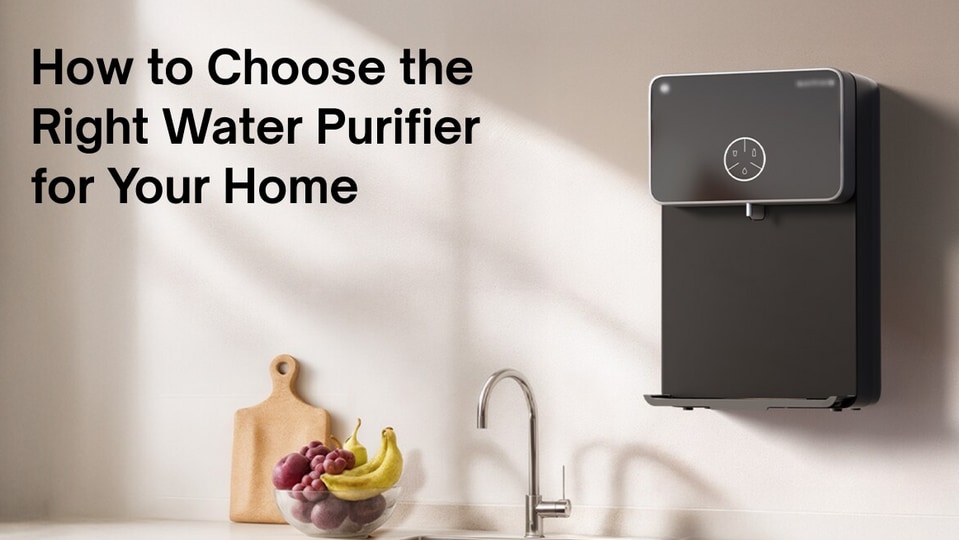
This becomes extremely difficult to ignore once the scale of India’s water problem is considered. India ranks 120 out of 122 countries on the water quality index, while 21 major cities, including Delhi and Bengaluru, are projected to exhaust groundwater reserves by 2030. At the same time, around 70% of surface water (rivers) remains unfit for consumption.
In conditions like these, a reliable water purifier becomes the only line of defence that Indians have control over. But choosing the right one requires looking beyond marketing claims, towards something more practical. This guide compares three of India’s best-selling models on Amazon: the Native M2 Pro by Urban Company, Atomberg Intellon and Aquaguard Ritz Pro across filtration, ownership costs and long-term usability.
Step 1: Know Your Water Source
The single most important factor in choosing a water purifier is understanding where your water comes from.
- Municipal water is treated at source but picks up industrial runoff, pesticide residue, and sediment through ageing pipelines before it reaches the tap.
- Borewell water, drawn from the ground, it frequently carries dissolved salts, hardness minerals, and heavy metals such as iron and arsenic.
- Tanker water is the least predictable. Its source and composition can shift between deliveries, with no standard contamination profile to plan around.
In many urban housing societies, these sources are regularly mixed to manage supply gaps, meaning the water entering your home can change day to day.
Step 2: Understand What RO, UV and UF Actually Do
RO, UV and UF are often presented as interchangeable technologies, but each is designed to address a different category of contamination.
- Ultrafiltration (UF) removes suspended particles and larger microorganisms, but cannot act on dissolved substances.
- UV purification neutralises bacteria and viruses using ultraviolet light, but does not remove physical or chemical impurities.
- Reverse Osmosis (RO) pushes water through a semi-permeable membrane, removing dissolved salts, heavy metals, chemicals, and microbes, contaminants that UV and UF cannot address.
In Indian water quality conditions, 100% RO+UV based systems are generally the safest choice.
Buyers should be cautious of systems that use features such as MTDS or taste adjustment. These mix non-RO treated water back into purified output, functioning as a bypass rather than a filtration stage. This can reintroduce microplastics and heavy metals into your drinking water.
Out of the 3 best selling ROs, Native M2 Pro by Urban Company and Aquaguard Ritz Pro both offer 100% RO purification with proper mineralisation. Atomberg Intellon, on the other hand, offers taste adjustment and adaptive filtration modes, where RO may be partially or completely bypassed in certain low TDS conditions.
Step 3: Don’t Overvalue TDS Numbers
TDS measures the total concentration of dissolved substances in water, but not what those substances are. It is one of the most misunderstood metrics in the water purifier market.
According to the World Health Organization (WHO), TDS includes inorganic salts such as calcium, magnesium, and sodium, along with small amounts of organic matter. It may also contain potentially harmful contaminants like fluoride, nitrates, and heavy metals.
Let’s take the example of the Yamuna River. The river remains heavily polluted throughout the year with high ammonia concentration and is unfit for human consumption.
However, the TDS of Yamuna river still hovers around 200 TDS in some parts. A number well below the Bureau of Indian Standards' acceptable limit. Yet no one would drink it without purification. This goes to show that a TDS number alone cannot distinguish between the two.
Features focused purely on adjusting TDS may improve taste, but do not guarantee safety. Which is why products relying on MTDS, like the Atomberg Intellon rank lower on our safety scale.
Step 4: Think Beyond the Purchase Price
The upfront price of a water purifier is only a small part of the ownership equation. Filter replacement cycles, servicing costs and long-term maintenance often determine what the appliance actually costs over several years.
Filter Life
Most water purifiers require ongoing maintenance, with filter replacement forming the largest recurring expense over time. Brands market filter life claims of up to two years. However, independent real-world testing tells a different story.
Independent researchers of the home appliance category have tested multiple water purifiers to check the veracity of claims made by India’s best selling products. As per the research, all 3 models compared in this article performed well in their filter testing, having filter membrane efficiency of >90% after 24 months.
- The Atomberg Intellon topped the list with 96.53%.
- Native M2 Pro (by Urban Company) stood at 94%.
- Aquaguard Ritz Pro stood at 90.20%.
Given that all products up for comparison offer decent filter life, what is it that separates them? It's their long term cost of ownership and warranty conditions that gives one of them a clear edge.
Cost of Ownership
Owning a water purifier has a lot more facets than what product specifications and brand certifications claim.
This includes:
- The cost and frequency of filter replacements
- Annual maintenance contracts (AMCs)
- Misleading warranty coverage
- The responsiveness of after sales support
These factors make ownership transparency important at the time of purchase. Systems with predictable maintenance, unconditional warranties and dependable support often prove more economical over time, even at a higher upfront cost.
Native M2 Pro by Urban Company offers an unconditional and renewable warranty on the entire product, which sets it apart from the competition. Atomberg Intelllon warranty renews only on replaced parts, while Aquaguard Ritz Pro offers an incomprehensive warranty followed by AMC plans.
Step 5: Consider Your Household Needs
A water purifier is used multiple times throughout the day, often by everyone in the household, including children and elderly family members. As a result, factors such as storage capacity, dispensing convenience and power backup can end up shaping a significant part of the ownership experience. In areas with frequent power cuts, for instance, battery backup and larger storage tanks become far more practical than they appear.
Among the three models here, the Native M2 Pro offers the most convenience-focused setup, combining touch dispensing, a retractable tray, battery backup and an 8L storage tank. The Atomberg Intellon offers smart monitoring and similar storage capacity, though dispensing remains manual and tray support is absent. The Aquaguard Ritz Pro, with a 5L tank and no power backup, is the most constrained of the three for a household of typically more than 2-3 members.
Comparison
# | Model | Price | Purification | Filter Life | Warranty | Cost of Ownership | Ease of Daily Use |
1 | Native M2 Pro (by Urban Company) | ₹18,999 | RO+UV+Copper+Alkaline | 2-year filter life | Comprehensive 2-year renewable warranty | Low | High |
2 | Atomberg Intellon | ₹17,999 | RO+UV+Minerals+Auto TDS adjustment (MTDS) | 2-year filter life | Comprehensive 2-year warranty (renews only on replaced parts) | Medium | High |
3 | Aquaguard Ritz Pro | ₹16,999 | RO+UV+UF+Alkaline+Copper+MTDS | 2-year filter life | Incomprehensive 2-year warranty | High | Low |
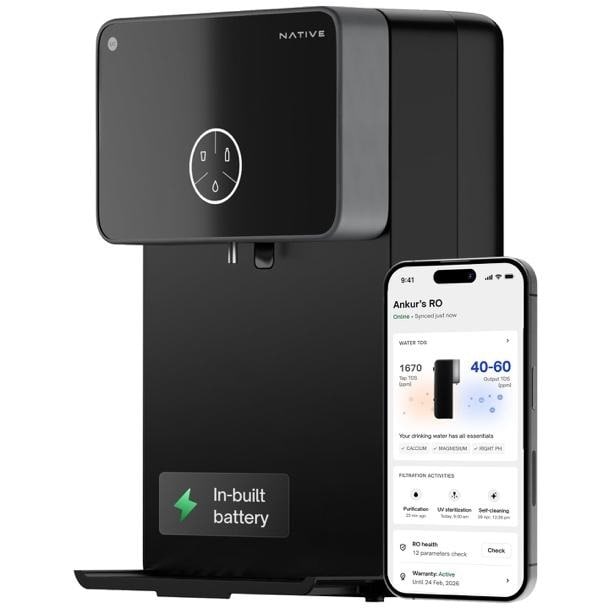
The Native M2 Pro aligns closely with the baseline requirements for unpredictable urban water.
It relies entirely on an RO and UV architecture, avoiding the bypass mechanisms such as MTDS.
The higher upfront cost is offset by an unconditional and renewable warranty covering the entire machine, rather than just individual parts. With a low long-term cost of ownership and high daily usability outlook, it structurally avoids the hidden maintenance traps common in this category.
These factors combined give it the highest ranking amongst the 3, making it most suited for an Indian household.
Atomberg Intellon
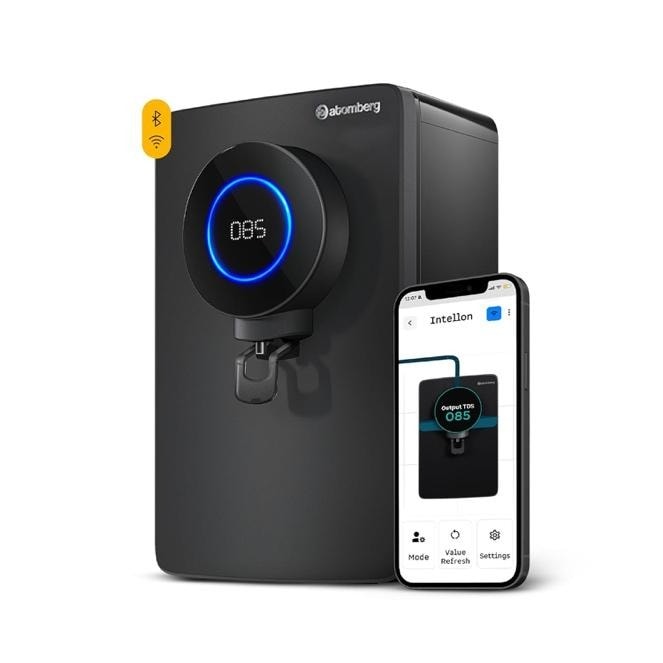
The Intellon offers a capable RO and UV foundation and performs well in daily use. However, it operates on the MTDS mechanism, masking it as Auto-TDS Adjustment which can be harmful for users in the long run if their source water contains heavy metals.
Buyers enjoy a complete two-year warranty but after 2 years the coverage only renews on replaced parts rather than the whole unit. This elevates its long-term cost of ownership, making it an appliance that requires careful consideration before purchase.
Atomberg Intellon scores well on ease of use and reliability, but its purification philosophy may be less suited to households where water quality changes frequently or unpredictably.
Aquaguard Ritz Pro
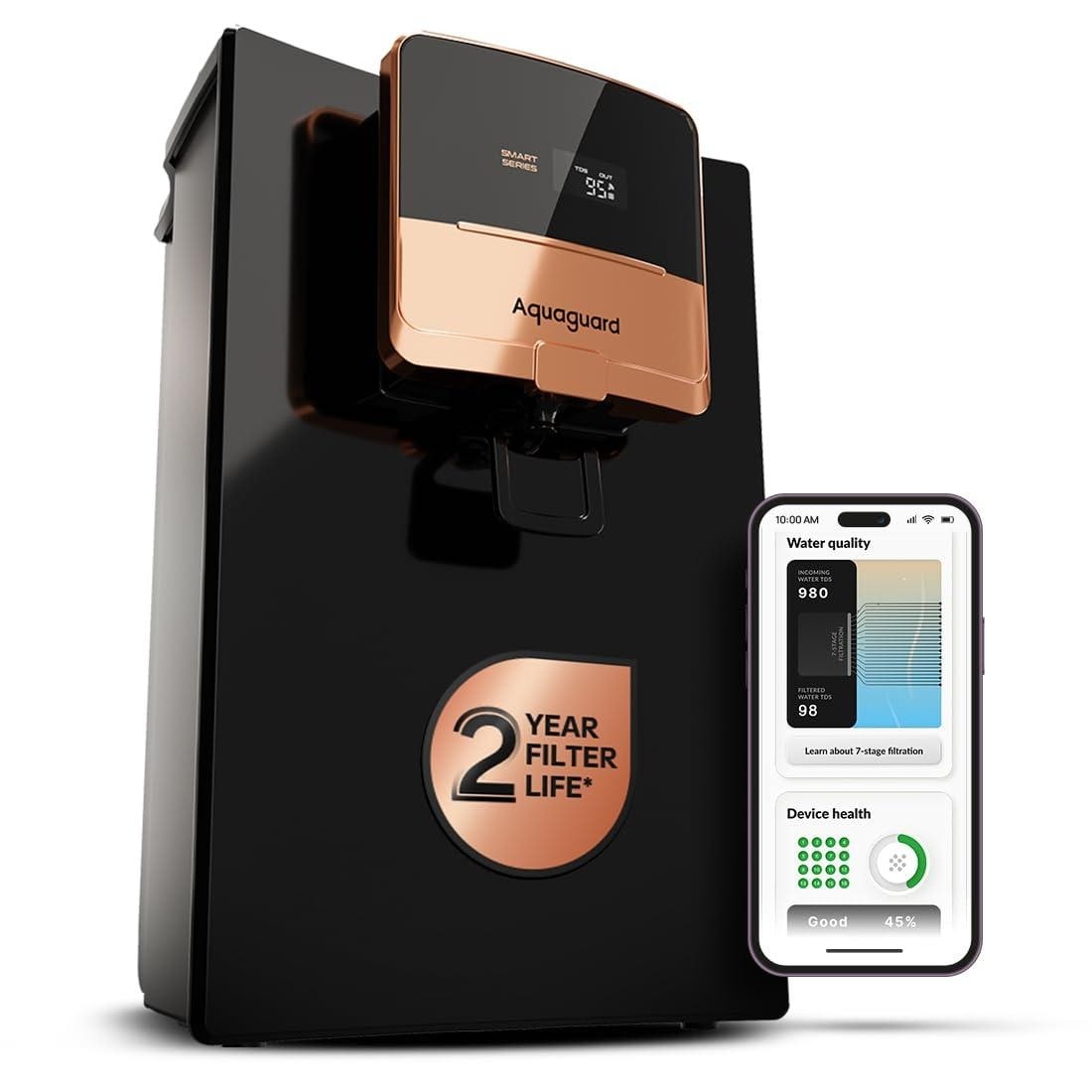
While the Aquaguard Ritz Pro offers 100% RO and mineralisation, it comes with an incomprehensive two-year warranty. The warranty does not renew and users have to opt for AMCs. This is how the financial burden of maintenance shifts onto the user, resulting in high long-term cost of ownership.
Furthermore, low storage and dated design causes this model to rank number 3 on this list.
Final Step: Plan for the Worst, Not the Best
In Indian cities, water quality rarely remains stable. Pipelines age, groundwater shifts, tanker sources vary and seasonal changes affect both quality and availability.
UV and UF systems are not designed to address dissolved salts, heavy metals or chemical contaminants. In stable water conditions, they can perform adequately. But their limitations become visible as soon as the source changes.
RO is built to deal with uncertainty. It removes dissolved salts, heavy metals and a broad range of chemical impurities, making it the only mainstream household technology designed to consistently handle both visible and invisible contaminants across changing water conditions.
Note to readers: This article is part of HT's paid consumer connect initiative and is independently created by the brand. HT assumes no editorial responsibility for the content, including its accuracy, completeness, or any errors or omissions. Readers are advised to verify all information independently.
Want to get your story featured as above? click here!


