
 E-Paper



India Energy Week 2026 Opens with a Hard Look at Growth, Energy and Constraints
At IEW 2026, discussions in Goa moved quickly from ambition to affordability, infrastructure & the realities of scaling energy systems at Indian demand levels.

 Prefer HTon Google


Underway in Goa, India Energy Week 2026 has begun to test its own premise in real time: that the energy transition is not a clean switch from one system to another, but a simultaneous build-out of multiple systems under hard constraints.
Those constraints were named early and repeatedly across the first two days - and they map closely to the conference architecture itself. Day 1, anchored on the Collaboration stage, leaned into geopolitics, supply security and the case for investment at scale. Day 2, across Resilience and Transition, narrowed onto the practical governors: affordability, infrastructure, and the ability of grids and gas networks to absorb change without compromising reliability or access.
Addressing the inaugural ceremony via video conferencing, Prime Minister Narendra Modi framed India's energy moment squarely through the lens of reform and capital mobilisation, positioning the country as both a fast-growing market and a competitive global investment destination.
“Today's India is riding the reform express and is rapidly implementing reforms in every sector. We are undertaking reforms to strengthen domestic hydrocarbons and creating a transparent and investor friendly involvement for global collaborations. India is now moving beyond energy security and working towards the mission of energy independence. India is developing an energy sector ecosystem that can meet India's local demand and with affordable refining and transportation solutions, export to the world will also be highly competitive. Our energy sector is at the heart of our aspirations. It offers investment opportunities worth $500 billion. Therefore, my appeal is: Make in India, Innovate in India, Scale with India, Invest in India.”

Where the Prime Minister's remarks focused on capital and reform, Union Minister for Petroleum and Natural Gas Hardeep Singh Puri addressed the structural logic of how energy systems evolve - and what transition means in practice. “The history of energy has never been about replacement alone. It has been about addition. New sources have consistently complemented existing ones allowing systems to expand and adapt. This remains the defining reality of the global energy transition. In so far as we are concerned, our trillemma continues to be the same: consistent availability, affordability and sustainability.”
The scale at which those systems must now expand was articulated by Sultan Ahmed Al-Jaber, Minister of Industry and Advanced Technology of the United Arab Emirates, Managing Director and Group CEO of ADNOC, and Chairman of Masdar. “Behind the current turbulence is a much bigger picture of transformation at scale. And transformation rewards those who move boldly, not those who wait for calm seas. Because the defining story of energy today is simply growth. growth that is driven by three powerful mega trends. One, the rise of emerging markets led by Asia and in particular India. Two, the exponential growth of AI and the rapid expansion of digital infrastructure. And three, the transformation of energy systems, not a formula based on a single source, but an integration of many.”
Together, these three positions - investment as the enabler, addition as the operating principle, and growth as the underlying driver - shaped the substance of the first two days as the conference moved quickly from articulating the challenge to examining what it will take to deliver at scale.
Day 1: Collaboration Under Pressure
The Collaboration stage on Day 1 translated the opening framing into policy and market conversations shaped by volatility, geopolitics and uneven transition pathways.
That tone was set in the ministerial panel Charting a course through uncertainty: securing affordable, accessible and sustainable energy in a turbulent world, which brought together Union Minister for Petroleum and Natural Gas Hardeep Singh Puri, Canada's Minister of Energy and Natural Resources Tim Hodgson, and International Energy Forum Secretary General Jassim Al Shirawi.
The speakers broadly agreed that energy systems are operating in a period of sustained uncertainty rather than temporary disruption. Speakers emphasised that rising demand from emerging economies, coupled with geopolitical fragmentation and shifting trade dynamics, has brought energy security, affordability and sustainability into sharp alignment - with no single transition pathway applicable across countries.
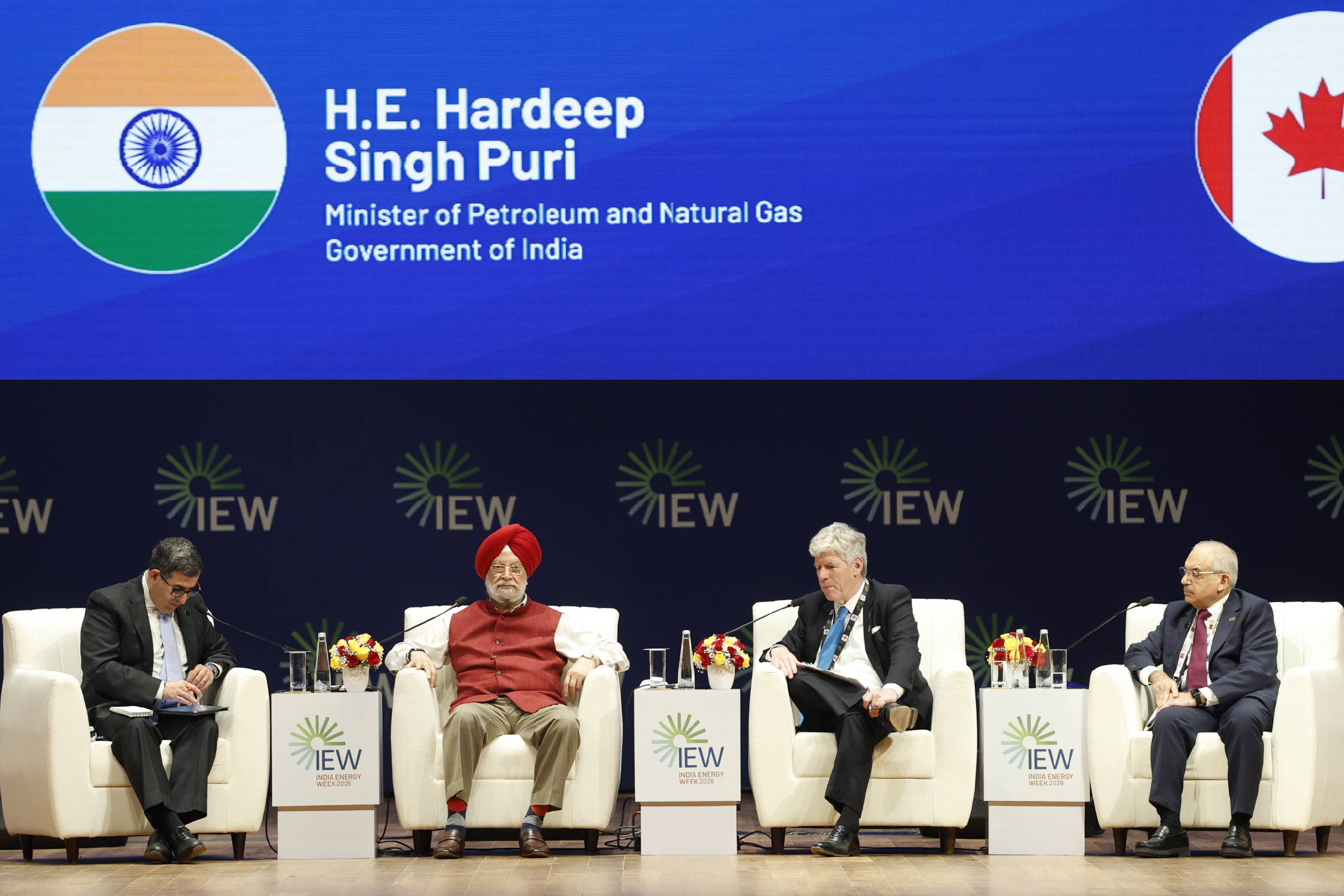
Speaking from India's perspective, Union Minister Hardeep Singh Puri noted that energy availability remains central to economic resilience, noting that India had navigated recent global turbulence without shortages by diversifying supply sources, expanding supplier geographies and advancing reforms across the energy value chain. He reiterated that growth in demand must be met through energy addition rather than abrupt replacement, with predictable markets serving the interests of both producers and consumers.
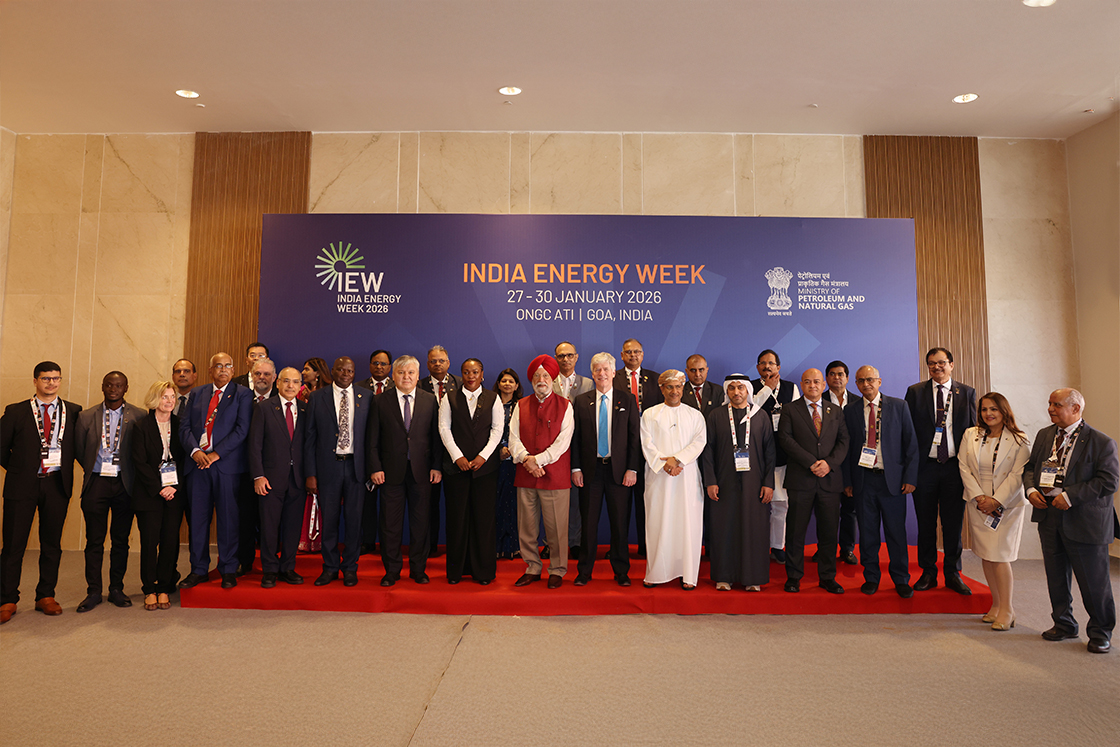
That emphasis on collaboration showed up in the form of concrete bilateral outcomes. On the sidelines of the event, India and Canada signed a joint statement renewing the India-Canada Ministerial Energy Dialogue, signalling intent to deepen cooperation across LNG, LPG and crude oil, alongside cleaner technologies, critical minerals, storage, electricity systems and the application of artificial intelligence in the energy sector. The agreement positioned India as a long-term demand anchor and Canada as a reliable supplier, with reciprocal investment and business-to-business partnerships playing key enablers.
Natural gas stood out as the most immediate test case for this collaborative logic. In the leadership panel Repositioning natural gas and energy transformation: pragmatic bridging resource to pivotal destination fuel, industry leaders examined the role of gas and LNG in strengthening energy resilience while supporting near-term emissions reduction through coal-to-gas switching.
The discussion reflected broad consensus that natural gas is increasingly being seen not only as a transition fuel, but as a long-term component of modern energy systems. For India, panelists pointed to the rapid expansion of pipelines, LNG terminals, regasification capacity and city gas distribution networks, while also flagging affordability as the principal constraint on wider adoption. Policy stability, access to long-term finance and renewed upstream investment were identified as necessary conditions for scaling gas without undermining affordability.
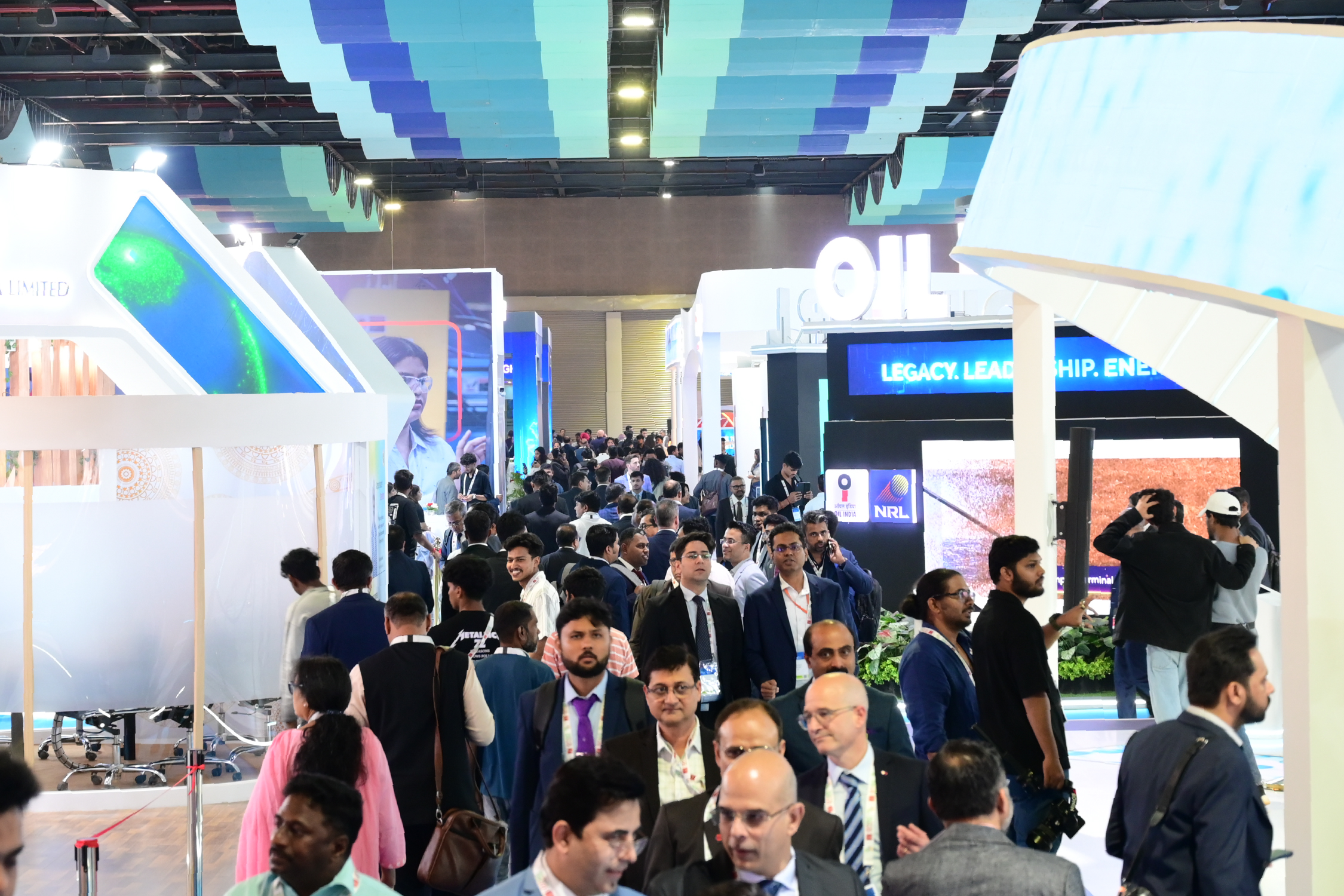
Beyond the conference halls, the exhibition floor reinforced this "addition" approach through tangible demonstrations of parallel pathways. The Hydrogen Zone, inaugurated on Day 1, showcased technologies across hydrogen production, storage and utilisation, with a focus on decarbonising hard-to-abate sectors such as refining, fertilisers, steel and mobility.
Public sector companies used the platform to highlight developments spanning hydrogen-powered drones, biofuel innovations including seaweed-based feedstocks, LNG bunkering, petrochemical integration at LNG terminals, and end-to-end value chain models covering upstream, midstream, downstream and new energy businesses.
Day 2: Resilience, Affordability and System Capacity
Day 2 shifted the focus from collaboration to resilience, with discussions narrowing onto the practical limits that will determine whether energy systems can scale at Indian demand levels.
On the Resilience stage, the leadership panel Managing global LNG supply and demand dynamics placed affordability at the centre of India's gas trajectory. Petronet LNG's managing director and CEO, Akshay Kumar Singh, pointed out that LNG prices in the range of USD 6-7 per MMBtu are critical for expanding adoption across transport, power generation and city gas distribution, and for establishing a stable, long-term demand curve rather than episodic consumption.
That affordability constraint carried directly into the panel on Establishing global models for City Gas Distribution networks. Speakers highlighted that expanding CGD is not simply a matter of adding connections, but of coordinated planning between trunk pipelines and city-level networks, robust safety standards, operational reliability and consumer trust. A recurring theme was the need to move beyond access toward sustained use, positioning affordability and service continuity as integral to network resilience.
Longer-term demand pressures were addressed through the presentation of OPEC's World Oil Outlook 2025 on the Resilience stage. The Outlook projected India as the single largest contributor to global energy demand growth through 2050, with primary energy demand nearly doubling over the period. Oil, gas and renewables were presented as complementary components of a balanced energy mix, reinforcing the case for continued investment across upstream, midstream and downstream infrastructure.
On the Transition stage, attention turned from fuels to electricity systems. The session on The era of the electrostate examined the growing centrality of electricity to India's energy transition, with speakers focusing on electrification, grid expansion and digitalisation as critical enablers of both decarbonisation and energy security. Distribution sector reforms, smart metering and governance improvements were discussed as necessary for strengthening the operational and financial health of power systems as demand rises.
From framing to execution
Across the first two days, India Energy Week 2026 moved quickly from setting the frame to stress-testing it against delivery realities.
The dominant signals were consistent. Demand growth is the baseline, not a scenario. Energy transition is being approached as system expansion rather than substitution. Affordability is becoming the binding constraint across fuels, networks and end-use sectors. And partnerships - between governments, between producers and consumers, and across value chains - are being treated as structural necessities rather than diplomatic gestures.
What has emerged so far is not a contest between fuels or technologies, but a test of system capacity. India Energy Week's early conversations suggest broad alignment on the direction of travel; the harder work lies ahead, in translating that alignment into investment decisions and infrastructure at scale. In a transition defined by growth rather than contraction, execution will matter more than intent.
Note to the Reader: This article has been produced on behalf of the brand by HT Brand Studio and does not have journalistic/editorial involvement of Hindustan Times.


