
 E-Paper



Fake mineral water floods city market
As per industry estimates, almost 50% of the total water supplied in the name of 'mineral' or 'RO-purified' water in Gurgaon happens to be spurious, Leena Dhankhar reports.

 Prefer HTon Google


This story is from archives and was originally published a year ago.
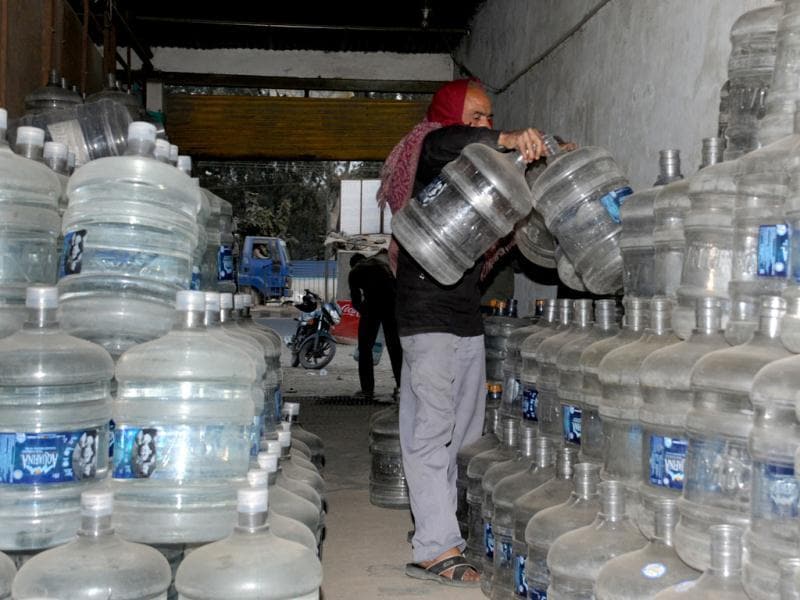
With summer round the corner, it's soon going to be business time for the water mafia that controls the supply and distribution network of bottled water. As per industry estimates, almost 50% of the total water supplied in the name of 'mineral' or 'RO-purified' water in Gurgaon happens to be spurious.
Bottled in highly unhygienic conditions in hutments or one-room establishments, with no water purifier machines, in and around slum dwellings, residents pay Rs 75 for a 20-litre can of tap water.
According to sources, there is a daily demand of 30,000 water jars in Gurgaon and 50% of it is met by unregulated and unauthorised suppliers.
During peak summers, the demand touches 50,000 jars per day and the mafia would continue to rule the roost, said a distributor of a multi-national water company on condition of anonymity.
Gurgaon civil surgeon Dr Praveen Garg said, "We are aware of the issue and have plans to check illegally-run water purifier plants and will soon assign teams to check compliance with ISI norms. A license process will be introduced soon. Registration of units with the health department would become mandatory and ISI certification would be top priority. Strict action will be taken against the guilty."
According to norms, a water plant should be spread over at least 1,500 square yard area and should have facilities like thermal sheet roof, air conditioned microbiology lab, cylinder room, two laboratories to test water, a special room to keep bottles, stainless steel water pipes and a water storage tank.
"People are at risk of respiratory, kidney and digestive health diseases due to consumption of non-treated water being supplied by unauthorised water plants.

There are around 40 illegal plants located in Gurgaon and surrounding areas," said Dr Satish Yadav, an expert who was written the book 'Water - Problem and its Management'.
Gurgaon police commissioner KK Sindhu, meanwhile, promised strict action.
"We will soon conduct raids and anyone found supplying fake water would be punished. We cannot compromise on health issues and water is a necessity.
Anyone dealing in the illegal water business would not be spared. We will check all dealers, distributors, plants and shopkeepers. Samples would be collected in the coming week," he said.
Interestingly, in a city where the illegal water business flourishes, the Gurgaon administration does not have a laboratory to check water purity and the samples collected during raids on January 31 were sent to a government laboratory in Karnal.
"Even after sealing four water bottling plants in Gurgaon at Islampur, Samastpur, Chakarpur and Wazirabad on February 1, work continues from other locations. A day's action cannot stop this business. The police have to find a permanent solution and repeated efforts are needed to keep a check," said a distributor who did not want to be identified for the fear of being targeted by the mafia.
He added, "We cannot supply water in areas where the mafia has a monopoly as they are criminals and can harm us. Our staff avoid going to such areas. The police know this but still turn a blind eye."
Thousands of fake stickers, labels, seals, caps and bottles of Aquafina, Kingfisher and Bisleri filled in sacks were recovered by the police during a raid but the supply continues unabated.
"The mafia is acquiring enormous proportions and this summer, 15 more illegal plants are expected to be set up," said an authorised dealer.
Most people are not even aware that what they are drinking is actually tap water and shell out Rs 75 per 20-litre jar.
The set-ups have no registration or license for selling products of branded companies like Bisleri, Aquafina and Kingfisher. Last January, raids were conducted after officials of Aquafina 'tipped off' the police of fake brands flooding markets.
In the wake of increasing demand for packed drinking water from residents, hundreds of private water manufacturing units have come up in Gurgaon.


