
 E-Paper



Honey Badger pugmarks found in Aravallis during survey
Officials of the Wildlife Institute of India conducting a study of carnivorous species in the Aravallis have found Honey Badger pugmarks in Mohatabad village of Faridabad.


In an interesting discovery, the officials of the Wildlife Institute of India (WII), who are conducting a study of carnivorous species in the Aravallis, have found Honey Badger pugmarks in Mohatabad village of Faridabad.
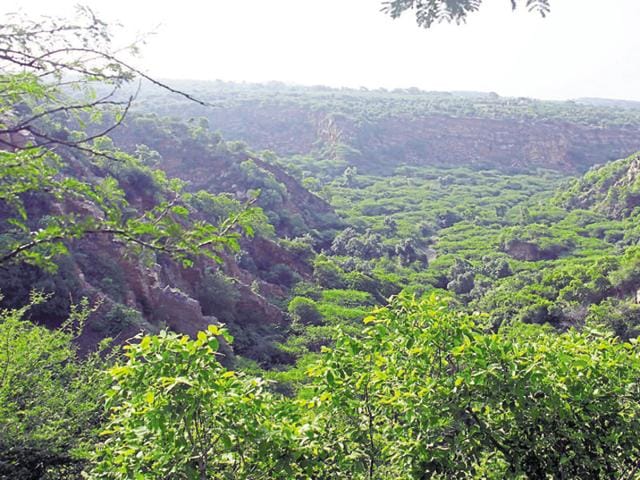
The exercise, which was part of a survey, is being carried out in five districts in the state and the data collected will be analysed by experts to protect wildlife in the region.
The WII team conducting the survey comprises of project biologists Anchal Bhasin and Paridhi. Dr Bilal Habib and Dr Gautam Talukdar are the project investigators. The result of the study will be submitted to the Haryana forest department.
“There was no sign of Honey Badger in any of the previous surveys. Therefore, the finding is an interesting development,” said Anchal Bhasin, biologist who is conduction the study.
Confirming the details of the findings, she said, “We have also found 6-7-km-long-trail of pugmarks of leopards in the region. These signs clearly present a scenario that the area is rich in wildlife and needs to be protected.”
“Leopards are highly sensitive. If they are disturbed, they hide in the core area of the forest.”
Paridhi Jain, the other biologist said that while examining the scat of a number of animals, they found plastics and pieces of cloth in them. “This finding is very disturbing. We have found that wild animals are consuming non-degradable material. This is because of high human presence in the area,” said Jain.
An environmentalist, Sunil Harsana, who is also travelling with the WII team said, “We have found pugmarks of a leopard and a cub. The area is close to Asola-Bhatti Wildlife Sanctuary.”
Earlier in the month, the team covered an area of 30 km around Damdama Lake and Sultanpur Bird Sanctuary in the Gurgaon district. A 2.5 km-long trail of leopard pugmarks was found. The team also found hyena pugmarks and some unidentified pugmarks that could be of the Indian fox, which is rare in this region.
The proposal for the survey was submitted in November 2014 while the survey began last month. The project is being conducted to map the land cover in the Aravallis and to identify carnivore species in the region so their habitat can be protected.

Stay updated with all the Breaking News and Latest News from Mumbai. Click here for comprehensive coverage of top Cities including Bengaluru, Delhi, Hyderabad, and more across India along with Stay informed on the latest happenings in World News.


