
 E-Paper



Covid-19: Gurugram doubling rate highest among 20 worst- affected districts in India
Experts say this shrinkage in rate implied that the containment measures have been inadequate and that increased transmission could result in a surge in cases.

 Prefer HTon Google


After recording a Covid-19 case doubling rate of 36 days in the last week of April, Gurugram now has a rate of a week. This is the highest among the 20 worst affected districts in the country (by case load), according to data from the Union ministry of health, since at least June 7.
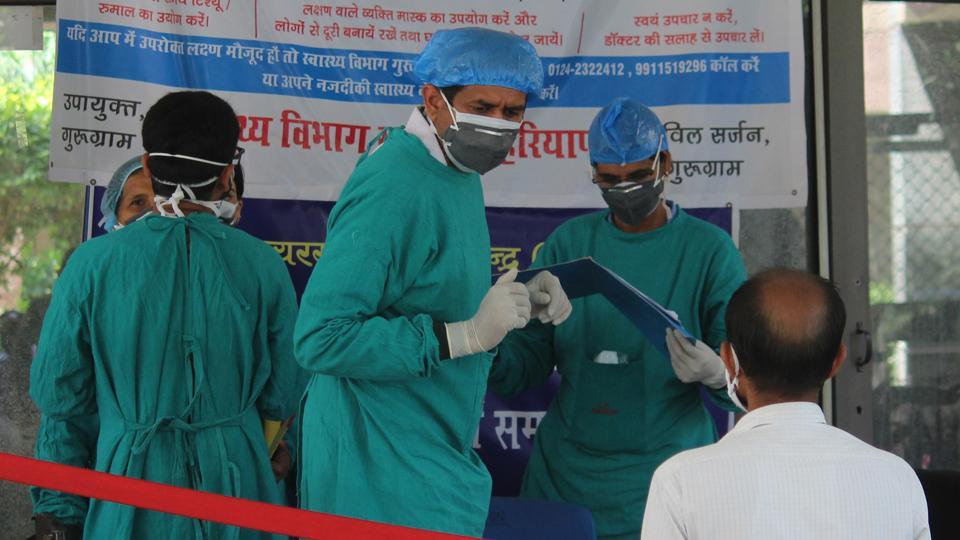
Experts say this shrinkage in rate implied that the containment measures have been inadequate and that increased transmission could result in a surge in cases.
While the position of different districts on the ministry data sheet varies every day, Gurugram had a doubling rate of around seven days throughout May. A faster doubling rate, experts said, indicates continuing transmission of the coronavirus among the population, and a surge in the number of cases.
In comparison, latest data for the three worst affected districts in terms of cases -- Maharashtra’s Mumbai (over 52,500 confirmed cases) and Thane (over 14,700), and Tamil Nadu’s Chennai (over 25,000) --- the doubling rates was 19, 15 and 13 days, respectively. In neighbouring Delhi (34,687 cases), the doubling rate was 12.6 days. The national average is 17 days, while for Haryana it is eight days.
On Thursday, Gurugram recorded a total of 2737 cases, with 191 fresh cases. The city suffered 19 deaths due to the coronavirus disease.
Experts warned that Gurugram’s lower doubling rate points to another surge in cases in coming days.
“India is still in a phase of linear growth, not exponential growth, so the doubling-rate metric is not particularly important at this stage. However, a faster doubling-rate means that cases will definitely rise in the near future, and authorities need to prepare by ramping up testing, contact tracing, and making preparations for hospital beds, oxygen cylinders and ventilators,” said Dr Rajesh Kumar, epidemiologist and former professor at the department of community medicine, PGIMS Chandigarh.
At the current daily growth rate of cases for Gurugram, which stands at 10.8 percent (based on new case data over the past two weeks), the district is likely to see between 25,000 to 30,000 cases by the end of the month, indicating that the district’s doubling rate may shrink further in coming weeks. A senior Integrated Disease Surveillance Programme(IDSP) official in Panchkula, who was not authorised to speak to the media, confirmed that this might indeed be the case.
“Authorities should work in anticipation of this surge. A shrinking doubling-rate may also imply that previous containment and contact tracing measures have been inadequate, if not ineffective,” said Dr Prabhakan Dorairaj, vice president (research and policy) at the Public Health Foundation of India.
Sonal Goel, additional chief executive officer (additional CEO), Gurugram Metropolitan Development Authority(GMDA), and nodal officer for managing hospital beds and ventilators, did not respond to requests for comment on Thursday.
However, a district health official confirmed the availability of 4,000 beds and 350 ventilators across public and private hospitals, and revealed that at least a 1,000 more beds are being arranged. “Even if we do get 30,000 cases by end of the month, we will be able to treat those who need attention,” the IDSP official said.
Experts warned, however, that the doubling rate metric on its own should not be taken as an indicator of the severity of the outbreak. “Each state is working with its own strategy, and dealing with differing population sizes. One cannot say that Gurugram is facing a more severe outbreak than Mumbai just because its doubling rate is faster. But, given the shrinkage in Gurugram’s doubling rate, one can say that transmission of the virus has not been curbed,” said Dr Lalit Kant, an independent public health consultant and former head of the Indian Council of Medical Research’s epidemiology division.
Haryana, meanwhile, had a doubling rate of 8 days, with a daily growth rate of 7.1%, as of the morning of June 11. This is the highest in the country, followed by Karnataka (11 days), Jammu & Kashmir (12 days) and Delhi (13 days). “We have to be more careful about enforcing social distancing, as these states all have a lower daily growth rate than Haryana,” said the senior IDSP official.


