
 E-Paper



India accounts for 6% of world’s new malaria cases: WHO report


India accounts for 6 per cent of the world’s 216 million cases malaria cases and 7 per cent deaths in 2016, estimates the World Health Organisation’s World Malaria Report 2017. Its surveillance is among the worst in the world, with only 8% cases detected and reported.
Six percent of the world’s new cases of malaria and seven percent deaths caused by the mosquito-borne infectious disease were reported from India as 216 million people in 91 countries were infected in 2016, the World Health Organisation said in a report on Wednesday.
India’s share of the estimated number of malaria cases has been 90%, followed by Indonesia (9%) and Myanmar (1%) in the Southeast Asia region, according to the annual World Malaria Report 2017.
It also accounts for highest number of malaria deaths (331) in the southeast Asia region and less only to countries in sub-Saharan Africa.
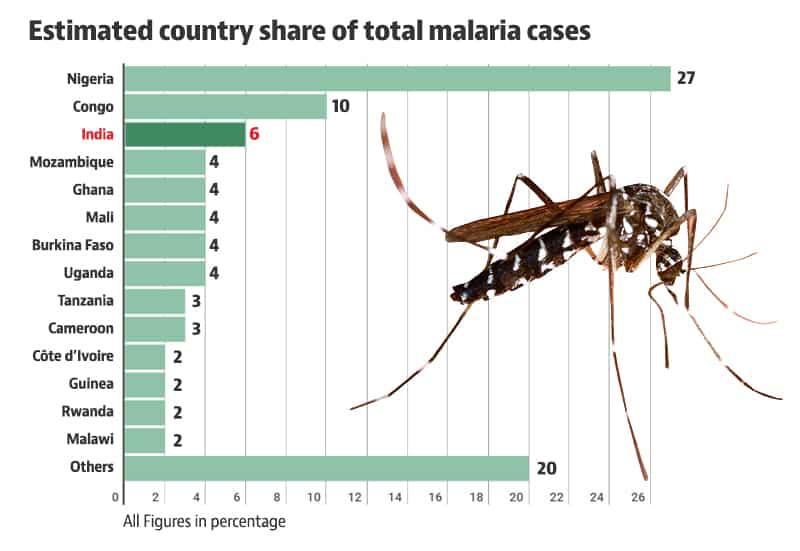
India is one of the 15 countries that carry 80% of the global disease burden, according to the report. Nigeria accounts for the highest (27%) proportion of cases, followed by Democratic Republic of Congo (10%), India (6%) and Mozambique (4%).
The report said, between 2014 and 2016, there was a substantial increase in case incidence in the WHO Region of the Americas, and marginally in the WHO Southeast Asia, Western Pacific and African regions.
“In 2016, 85% of estimated vivax malaria cases occurred in just five countries (Afghanistan, Ethiopia, India, Indonesia and Pakistan),” the report said.
India had the maximum share (51%) of vivax cases, followed by 12% in Pakistan and 10% in Ethiopia.
The report has also criticised India’s surveillance system as weak.
“Countries with weak malaria surveillance systems include India and Nigeria, two major contributors to the global burden of malaria, with 8% and 16% of cases, respectively, detected by the surveillance system,” the report said.
Countries like Brazil and Venezuela have a better case reporting through malaria surveillance system, with 80% and above reporting rate.
Malaria, along with AIDS and tuberculosis, also receives more than half of the global fund to fight them.
To prevent the disease, insecticide-treated nets (ITNs) have been proven very effective and are also lost-cost intervention. Outside sub-Saharan Africa, most deliveries of ITNs were accounted for by eight countries including India (15.5 million); Myanmar (11 million); Indonesia (7.7 million); Pakistan (5.1 million); Cambodia (5 million) and Afghanistan (4.4 million).
Some of the challenges, said the report, that impeded these countries’ abilities to stay on track and advance towards elimination include lack of sustainable and predictable international and domestic funding, risks posed by conflict in malaria endemic zones among many others.
Union health minister JP Nadda, however, seemed optimistic at the progress that India has made in malaria control.
“… India has successfully reduced its new malaria cases by one-third and crossed the malaria mortality targets of 2020,” he tweeted.

Catch your daily dose of Fashion, Taylor Swift, Health, Festivals, Travel, Relationship, Recipe and all the other Latest Lifestyle News on Hindustan Times Website and APPs.


