E-Paper


Barcelona fined €602 over Álvarez: The rules on approaching contracted players across football leagues
Barcelona was fined €602 after Atlético Madrid alleged it approached Álvarez without written notice. What FIFA rules say about football transfers.

 Prefer HTon Google


Spain’s football federation fined Barcelona €602 on Tuesday over the club’s approach for Atlético Madrid striker Julián Álvarez, under rules that require a club to notify a player’s current employer in writing before it negotiates with him.
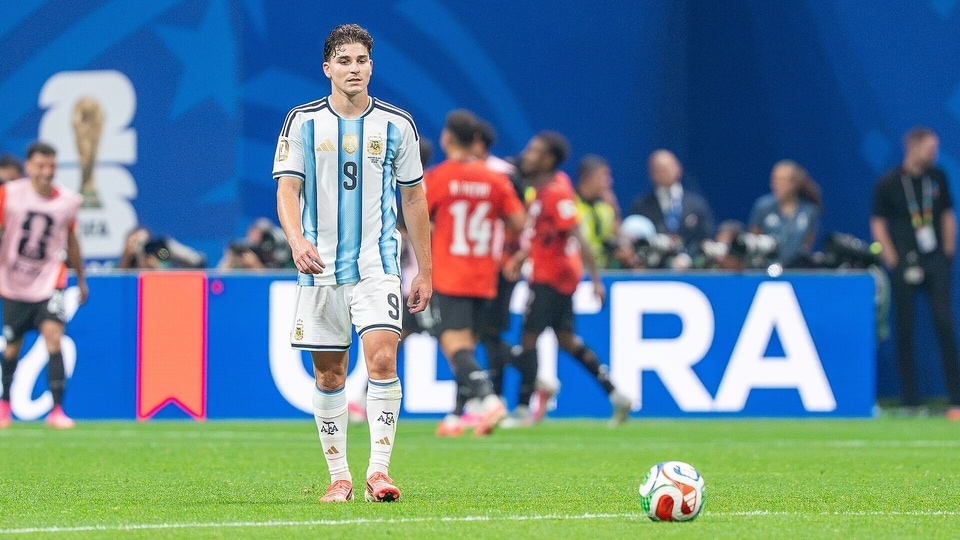
Atlético had accused Barcelona of approaching Álvarez without first telling the club in writing, Reuters reported. The Royal Spanish Football Federation (RFEF) imposed the fine under Article 133 of its disciplinary code. That article covers minor failures to meet regulatory obligations. Álvarez, a 26-year-old Argentine who won the 2022 World Cup with his country, joined Atlético from Manchester City in 2024 on a six-year contract, which runs until June 2030.
According to Spanish newspaper MARCA, Barcelona plans to appeal the fine, maintaining that it followed the required procedures when approaching Álvarez.
How the dispute unfolded
Álvarez said in an interview during this year’s World Cup that he “wanted to fulfil his dream” of playing for Barcelona, which set off a transfer dispute that ran through the summer transfer window, Reuters reported.
Atlético also took its complaint to Fifa, football’s world governing body, which said it had no jurisdiction over the case. Both clubs belong to the Spanish federation, and Fifa’s regulations leave transfers between clubs of the same association to that association’s own rules.
How a transfer works
A footballer under contract is bound to the club until the deal ends, and a club that wants him sooner has to buy the player out of it. A permanent transfer therefore involves two negotiations. First, the two clubs agree a transfer fee, which compensates the selling club for releasing the player early. Second, the player and the buying club agree personal terms, including salary and contract length.
Agents usually act for the player in these talks. Once both deals are done, the player has a medical examination and signs, and the new club registers him with its football association.
Some contracts include a release clause, a fixed sum at which the player can end his contract early. In Spain, a 1985 royal decree governing professional athletes lets a player end his contract before it expires, and the release clause fixes the price of doing so. La Liga said in 2020, over Lionel Messi’s contract, that it would not let a player be deregistered from the federation until the clause was paid. Clubs can also arrange loans, temporary moves after which the player returns, sometimes with an option or an obligation to make the move permanent.
Also read: China’s most successful Astroturf operation: grassroots football
Approaching a contracted player
Fifa’s Regulations on the Status and Transfer of Players spell out the duty. Under Article 18(3), a club that intends to sign a professional footballer must inform the current club in writing before entering negotiations. Any breach must be sanctioned.
Fifa requires every national association to include Article 18 in its own rules without changes. Article 18(3) also lets a player sign for another club only once the contract has expired or is within six months of expiring.
In England, an approach made without the employer’s permission is known as tapping up. In 2005, Chelsea and their then manager, José Mourinho, were found guilty of tapping up the Arsenal defender Ashley Cole under Premier League rules which are stricter than Fifa’s and bar clubs from approaching a contracted player without the club’s permission, BBC Sport reported.
A player’s wish to move does not free a club from giving notice. Penalties depend on how serious a breach is and which body hears it. Minor procedural failures can bring a fine, as Barcelona’s did, while more serious breaches can bring sporting sanctions such as transfer bans or points deductions.
How a player can leave
A player can ask to leave, but the club does not have to agree. Under Fifa’s rules, a contract between a player and a club can end only when it expires or by mutual agreement, unless one side has just cause, a recognised ground such as unpaid wages.
A player whose contract has run out can join another club without the new club paying the old one a fee. Free movement for out-of-contract players within the European Union dates from the 1995 Bosman ruling. In that ruling, the European Court of Justice sided with Jean-Marc Bosman, a Belgian player whose club, RFC Liège, had blocked his move to the French side Dunkerque after his contract ran out, according to Fifpro, the international players’ union. A free transfer still costs the new club wages, often a signing bonus and agent fees, and training compensation can apply in some cases.
Moves within a country and across borders
Fifa writes the global rules, and every national association runs its own rules on registration, transfers and discipline within them. A Spanish club answers to the RFEF, while a Premier League club answers to the Football Association and the Premier League. Associations also decide their own transfer windows, the periods in which clubs can register new players, so windows can open and close on different dates in different countries.
A move between two clubs in the same association, such as from La Liga to Spain’s second division, is a domestic transfer. A move from Barcelona to a Premier League club is international.
In an international move, the clubs must enter the deal in Fifa’s Transfer Matching System (TMS), an online platform for recording and processing transfers. The player’s new association must then obtain an International Transfer Certificate (ITC) from his old association before it can register him. The new club starts that process, and players cannot obtain the certificate themselves, according to Fifpro.
A player released by a club in one country usually cannot be registered by a club abroad once the receiving association’s window has closed, unless an exception applies. International moves can also bring training compensation and solidarity payments, which go to clubs that helped develop the player. Disputes within Fifa’s jurisdiction go to its Football Tribunal.
Also read: Michael Carrick drops Bruno Fernandes after Man United captain's tactical criticism
What happens next
Barcelona can challenge the fine through the federation’s appeals process. The fine has not changed Álvarez’s contract or registration, and he remains an Atlético player.
Any move before 2030 would normally need Atlético’s agreement or payment of his release clause. Atlético cited that clause, of €500 million, when it rejected a €150 million bid from Real Madrid in June, according to Real Madrid, Reuters reported.
The Bureau of the Fifa Council approved revised transfer regulations on June 10, 2026, and they take effect on January 1, 2027. Fifa says the changes cover compensation for breach of contract, sporting sanctions and contracts for minors, as well as players’ share of transfer fees. The changes do not affect Barcelona’s case, which the Spanish federation decided under its own disciplinary code.