
 E-Paper



Gun goes off at Varanasi airport: How a hijacking, a bomb blast and IC-814 prompted India's aviation rulebook
Following the Varanasi airport incident, here’s how India and the US regulate the transportation of legal firearms on flights.


In Die Hard, John McClane steps off a red-eye to Los Angeles with his service Beretta tucked into his waistband. Nobody at the gate blinks. He then goes on, in his vest, to take down a skyscraper full of terrorists.
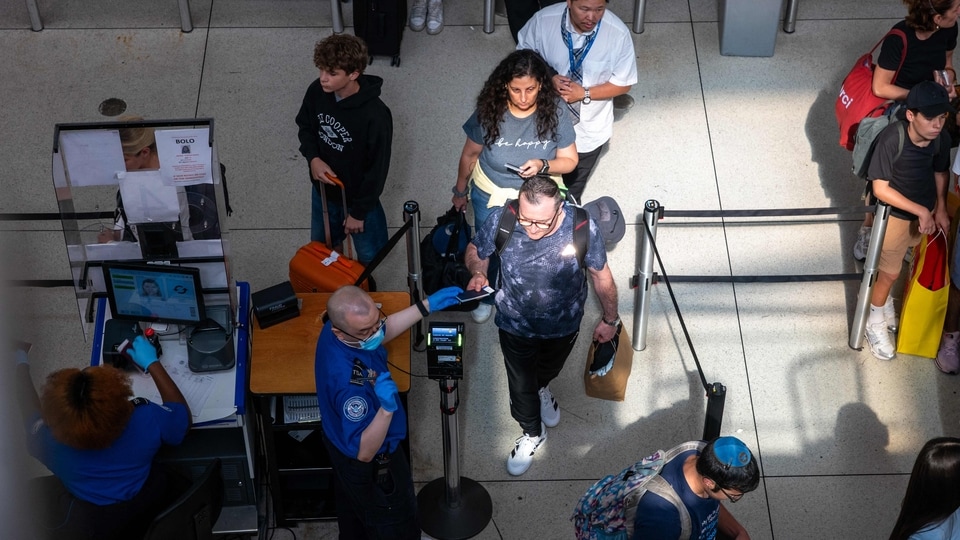
For nearly four decades, viewers have watched all of it without lingering on the airport paperwork. Neither in 1988 nor today would that walk off the jet bridge have been legal, on either side of the Pacific.
The legality of carrying guns on commercial flights is back in the news after a passenger's licensed pistol went off during a mandatory security check at Varanasi's Lal Bahadur Shastri International Airport on Sunday, injuring two screeners when the round ricocheted.
The passenger, Kamlesh Kedarnath Rai of Azamgarh, bound for Mumbai on Air India Express IX 1810, as per norms, declared his 7.62 mm pistol and 21 live cartridges at the check-in counter, and was escorted to the isolated bay where firearms are inspected before they are cleared for the hold. Something went wrong at that step. The Bureau of Civil Aviation Security (BCAS) has opened a formal inquiry into what.
What does the rulebook say as a passenger arrives at an airport with a licensed firearm, and where did these rules came from? Most of them, it appears, were written in the aftermath of a bombing and two hijackings.
Also read: Two more Air India pilots fail to clear drug test after Phuket flight fiasco
The norms
Indian aviation law starts, on this subject, with a sentence written in the last decade of British rule. Rule 8 of the Aircraft Rules 1937 provides that no person shall carry, or cause to be carried, in any aircraft to, from, within or over India, any arms or ammunition "except with the written permission of the Central Government and subject to the terms and conditions of such permission." Sub-rule (2) lays a duty of care on the pilot, the consignor, and every person handling the goods.
The remaining norms – such as the declaration at check-in, the packing, the separation of cartridges from the weapon, the isolated bay at the airport – have been formed in the nine decades since.
Currently, BCAS AVSEC Order 11/2024 dictates the rules on passenger carriage, along with a companion order, 03/2022, which covers weapons carried by personal security officers assigned to VVIPs and VIPs.
The Arms Act 1959 and the Arms Rules 2016 work alongside, governing the licence and the quantum of ammunition. Penalties are described under the Aircraft Act 1934.
In Indian law, carrying a licensed weapon on a commercial flight needs permission that the government grants case by case, on procedural conditions.
Those conditions may come down to seven steps. The passenger is expected to give the airline advance notice, and to declare the weapon and ammunition at check-in along with the original arms licence. The airline then verifies the endorsement against identification and directs the passenger over to a screener, who escorts him — with the weapon and ammunition — to a bay set apart from the general security clearance belt. There, the weapon is rendered safe: chamber open and magazine out. The weapon is then locked into a hard-sided container.
The ammunition, packed separately in original manufacturer boxes or an approved metal or fibre box, cannot exceed 5kg weight under airline-level caps, which are tied to the licence.
Air India permits one licensed revolver, pistol or shotgun and up to fifty cartridges per passenger, at a handling charge of ₹5,000 plus GST on domestic sectors. Both weapon and ammunition then travel in an inaccessible cargo hold. The passenger collects them at destination against a receipt and photo identification.
The screeners running that check at most Airports Authority of India (AAI)-managed airports — Varanasi among them — are employees of AAICLAS, the AAI's cargo-logistics arm. They hold BCAS certifications renewed every two years, and rotate off the X-ray console every twenty minutes under fatigue-mitigation rules. Around them stands the Central Industrial Security Force (CISF), which provides armed presence and access control without touching the physical inspection.
BCAS presides over both, writing the standards and auditing the compliance.
Norms in the US
For all the daylight between Indian and American gun culture on the ground, the two rulebooks in the air look remarkably alike. Under section 1540.111 of the American Code of Federal Regulations (CFR), a firearm cannot be taken into the flight cabin or on a passenger, ever, regardless of state concealed-carry or open-carry laws.
It is permitted in checked baggage only if the passenger declares it to the airline before checking, only if it is unloaded, only if it is packed in a hard-sided container, and only if that container is locked with the passenger alone holding the key or combination. Ammunition is capped by hazmat rule at 11 lb — roughly 5 kg, close to the Indian limit. The criminal statute behind the regulation, 49 USC § 46505, carries a penalty of up to ten years' imprisonment.
But, this rulebook is often flouted.
In 2024, officers of the Transportation Security Administration (TSA) intercepted 6,678 firearms at security checkpoints across 277 American airports. About 94% of them were loaded. Atlanta's Hartsfield-Jackson alone contributed 440.
TSA administrators have publicly linked the steady rise in checkpoint interceptions since 2008 to the spread of permitless-carry laws now on the books in roughly 29 states across the US.
Courts have consistently ruled that Second Amendment protections – which deem carrying guns a fundamental right – stop at the sterile-area rope. Once inside the airport checkpoint, the cabin is a federally regulated space, and whatever right an American may otherwise have to carry a firearm ends the moment they cross the security line.
Passengers caught with an undeclared firearm in the US can face civil penalties of up to $14,950 and lose TSA PreCheck for at least five years.
Where the rules came from
For most of jet age, aviation security in India was thin. That changed on 10 September 1976, when six men hijacked an Indian Airlines flight from Delhi to Mumbai shortly after take-off and diverted it to Lahore. The crisis was resolved after Pakistani intervention, but it produced the Pande Committee, and in January 1978, the government set up the Bureau of Civil Aviation Security (BCAS) as a unit under the Directorate General of Civil Aviation.
BCAS's brief was to coordinate, inspect, monitor and train personnel on security matters, making it the first serious aviation-security bureaucracy the country had.
Nine years later, the bureau got a wider mandate because of a bomb. On June 23, 1985, a device concealed in a checked baggage detonated aboard Air India Flight 182 — the Kanishka — over the Atlantic near the Irish coast, killing all 329 people on board.
The attack was traced to Sikh militants operating out of Canada, and until the 9/11 attacks in the US, it was the deadliest single act of aviation terror in history.
On April 1, 1987, the government reorganised BCAS as an independent department under the Ministry of Civil Aviation, headed by an Indian Police Service (IPS) officer of director general of police rank.
Nearly every protocol a passenger walks through at an Indian airport today — hold-baggage screening, isolated inspection bays, declared-weapon procedure — descends in a straight line from that reorganisation.
The third pivot came at the end of the century. Between December 24 and 31 in 1999, five hijackers took Indian Airlines flight IC-814 from Kathmandu to Kandahar via Amritsar, Lahore and Dubai, ending an eight-day standoff with the release of three jailed militants, including Jaish-e-Mohammed (JeM) founder Masood Azhar.
The response, in early 2000, was the Sky Marshal programme.
Armed, plainclothes officers drawn from the National Security Guard (NSG) began travelling on selected international and sensitive domestic routes, with the cabin and cockpit crew briefed on their presence and no one else. Deployment was reportedly doubled in late 2024 amid a surge of bomb-threat hoaxes on Indian flights. Sky marshals are a narrow exception to the no-weapons-in-the-cabin rule of Indian civil aviation.
The American timeline for their rules can be compressed to a single date. Before September 11, 2001, airport screening in the US was contracted out by the airlines to private firms under loose Federal Aviation Administration (FAA) oversight.
The Aviation and Transportation Security Act, signed weeks after the terror attacks, federalised the workforce and created the TSA.
The Federal Air Marshal Service, until then a small legacy unit, was scaled up into a thousands-strong armed cadre riding US carriers on a threat-driven roster. In 2002, the Arming Pilots Against Terrorism Act created the Federal Flight Deck Officer programme, allowing volunteer pilots, once trained and deputised by TSA, to carry on the flight deck to defend against unauthorised cockpit entry. That programme is the American analogue to India's sky marshals, and the only other route by which a firearm may legally travel in the front half of an American commercial airliner.
The questions after Varanasi incident
The BCAS inquiry into Sunday's discharge will likely focus on questions that the ministry's statement did not answer. The first is whether the pistol Rai handed over at the isolated bay had a chambered round, or a magazine still inserted with rounds in it.
Under the American definition in 49 CFR § 1540.5, either would count as loaded. The expectation on the ground in India is no different: a passenger presenting a weapon for inspection is expected to know that it is empty and to demonstrate that it is.
If Rai walked in with a live round in the pistol, the flaw in following the norms may be placed here.
The second question goes the other way. If Rai had cleared the weapon and handed over an empty pistol, and the round came from a magazine reinserted or a chamber closed during the screener's inspection, the flaw may sit with the training and the protocol — with AAICLAS and, upstream, with BCAS.
The current AVSEC order is not a public text, which means the answer to a basic question — who, precisely, is supposed to lay hands on the weapon at which step — is itself something the inquiry will have to look into.
The third is the wider question: whether the piece of paper Rai handed over at check-in is the front end of a system that works, or the front end of one that only reads as if it does.


