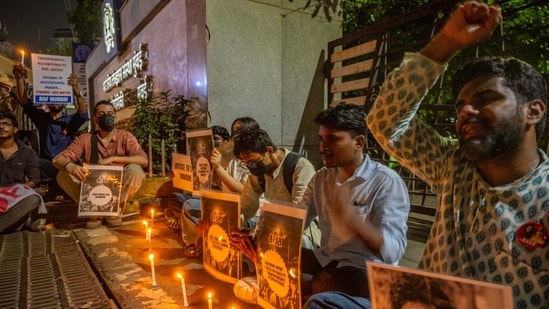
The death by suicide of a second-year BTech student at IIT Bombay last week, followed by three days of protests on the Powai campus, has renewed scrutiny of student suicides across the Indian Institutes of Technology (IITs).
The Union education ministry in July 2023 informed Parliament that 39 students died by suicide in the five years between 2018 and 2023 across IITs. According to an independent assessment, the number of deaths could be higher.
The issue of student well-being is not isolated to IITs but the cases are in the spotlight because these are among the most prestigious and competitive institutes for studying sciences in the country.
A look at what IITs and the Centre have done, what official inquiries have found, and what may still be needed:
Actions taken so far
In a written reply to Parliament on August 10, Union minister of state for education Sukanta Majumdar said the education ministry had drawn up an “Integrated approach for Promoting Positive Mental Health, Resilience, and Wellbeing” under the Malaviya Mission Teacher Training Programme (MMTTP), a national capacity-building scheme for higher education faculty. Under this, fortnightly sessions were being held with faculty members to help them identify and address student mental-health concerns at an early stage, he said.
{{/usCountry}}In a written reply to Parliament on August 10, Union minister of state for education Sukanta Majumdar said the education ministry had drawn up an “Integrated approach for Promoting Positive Mental Health, Resilience, and Wellbeing” under the Malaviya Mission Teacher Training Programme (MMTTP), a national capacity-building scheme for higher education faculty. Under this, fortnightly sessions were being held with faculty members to help them identify and address student mental-health concerns at an early stage, he said.
{{/usCountry}}Majumdar also cited the annual National Wellbeing Conclaves — at IIT Hyderabad in 2024 and IIT Bombay in 2025 — along with a regional mental-health workshop at IIT Madras in July this year, and counselling and wellness centres set up across IIT campuses. Similarly, workshops on mental wellness and stress management have been held at IIT Madras, IIT Delhi, IIT Guwahati, IIT Gandhinagar and IIT Roorkee.
Some institutes have gone beyond counselling to make physical changes to hostels, aimed at restricting access to common means of suicide. IIT Kanpur, in March this year, removed embedded clothes-drying pipes from hostel rooms and begun fitting spring-loaded devices in ceiling fans. The mechanism is designed to sound an alarm and lower the fan if excessive weight is applied.
IIT Bombay said on Sunday (September 20) it was considering replacing ceiling fans in hostel rooms with wall-mounted units, though officials said the decision predated the recent death and was part of routine maintenance.
Also read: Who is Suryanarayana Doolla? IIT Bombay professor in focus in student suicide case
Findings of Supreme Court task force
The interim report of the Supreme Court-appointed National Task Force (NTF) on student mental health, released this June, flagged gaps in institutional preparedness. Faculty members across IITs felt “ill-equipped” to address mental-health issues, and “90% lacked adequate training to support students facing such concerns”, the panel said.
The top court constituted the NTF in March 2025 after taking note of a “disturbing pattern” of student suicides across higher educational institutions. The move came while the court was hearing a case concerning the deaths of two IIT Delhi students from Scheduled Caste communities in 2023, whose families had alleged caste-based harassment and sought registration of FIRs. The court had said the recurring suicides pointed to the “inadequacy and ineffectiveness” of the existing legal and institutional framework in addressing students’ mental-health concerns and preventing suicides.
According to the panel’s report, responses from 31 centrally funded institutions, including 23 IITs, showed that although 18 institutes had at least one mental-health service provider, only four reported formal training for faculty mentorship programmes and only 10 reported formal training for peer-support initiatives.
The panel noted that the term “counsellor” was used inconsistently across institutes, making it hard to assess how many trained mental-health professionals were actually available.
Faculty members who spoke to the NTF described a “relentless culture of academic competition” at the IITs, where success was defined narrowly by grades, ranks and placement packages. Counsellors, the panel found, often became aware of distressed students “too late” because of the absence of proactive screening and integrated reporting systems involving faculty and hostel staff.
Social inclusion
The NTF drew attention to social inclusion on campuses.
Citing figures placed before Parliament in 2023, it noted that of 3,542 students who dropped out of seven IITs between 2018 and 2023, nearly 60% belonged to reserved categories — 2,066 Other Backward Class (OBC), 1,068 Scheduled Caste (SC) and 408 Scheduled Tribe (ST) students.
Caste-based discrimination on campuses remained “rampant”, the report said, pointing to a mismatch between student and faculty representation. Around 60% of IIT students come from SC, ST and OBC communities, but faculty representation was 6.6% for SCs, 2.1% for STs and 21.3% for OBCs, it noted.
Dr Aqsa Shaikh – professor at Hamdard Institute of Medical Sciences and Research, Delhi, and an NTF member – told HT institutes needed to involve students in designing wellbeing interventions. “I think it is important that when policies are made for the students, it is not just conveyed to them, but they are also at the table where these policies are framed. It is important to see students as not just beneficiaries of the interventions but as co-architects of any framework that looks at their wellbeing,” she said.
“Academics at IITs can be extremely demanding, and there is constant pressure around grades, internships and placements. Many students feel faculty members are not always approachable and that concerns raised by students are not taken seriously. While institutes talk about mental wellbeing, the support often feels inadequate when students are going through difficult periods. The opportunities are excellent, but so is the pressure, and many students feel more needs to be done to support mental health," a second year BTech student at an IIT told HT.
Also read: Suryanarayana Doolla, IIT Bombay professor, suspended from deanship amid student suicide probe
Inquiries under way
IIT Delhi last month constituted a committee headed by retired Delhi high court judge Justice Mukta Gupta to examine the death by suicide of a 31-year-old MSc student on August 22. The committee, which is to submitted a report by September-end, has been tasked with looking at the circumstances leading to the death and any institutional lapses that may have contributed to it.
After a PhD student died by suicide at IIT Kanpur earlier this year, the Union education ministry on January 22 set up a three-member panel to review the implementation of mental-health guidelines, examine the adequacy of counselling and grievance-redressal systems, identify institutional gaps and recommend measures to prevent suicides.
A member of the panel said on Sunday the committee had submitted its report, but the ministry was yet to make the findings public.
At IIT Bombay
IIT Bombay on Monday suspended a professor named in an FIR over the student’s death and apologised for its initial statement that said the youngster was caught cheating using ChatGPT during an examination just hours earlier.
“We apologise for the statements contained in our earlier communication concerning the circumstances” surrounding the student’s death, the institute said.
“The details and circumstances leading up to the incident remain subject to investigation by the appropriate authorities. In view of the ongoing investigation, it was inappropriate to have set out or characterised details relating to the events preceding his demise before they had been duly established through the appropriate investigative process,” it added.
The statement came as IIT Bombay’s Powai campus remained on edge amidst student protests over the youngster’s death.
The student’s father has named a dean of student affairs – the professor now suspended pending inquiry – alleging abetment of suicide on grounds of caste discrimination. The FIR was registered an FIR on charges of abetment of suicide under the Bharatiya Nyaya Sanhita (BNS) and provisions of the Scheduled Castes and Scheduled Tribes (Prevention of Atrocities) Act.
Discussing suicides can be triggering for some. However, suicides are preventable. If you need support or know someone who does, please reach out to your nearest mental health specialist.
Helplines: Aasra: 022 2754 6669; Sneha India Foundation: +914424640050 and Sanjivini: 011-24311918, Roshni Foundation (Secundrabad) Contact Nos: 040-66202001, 040-66202000; ONE LIFE: Contact No: 78930 78930, SEVA: Contact No: 09441778290