E-Paper



India protests Pakistan warship collision: From 3-nautical-mile rule to advance notice, what the 1991 pact says
MEA says the Pakistani ship breached Article 10 of the 1991 agreement, which also sets 15 to 90 days’ notice for major military exercises

 Prefer HTon Google


India on Wednesday summoned Pakistan’s seniormost diplomat in New Delhi and lodged a strong protest after the country’s warship collided with an Indian frontline warship in the Arabian Sea.
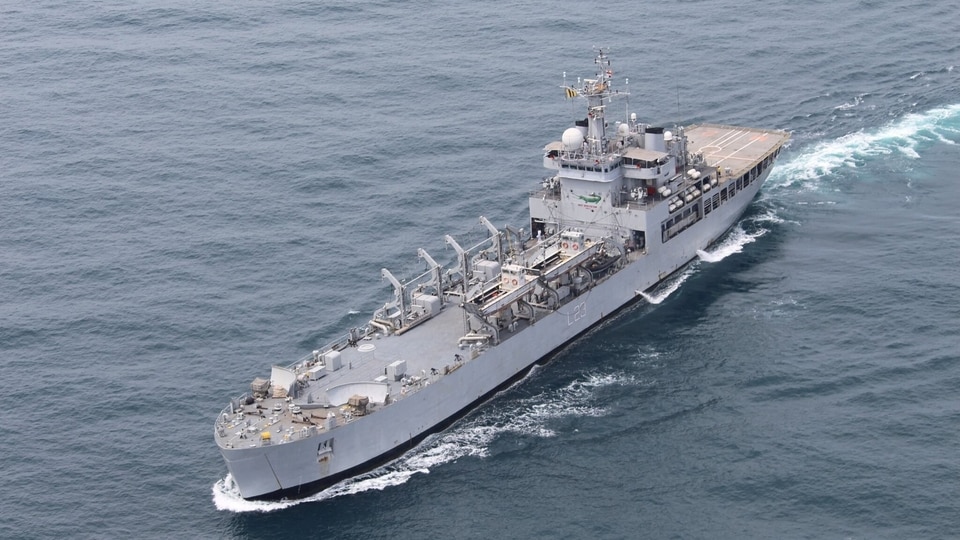
The Ministry of External Affairs (MEA) summoned Saad Warraich, the charge d'affaires of the Pakistan high commission, over “unacceptable and unprofessional conduct of Pakistani naval units at sea that led to a collision with a unit of the Indian Navy”.
On Tuesday evening, a Pakistan Navy vessel closed in at high speed on the Indian warship, which was on a routine surveillance mission in the north Arabian Sea, officials aware of the matter told HT. The Pakistani vessel manoeuvred in an unprofessional and unsafe manner, which led to the collision, they said.
The MEA said the incident, which took place in international waters, did not cause “any major damage”, but that the Pakistani ship's conduct was in "direct contravention" of Article 10 of the 1991 India-Pakistan Agreement on Advance Notice on Military Exercises, Manoeuvres and Troop Movements. The article bars ships and submarines of the two navies from coming within three nautical miles of each other in international waters.
The ministry advised Warraich to convey to the Pakistani authorities the need for all military units to observe due care and respect the relevant agreements between the two sides, to prevent any repeat of such incidents. India’s charge d'affaires in Islamabad was also told to lodge a similar protest with Pakistan's foreign ministry.
Also Read | Pakistan Navy vessel collides with Indian warship, New Delhi lodges strong protest: 'Unprofessional'
The 1991 agreement
India and Pakistan signed the agreement in New Delhi on April 6, 1991, when Chandra Shekhar was prime minister. The bilateral confidence-building measure came into force on August 19, 1992 after ratification, and India registered it with the United Nations in December 1994.
Under the pact, each country must give the other prior notice of major military exercises and troop movements near the border. Each must also ensure such exercises are neither directed at nor built up against the other side, to avoid misunderstandings that could spark a crisis.
“...India and Pakistan recognise the need to jointly formulate an agreement at the Government level on giving advance notice on exercises, manoeuvres and troop movements in order to prevent any crisis situation arising due to misreading of the other side's intentions,” the agreement says.
“Their Land, Naval and Air Forces will avoid holding major military manoeuvres and exercises in close proximity to each other. However if such exercises are held within distances as prescribed in this Agreement, the strategic direction of the main force being exercised will not be towards the other side, nor will any logistics build up be carried out close to it,” it adds.
Both sides must also share the schedules of major military exercises in writing, through diplomatic channels, well in advance.
What does Article 10 say?
Article 10 governs naval safety in international waters. “The Naval ships and submarines belonging to the other country are not to close less than three Nautical Miles (NMs) from each other so as to avoid any accident while operating in international waters,” it states.
Most of the agreement’s provisions deal with advance notice of exercises and troop movements. Article 10 is a technical safety measure, meant to prevent unintended collisions or close encounters between the two navies.
Also Read | Pakistan, Indian Navy ships come head-on in international waters: What we know
Keeping combat aircraft apart
The treaty bars combat aircraft from flying within 10 km of the other country’s airspace, including its Air Defence Identification Zone (ADIZ). The ban covers fighters, bombers, reconnaissance aircraft, jet military trainers and armed helicopters.
Aircraft flying from the Jammu, Pathankot, Amritsar and Suratgarh air bases in India, and the Pasrur, Lahore, Vehari and Rahimyar Khan bases in Pakistan, are exempt from the 10 km limit but must stay at least 5 km from the other side’s airspace.
"Unarmed transport and logistics aircraft including unarmed helicopters and Air Observation Post (AOP) aircraft will be permitted to operate upto 1,000 metres from each other’s airspace including the ADIZ (Air Defence Identification Zone). Aircraft of either country will refrain from buzzing surface units and platforms of the other country in international waters,” it says.
Also Read | 'Gimmicks, phoney announcement': India on Pakistan's move to raise bounty on Jaish chief Masood Azhar
How much notice is required
The treaty sets notice periods for each service:
-Land: 30 days for divisional-level exercises, under Article 5; 60 days for corps-level exercises; and 90 days for army-level exercises.
-Sea: 30 days, also under Article 5, for major naval exercises in which six or more destroyer- or frigate-sized ships, or larger vessels, operate together and cross into the other side's Exclusive Economic Zone.
-Air: 15 days for exercises at Regional Command level or above.
What must be shared
The country holding the exercise must give the other side:
-The exercise's type and level
-Its general area on land, in the air and at sea
-Its planned duration
-The number and type of formations taking part
-Any planned shifting of forces from other commands, corps or strategic formations
-The movement of strategic formations, particularly armoured divisions, mechanised divisions, air assault divisions/reserve infantry formations and artillery divisions/air defence artillery divisions
Also Read | Cash-strapped Pakistan’s jet, missile display exposes reliance on China, Turkey as India boosts defences
If plans change
If the area or grouping of an exercise changes, the country concerned must send fresh details at least 30 days in advance for corps-level exercises and above, and 15 days in advance for divisional-level and naval exercises. Minor changes to previously notified air exercises require seven days' notice.
Any induction of additional troops of division size must be notified at least two days before the troops begin moving. “In case of immediate movements, information may be passed on Hot Line to the Army Headquarters of the other country. The force so employed will not move forward their logistic bases/installations and armour/artillery,” the agreement says.
Each country is also “entitled to obtain timely clarification from the country undertaking military manoeuvres/exercises concerning the assembly of formations, the extent, direction of the exercise and the duration”.
(With inputs from Rahul Singh in New Delhi)