
 E-Paper



Padma railroad bridge: A crucial connectivity link
The article has been authored by Rezaul H Laskar, Hindustan Times. The writer was part of a group of Indian journalists that visited Bangladesh at the invitation of the Bangladesh government.

 Prefer HTon Google


Standing on the deck of a boat bobbing on the choppy waters of the Padma river, engineer Ahamed Ahasan Ullah Majumder says once all the links with the massive $3.8-billion bridge behind him are completed, the train journey between Kolkata and Dhaka will be shortened by two hours.
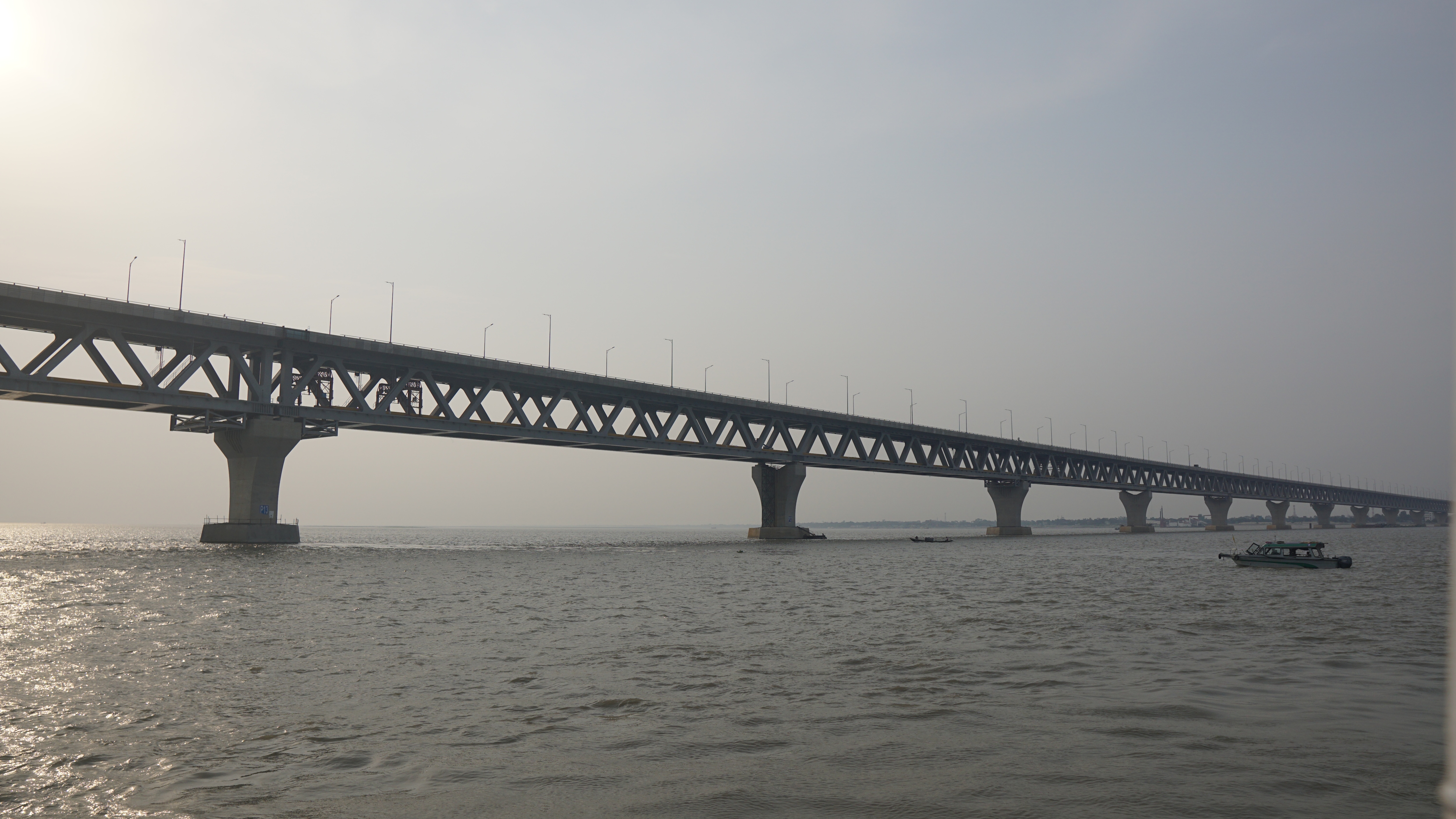
The Padma road-rail bridge, with a length of 6.15 km and 41 spans, was built over almost eight years with the Bangladesh government’s own funds after the World Bank pulled out of the project over allegations of corruption. The bridge is at once an engineering marvel and a symbol of the economic transformation of Bangladesh under the leadership of Prime Minister Sheikh Hasina.
Majumder, who serves as an assistant engineer for the Padma Multipurpose Bridge Project at Mawa, is understandably proud of the work done to bridge the mighty Padma river, a project conceived almost immediately after the creation of Bangladesh in 1971.
“The bridge has 294 piles or pillars of different lengths that were erected on the river bed to support the spans. One of the piles holds a world record with a length of 122 metres,” he said.
As Hasina prepares to inaugurate the “bridge of national pride” on June 25, nearly 10 years after the World Bank walked away from the project, the Bangladesh government has said it will invite the World Bank president and other opponents of the project, such as opposition Bangladesh National Party leaders Khaleda Zia and Nobel laureate Muhammad Yunus.
Some in Bangladesh even say the large rally to be held on June 25 for the opening of the bridge will mark the start of Hasina’s campaign for the 2023 general election, with the prime minister eyeing a record fifth term on the back of the numerous development initiatives and unprecedented economic growth under her government.
The prefeasibility study for the bridge was done in 1998-99 during Hasina’s first term as premier, and work on the project, such as its design, was launched soon after she returned for her second term in 2008, while the construction by China’s state-run China Major Bridge Engineering Co Ltd began in 2014.
Amid efforts by some quarters in Bangladesh to portray the bridge as a part of China’s Belt and Road Initiative (BRI), the foreign ministry in Dhaka recently clarified the project was entirely funded by the government with no foreign funds from bilateral or multilateral funding agencies. The foreign ministry issued a statement on the matter soon after a group named the Bangladesh-China Silk Road Forum announced plans to hold a discussion on the theme “The Padma bridge: An example of Bangladesh-China cooperation under Belt and Road Initiative”.
Hasina too has sought to silence critics of the project this week, saying Bangladesh got its dignity back by constructing the country’s longest bridge with its own funds after the World Bank’s withdrawal.
“I thank [the World Bank], because we constructed the Padma bridge with our own funds with courage after that incident took place,” she said.
The bridge will provide a shorter route between 19 southwestern districts and the northern and eastern parts of Bangladesh, and Indian officials too have welcomed the project, saying it is expected to benefit West Bengal and the northeastern states of India in terms of both connectivity and trade.
“The connectivity with Kolkata will be much better and India will benefit from this project,” said one official, speaking on condition of anonymity.
According to foreign diplomats, the Bangladesh government has been canny in not putting all its eggs in one basket when it comes to seeking foreign funding and awarding contracts for major energy and infrastructure projects. The 1,320-MW coal-fired Rampal power station in Khulna, Bangladesh’s largest power plant, is being built by joint venture between India’s National Thermal Power Corporation (NTPC) and the Bangladesh Power Development Board (BPDB), while the Japan International Cooperation Agency is funding both the Dhaka Metro and the third terminal of the Dhaka airport.
An Indian private firm is also part of the construction of Bangladesh first 2.4 GWe nuclear power plant at Rooppur, a nearly $13-billion dollar project being implemented by Russia’s state-run atomic energy agency.
And while a Chinese state-run firm is building a 3.3-km tunnel under the Karnaphuli river to improve connectivity to the port city of Chattogram under a $1.1- billion project with substantial funding from the Exim Bank of China, Bangladesh has decided against going ahead with a high-speed railway project linking Dhaka and Chattogram despite considerable pressure from Beijing. The thinking, according to people familiar with the matter, is there was no need for such a project when the journey between the two cities on normal trains is not too long.
However, foreign diplomats cautioned that Bangladesh will face challenges when its overall debt servicing increases by about 2025, and this could be exacerbated by a tax-to-Gross Domestic Product ratio of about 8%, one of the lowest in South Asia. Bangladesh is also heavily dependent on the ready-made garments sector, which accounts for 80% of exports, at a time when remittances from expatriate workers are tailing off.
While India cannot match the open chequebook approach of the Chinese government, Bangladesh accounts for almost 28% of the total foreign development assistance provided by India, including $7.8 billion under government-to-government arrangements and $1.8 billion in loans.
Indian and Bangladeshi often describe the current relationship between the two sides as a “shonali odhyay” or golden chapter, but it is greater connectivity and trade between Bangladesh and India’s Northeastern states – as symbolised by projects such as the Padma Bridge and Dhaka’s decision to allow Assam and Tripura to use the Chattogram port – that could fuel the next chapter of economic ties.
The article has been authored by Rezaul H Laskar, Hindustan Times. The writer was part of a group of Indian journalists that visited Bangladesh at the invitation of the Bangladesh government.


