
 E-Paper



Saudi Arabia and the US look to reshape the region
This article is authored by Col Rajeev Agarwal (Retired), senior research consultant, CRF.

 Prefer HTon Google


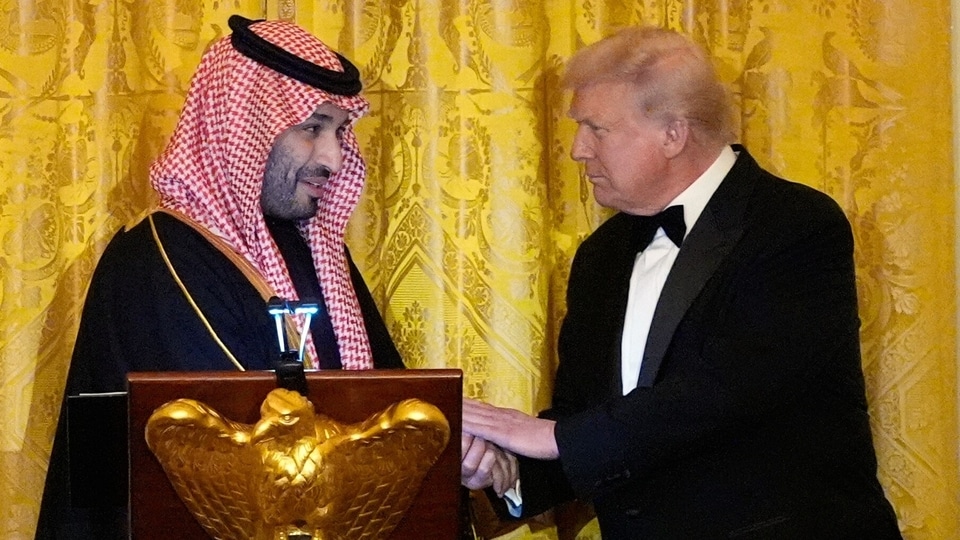
A day after the UN Security Council (UNSC) passed a US-backed resolution for deploying an International Stabilisation Force (ISF) in Gaza, Saudi Crown Prince Mohammed bin Salman (MbS) was in Washington on an official visit on November 18, 2025. The visit, which had been building up for some time, was premised on critical issues, both bilateral as well as key regional. For Saudi Arabia, a successful ceasefire in Gaza and security guarantees, primarily against any future threat from Israel were the key demands. The US, on the other hand was looking at billions of dollars in investment from Saudi Arabia besides trying to normalise relations between Saudi Arabia and Israel through an expansion of the Abraham Accords.
Peace in Gaza, although fragile, has been holding since the day the ceasefire came into force on October 10, 2025 after both Israel and Hamas agreed to implement the US sponsored ‘20 Point Trump Peace Plan’ announced on September 29, 2025. In the first 45 days of the ceasefire, many of the ‘low hanging fruit’ have been harvested which include pulling back of Israeli forces to a designated ‘Yellow Line’ in Gaza and cessation of Israeli air and artillery strikes as also ground operations. The 20 living hostages have safely returned to Israel while the bodies of the 28 dead hostages are being slowly returned to Israel, by Hamas. Plus, critical aid has started trickling into Gaza, although not in the numbers as envisaged in the 20 Point Peace Plan, as Israel continues to control and restrict entry of any aid into Gaza.
The subsequent progress of the peace plan hinges on three vital components. The first is the establishment and positioning of the International Stabilisation Force (ISF), second is the disarming of Hamas and demilitarisation of Gaza and thirdly, the governance of Gaza, by a technocratic, apolitical Palestinian committee, with oversight and supervision by an international transitional body, the "Board of Peace," to be headed and chaired by President Donald Trump. With the UNSC clearing the way for the deployment of ISF, it was almost the perfect time for the MbS visit to Washington.
Trump and MbS share a relationship which goes back many years. It was in March 2017 that MbS, then a Deputy Crown Prince, became the first Saudi Royal to visit the White House under Trump 1.0. Cognisant of the fact that MbS controlled the strings of economy in Saudi Arabia and had launched ‘Saudi Vision 2030’ earlier in April 2016, Trump administration was quick to assess the importance and future role of MbS in Saudi Arabia, discussing vital matters of economy, regional security and investments with the Deputy Crown Prince. Once MbS was elevated to the post of Crown Prince in June 2017, he visited the US again in March 2018, as a part of his first overseas as the Crown Prince. Trump too, on his part has chosen to undertake his first overseas visit in both terms to Riyadh, in May 2017 and again in May 2025.
Coming in the backdrop of developments in the region and their past chemistry, the current visit was high on expectations as well as optics. MbS was given a royal welcome in Washington, almost akin to a State visit, laden with fanfare and red carpet. A military band display and a US flypast with F-16s and F-35 added to the effect. Business meetings with global CEOs and a high-profile dinner capped off what is being termed as an extremely successful visit.
Among the deals and agreements, perhaps the one that caught the most headlines was US decision to sell the F-35, Fifth Generation Stealth fighter aircrafts to Saudi Arabia ‘in the same configuration as are being sold to Israel’ which was unprecedented given the restrictions on selling any weapon platform in the region which dilutes the ‘Qualitative Military Edge (QME)’ for Israel. A similar deal for sale of F-35 (with some dilutions in specifications due to QME requirements of Israel) was earlier announced for the UAE in Trump’s first term too, a deal which is yet to see the light of the day. Whether this deal finally delivers beyond the optics is a big question, especially after Israel’s prime minister (PM) Netanyahu declared a day later that US secretary of state, Marco Rubio, has assured him that Israel’s QME will not be diluted.
A Strategic Defense Agreement (SDA) was also signed during the visit. Saudi Arabia was also designated as a ‘Major non-NATO Ally’ by the US during the visit, giving both nations wider access to military cooperation, exchange of troops, joint military exercises and even supply of critical weapon platforms. Saudi Arabia joined the other 19 nations previously given this designation which include Egypt, Israel, Bahrain, Jordan, Kuwait and Qatar from the region besides countries like Pakistan. However, what was not in the deal was ‘iron clad’ security guarantees.
Both nations also signed an important deal on cooperation in the civilian nuclear energy sector. The Joint Declaration on the Completion of Negotiations on Civil Nuclear Cooperation is being seen as an important development as it could lead to the US helping set up a civil nuclear energy programme in Saudi Arabia and is also a step towards a possible ‘123 Agreement’ between the two which could facilitate transfer of US civilian nuclear technology, equipment, and materials to Saudi Arabia, which however requires a US Congressional approval Despite the deal, Saudi Arabia will not obtain uranium enrichment technology for its nuclear programme for which it will remain dependent on the US.
An agreement was also signed in the field of critical minerals, deepening collaboration to diversify critical mineral supply chains and safeguard America’s supply chain resilience for essential minerals, reducing dependence on Russia and even China in the future. Under the deal, MP Materials of US and Saudi Arabian Mining Company (Maaden) will build a refinery in Saudi Arabia that will process light and heavy rare earth minerals.
A landmark MoU was signed on Artificial Intelligence (AI) which promises to give Saudi Arabia access to world-leading American systems. The US companies, in turn, would benefit from billions of dollars of investment from Saudi Arabia. Under the deal, Saudi AI firm HUMAIN gained access to the most advanced Nvidia chips, a key requirement for the success of Vision 2030 in Saudi Arabia.
On the investments front, Saudi Arabia announced an investment of US $1 trillion into vital sectors of the US like infrastructure, technology, and industry, raising it from the $600 billion initially secured during the President’s May visit earlier this year. This opens up huge opportunities for American businesses, exporters, and workers by expanding market access and reducing trade barriers, facilitating Saudi investments into America.
The deals however missed out on many key issues that both nations were looking for. For Saudi Arabia, the defence deal fell short as it does not include iron clad security guarantees like the ones that have been offered to Qatar after Israel’s missile strike into Qatar in September this year. This means that the most important issue, national security, still remains unresolved for Saudi Arabia despite a promised delivery of the F-35 aircrafts which may take years if not decades to fructify.
The regional security dynamics evolving from the Gaza war and the possible normalisation between Saudi Arabia and Israel was yet another missing piece during the visit. On the possibility of joining the Abraham Accords, MbS was categorical when he said that “We want to be part of the Abraham Accords, but we also want to be sure that [we] secure a clear path [toward a] two-State solution (for Palestine)”. With Israel’s PM Netanyahu clearly ruling out any possibility of it a day later and limited leverage that the US may have on this issue over Israel, the possibility of Saudi Arabia joining the Abraham Accords soon, looks grim.
This visit, in addition to the deals and ‘missed deals’, was also significant in context of the evolving security landscape in the region. The fragile ceasefire in the Gaza strip is holding but the chances of it translating it into a lasting peace look slim. The widely reported plan of US and Israel to permanently divide Gaza into two territories and Israel’s refusal to hand over Rafah crossing on Egypt border back to Egypt, threatens long term prospects of peace. There have also been occasional reports of violation of ceasefire and retaliatory strikes by Israel into Gaza Strip which has led to more than hundred deaths since October 10 this year. Despite the UNSC resolution on ISF, there is no clarity yet on who will provide the troops and how will the ISF operate.
Iran is another factor in the evolving security dynamics that cannot be ignored. After the demolition of Hezbollah and Hamas, overthrow of Assad government in Syria in December 2024 and the 12 Day War with Israel in June, Iran is in a major rebuilding phase. Major defence pacts as well as procurement of modern weapon platforms, mainly with Russia and China, are in the works. Simultaneously, its quiet support towards rebuilding the capabilities of Hamas and Hezbollah too is being worked out. For Israel, this poses a future security threat and therefore the possibility of another Israel-Iran conflict in near future is a definite possibility.
However, the rivalry and animosity between Iran and Saudi Arabia seems to have been dialled down, especially after the peace deal signed in March 2023 and the support extended to Iran by the region, in its war against Israel over the past two years. However, caution, suspicion and deterrence still precede terms like peace and friendship in most Gulf countries, against Iran. The US on the other hand, looks quite content having severely damaged and downgraded Iran’s nuclear programme during the June conflict. And therefore, during the visit of MbS, unlike previous occasions, there was less of ‘Iran’ in the talks and declarations, indicating a major shift in the understanding of the threat and the evolving regional security landscape.
The visit of MbS to Washington happened at a critical inflection point in the region and was significant in terms of the optics generated and the deals signed. However, most deals signal nature of intent with undefined timelines and most fell short of the expected outcomes. The F-35 and the SDA may look good on paper but without an Article 5 of NATO like security guarantee, Saudi Arabia will always be unsure of US assurances on security. Similarly, the agreement on civil nuclear programme and AI can only fructify after many other processes in the US. On peace and security in the region, the lack of clarity on ISF in Gaza and no assurances on a two State solution meant that prospects of lasting peace in the region look slim and that the US will have to wait longer for Trump’s pet project, the Abraham Accords, to be extended to a key country in the region like Saudi Arabia.
This article is authored by Col Rajeev Agarwal (Retired), senior research consultant, CRF.


