
 E-Paper



Understanding enablers and barriers to social protection of sanitation workers
This article is authored by Anju Dwivedi and others from CPR.

 Prefer HTon Google


There has been a strong focus on improving the sanitation situation in the last decade in India due to the Government of India (GOI)’s flagship program called Swachh Bharat Mission. In the last decade, the country witnessed an increase in the number of toilets, sewer treatment plants and faecal sludge treatment plants. The demand for sanitation services has highlighted the issue of sanitation workers too. Sanitation workers are vital to the provision of safe sanitation for all the residents in the city. However, hazardous work conditions and low social status, coupled with discrimination, long working hours, and lack of social protection, accentuate their vulnerabilities.
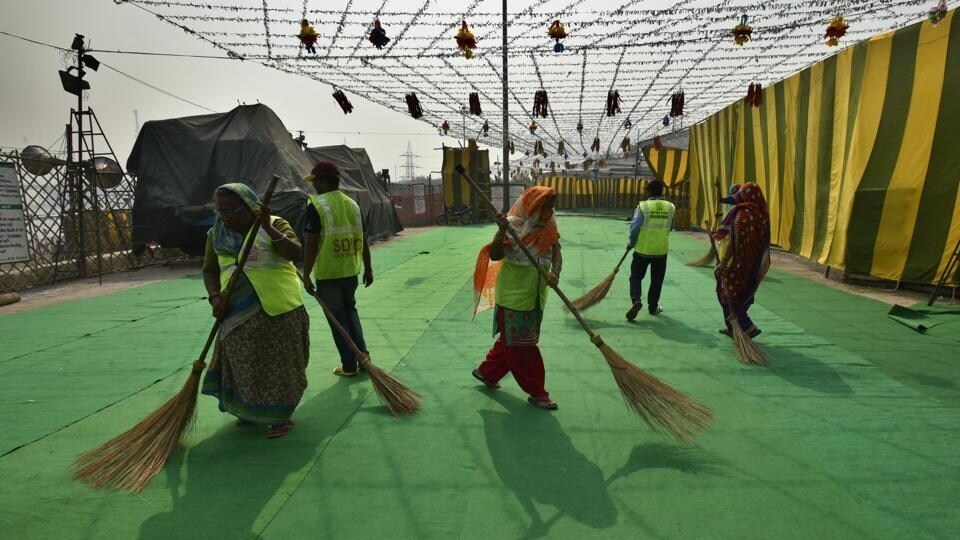
Recognising the high level of social and economic vulnerability and discrimination faced by sanitation workers, GoI and several state governments have initiated many programmes and schemes, including social protection measures for sanitation workers. The main objective of the research is to identify the enablers and barriers to availing social protection benefits (in the form of health care, insurance, pensions, and allowances) for sanitation workers. The study examines the social protection coverage of formal and informal sanitation workers in Dhenkanal, Odisha. Semi-structured interviews with Sanitation workers employed with ULB, private contractors and Area Level Federation were conducted to understand the challenges faced by Sanitation workers in accessing social protection. In addition, key informant interviews were also carried out with leaders from employee unions of sanitation workers, ULB officials, and other stakeholders, including private contractors.
The study recognises enablers such as a favourable policy environment, capacity enhancement, collaboration with other stakeholders, and barriers like low awareness, inadequate capacities, and lack of institutional convergence mechanisms to improve socioeconomic well-being and promote sanitation workers’ safety, dignity, and social protection. This study highlights the disparity in working conditions and employment benefits received by regular and contractual sanitation workers, the need for creating a formal grievance redressal mechanism and undertaking measures to build the capacity of sanitation workers. The report presents key recommendations emerging from the study, such as greater involvement of employee unions, convergence with other departments providing welfare benefits to sanitation workers, improving grievance redressal mechanisms, and creating more awareness and information dissemination to sanitation workers on different social protection measures.
The paper can be accessed by clicking here.
This article is authored by Anju Dwivedi and others from CPR.


