As HT Wknd celebrates 300 editions, we’re bringing you the best of the best, all in one place. Scroll through special editions on life in the pandemic, and life five years after; hear climate scientists talk about how terrified - and hopeful - they are; revisit our interviews with Herbie Hancock, Patrick Stewart, Samantha Harvey. Get nostalgic about Raj Kapoor, Guru Dutt, and Asterix. There’s more too - sci-fi and climate solutions, nurses who should have won that award, and our gently toxic history with cats. Dive in.
Special editions
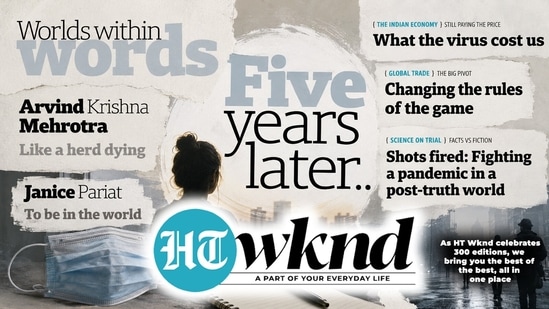
1) Worlds within words: Ruskin Bond, Arvind Krishna Mehrotra, Ira Mukhoty and Janice Pariat write for Wknd, on life in the pandemic; December 27, 2020
A Christmas miracle turns out to be a hopeful dream; a poet considers mortality; a writer muses on what it means to be veiled, and seeking ways to be heard; another seeks miracles in the garden. In a very special edition, the world came to our readers, through works of fiction crafted for Wknd, by some of India’s most remarkable contemporary voices.
Wknd exclusive: Meet a visitor from Finland in a pandemic-era tale by Ruskin Bond
Like a Herd Dying: An exclusive pandemic-era tale by Arvind Krishna Mehrotra
{{/usCountry}}Like a Herd Dying: An exclusive pandemic-era tale by Arvind Krishna Mehrotra
{{/usCountry}}Wknd exclusive: Ira Mukhoty writes of purdahs and the pandemic
Wknd exclusive: A pandemic-era tale of worlds within worlds by Janice Pariat
2) 5 years after the pandemic; March 9, 2025
There was a quiet promise implicit in the pandemic era. As we fought a devastating virus, this was a chance to renegotiate, redraw and reimagine our world. A chance to emerge more united than divided, better equipped and better prepared. We turned inward instead. Do you feel better prepared, in the world we now share? Essays by R Sukumar (the overview), Roshan Kishore (the toll), Prashant Jha (geopolitics and trade), Binayak Dasgupta (science on trial), Snehal Fernandes (the children) and Dhamini Ratnam (the world of work).
3) Reign check: The Mughal legacy, 500 years on – with essays by Rana Safvi, Vir Sanghvi, Swapna Liddle and more; May 3, 2026
In 1526, Babur won a battle against Ibrahim Lodi on the plains of Haryana, and the Mughal empire was born. It would last more than 300 years, all the way through to 1857. Echoes still linger, in India’s bureaucracy and jewellery, art, food and fashion. In the way our capital city looks, and the shape of the civil services. This special edition explores a unique legacy.
The Mughal Legacy, 500 Years On
4) Rings of fire: The Olympics Special; July 18, 2021
As we cheered for India at the Tokyo Games, Kunal Pradhan wrote of the athlete’s journey. They deserve our support not just once in four years but at every stage of the struggle, he said. This special also contained essays by Rudraneil Sengupta (on India’s best hopes at the Tokyo Games); Sharda Ugra (talking to Abhinav Bindra about how sport can unite a nation); and Rutvick Mehta (on first-timers in the Indian contingent).
Higher, faster, stronger: A tribute to the Indian Olympian
5) The Republic at 75; January 26, 2025
How have we fared on social justice, policy justice, liberalism, equity? 75 years after we adopted the Constitution of India, its beauty, might and ambition remain enshrined in its Preamble. What did the early dreams, debates and hopes for India look like? In a special edition, Wknd reproduced Republic Day essays drawn from the 1950s. These included:
Take it from the top: R Sukumar on the Preamble
Take it from the top: R Sukumar writes on the Republic @75
Constructive pacifism: C Rajagopalachari on war and peace
Constructive pacifism: An essay by C Rajagopalachari, from the HT archives
The film at crossroads: Balraj Sahni on realism in cinema
The film at crossroads: An essay by Balraj Sahni, from the HT archives
Our two main problems: Lal Bahadur Shastri on food and fabric
Our two main problems: An essay by Lal Bahadur Shastri, from the HT archives
Building up health: Amrit Kaur on new frontiers in care
Building up India’s health: A 1951 essay by health minister Amrit Kaur, from the HT archives
Are women freer?: Begum Hamid Ali on gender gaps, equal pay
Are women freer in free India?: An essay by Begum Hamid Ali from the HT archives
Centenaries and more
6) Raj Kapoor: The wonder years; by Karishma Upadhyay; December 8, 2024
“Whenever I die, take me to my studio, for it is possible that amidst the glitter of all the lights I may get up again and shout, ‘Action, action’,” Raj Kapoor once said. His funeral procession did make its way past RK Studios. But he didn’t leap up to shout Cut or Action. He was suddenly, inexplicably, gone, at 63. Decades later, we are still exploring the massive impact he has had. How he knew his audience, was on a mission to entertain them, but always put the art first. How one such endeavour broke his heart, and almost bankrupted him. How he gave the world an early glimpse of what India could do, and be. A tribute, in his centenary year.
The wonder years: A tribute to the legendary Raj Kapoor, in his centenary year
7) Director’s cut: Guru Dutt at 100; by Poonam Saxena; July 6, 2025
What was it that so haunted this young man? When he died by suicide in 1964, Guru Dutt was 39 years old. It was his third attempt. In his centenary year, Poonam Saxena revisited the tortured yet exquisite cinema, the unfading legacy and the personal trials of a remarkable artist.
Guru Dutt at 100: A Wknd tribute to a tortured artist and his enduring art
8) The little Gaul that could: Celebrating Rene Goscinny, creator of Asterix; by K Narayanan; August 23, 2026
Rene Goscinny died at 51. In that brief time, he created one of the comic world’s most beloved characters. Asterix (born 1959) transformed the industry, built up a fan base that is still growing. Readers of all ages remain glued to the layered, pun-laden, irreverent tales about two Gauls fighting off Romans. Time moves differently around an Asterix, says K Narayanan, in a tribute to Goscinny in his centenary year.
The little Gaul that could: How Asterix creator Rene Goscinny changed the world of comics
Climate
9) I feel terrified: What it’s like to be a climate scientist today; by Vanessa Viegas; October 24, 2021
This is it, and every bit counts. That was the message, over and over, as Wknd spoke to seven climate scientists from around the world, ahead of COP 26, about their greatest fears, what keeps them going, where they find hope. There is still a lot to save, they said. Do what you can. Do it now.
Global warning: This is it, and every bit counts
10) Is bioengineering simply setting fresh traps; by Natasha Rego; October 27, 2024
Giant fans are sucking carbon out of the air (but trading it in the form of carbon credits). There are plans to: Grow more plankton to absorb more CO2. Use glittery aerosols to reflect sunlight into space. ‘Re-ice’ the Arctic, bit by bit. This special explored how feasible the brave new ideas for carbon capture are, what the side effects look like, and what else it would take to slow, stall and stop warming.
Setting fresh traps: Carbon capture’s newest promises, and pitfalls
11) Cracks in the crystal ball – What do sci-fi writers dream about as dystopias unfold around them?
Natasha Rego interviewed Mimi Mondal, Prayaag Akbar, Samit Basu, Gautam Bhatia, Anil Menon and more; March 21; 2021
As India battled a devastating second wave of the pandemic, driven by new variants, this special explored how we got here, and where the plot might go next, as eight Indian speculative-fiction writers explored what the pandemic revealed about privilege, power, technology… and our ability to imagine the future.
Cracks in the crystal ball: 8 dystopian writers discuss 2020 / 21
12) Dark utopias: Five years on, Wknd set out to take stock of what sci-fi writers were writing about now.
Sukanya Datta discovered that the answer involved octopi societies, robot siblings, endless rain and even the collapse of karma; July 19, 2026
How is sci-fi in the Global South responding to the rise of AI, extreme climate events and algorithmic governance? What does the future look like from their vantage point? In some plots, we survive beyond capitalism, build cities on distant moons, tend to idyllic farms and make things by hand again. But even here, darkness lurks. Utopias aren’t quite what they used to be.
Robot siblings, octopi societies, dark utopias: The latest from the worlds of sci-fi
Profiles
13) Herbie Hancock by R Sukumar; Jan 21; 2024
Who is Herbie Hancock, beyond the jazz legend? In this interview, the living legend emerges as a master artist who isn’t afraid of reinventing himself. He is unfazed by the potential of AI. Once an engineering student, he has a soft spot for technology. His focus now, Hancock says, is to pass the baton he was handed.
Playing it forward: R Sukumar interviews jazz legend Herbie Hancock
14) Patrick Stewart by Dhamini Ratnam; October 29, 2023
Over 60 years, he has starred in Star Trek, X-Men, sci-fi and Shakespeare. What did it take to be so many things to so many people? In an exclusive interview conducted around the launch of his memoir, Patrick Stewart discusses the years of political and working-class convictions that shaped him; the then-ongoing SAG-AFTRA strikes, his early association with trade unions in Yorkshire, fairness, workers' rights and the power of the people.
A hearty Stew: Patrick Stewart on acting, labour unions, and his new memoir
15) Samantha Harvey by Kanika Sharma; December 8; 2024
In an interview published days after her Booker Prize win, the novelist explains why she doesn’t see her exquisite novel, Orbital, as a political novel or a work of climate fiction. Instead, she says, it is a reminder to look at Earth as fragile, shared – and finite. The book follows six astronauts aboard a fictionalised international space station over the course of a single day. An exclusive excerpt rounds off an evocative conversation.
Orbital is an ode to Earth as our home: A Wknd interview with author Samantha Harvey
16) Akshat Bansal at Paris Fashion Week, by Anesha George; October 16, 2022
When designer Akshat Bansal started out, he was very certain that he wanted his label to speak to an experimental generation yet to come. That explains his dramatic, future-friendly, gender-fluid, size-agnostic creations that featured prominently in the 2022 Paris Fashion Week. One can’t be a fashion designer without a strong point of view, he says.
More than he seams: A Wknd interview with designer Akshat Bansal
17) Shanti Teresa Lakra, the Andamanese nurse who never won an award; by Tanisha Saxena; June 4, 2023
Shanti Teresa Lakra was shortlisted for the prestigious Aster Guardians Global Nursing Award, but didn’t win. That’s not the first time, and it’s never mattered. She decided her mission was to help the remote Onge tribe of the Andaman Islands, and that is what she has done: living in a bare tent, sending her year-old baby away so he could be cared for in ways she couldn’t manage on site. “All these years later, I realise that I am not always able to communicate fluently in either Hindi or English. I sometimes run out of appropriate words,” she says. Her real prize: A Padma Shri, yes. But perhaps more treasured: the title of Lakra Yumma (Mother Lakra), given to her by the Onge, whose population has risen from about 78 to 105, in her years of care.
Meet the nurse with a Padma Shri who lived, worked with a remote Andaman tribe
Sport
18) Make it reign: Women in chess by Susan Ninan; October 20, 2024
When did Indian women stop being the underdogs in a world dominated by Russia and Eastern Europe? Shortly after India’s historic 2024 Budapest Olympiad gold win, Susan Ninan spoke to players such as Koneru Humpy, Harika Dronavalli, Vaishali R and Divya Deshmukh, to trace their decades-long journeys. What emerged was a story about mentors, support systems, growing visibility and infrastructure that now sustains the revolution.
Make it reign: Inside the world of India’s female chess players
19) Play by play: India’s rise as a Test powerhouse; by Somshuvra Laha. With an essay by Sanjay Manjrekar; June 13, 2021
Published ahead of the inaugural World Test Championship final, this special traces the turbulent but inspiring story of Indian Test cricket. From the early years of princely politics and factionalism to cohesive leadership under Mansur Ali Khan Pataudi; the overseas breakthrough in the 1970s; and eventually a hungry, powerful new generation, rising in the rankings first under MS Dhoni and then Virat Kohli.
Play by play: India’s rise as a Test powerhouse
20) A score to settle: The fight for pay parity in sport; by Rutvick Mehta, Aditya Chaturvedi, Dhiman Sarkar and Vivek Krishnan; July 9, 2023
What does equality in sport look like? Women players, in almost every sport, anywhere in the world, are still underpaid, despite efforts to right the balance. The special investigated the persistent gap in prize money, salaries and financial security for women athletes; explored why change has been so slow and inexplicably hard-won for sportswomen; and how these hurdles continue to shape who can afford to build a career in sport.
A score to settle: Where are we in the fight for pay parity in sport?
21) Fever pitch: How the climate crisis is changing the world of sport; by Sukanya Datta; January 19, 2025
Around the world, athletes are battling the climate crisis. Marathons are being run at midnight to minimise the impact of heat. Winter sports are being shifted because there isn’t enough snow. Runners are collapsing. Mountaineers are concerned. The Summer Olympics may eventually become the Autumn Games, one researcher says. Sportspeople are starting to take action, and speak up. Fans have a role to play too.
Fever pitch: See how the climate crisis is changing the world of sport
You & your world
22) How black money distorts our view of wealth; by Kashyap Kompella; March 15, 2026
The surge of black money through our economy is hard to track, hard to tally. We have only vague outlines of how much there is, and how it moves and grows. We think of it as a parallel economy, but it isn’t. Not really. It is twisting housing prices out of shape, driving luxury goods markets. It mangles our sense of how the pyramid of wealth is shaped, and distorts our sense of our place within it. An overview of what we know, about where things really stand.
The X Files: See how black money distorts your sense of wealth, earnings - and self
23) The future of money by Kashyap Kompella; July 27, 2025
How did we get to the point where so much of the world’s money is, in a sense, fictional; a quiet social contract in which we simply agree that certain numbers represent a certain value? What’s next for this pivotal invention that now underpins our world? Its nature, even its role, are changing. From pouch to pocket to pixel, as money becomes software, the core issue is no longer how it looks or even how it moves. It’s who decides where it goes, when it stops, and why.
The future of money: Kashyap Kompella on what’s next for this pivotal invention
24. Where is everyone?: Where we are in the search for alien life; by Anesha George; October 12, 2025
We’ve been searching for decades, but haven’t found so much as a microbe in space yet. Could it be that we’re early; that life simply has not evolved yet in the neighbourhood? Are we doing it all wrong? Is there a bustling universe of sentient beings out there, waiting for us to catch on? Humans are now beginning to build technology that could make the difference in our quest for alien life. We have a growing understanding of what to look for. What might we find? Why does it matter?
Where is everyone?: The latest from our search for alien life, an Earth-like planet
25) How to train your human: The story of us and cats; by Gowri S; February 15, 2026
There have been cat people for thousands of years. And yet, in all the world, only one species of wildcat has deigned to be domesticated. Somewhat. Our felines remain ‘peculiar’ in a number of
ways, as one researcher puts it. They hold on to their hunting abilities and independence. They don’t always wait to be adopted. See how they have changed, in our midst; how new research is updating the arc of our bond. And how we have celebrated, over millennia, the world’s most supercilious pet.
26) Notes on war, stress, boredom, snow: Inside a rare museum of children’s notebooks; by Gowri S; August 9. 2026
We don’t think of them as keepers of history, but as children navigate the world and attempt to make sense of it, there is emotion, pathos and immense detail in the records they keep. An entire parallel history of this kind now sits in a 650-sq-ft museum of children’s notebooks in Milan, sourced from antiques dealers, collectors and families. Look for notes on what children want, the battles they fight, and ways in which they wish their world was different.
Drawings, notes, hopes and dreams: Inside a rare museum of children’s notebooks
27) What’s the next course? The future of food; by Mridula Ramesh; October 22, 2023
If food production were a country, it would eclipse China as the leading carbon polluter of the planet. Food waste is a bigger climate villain than coal. To change the path by which food reaches our plates,we will need to look at why we waste food, why we allow prices to fluctuate wildly, why feeding ourselves involves so much plastic. How can we shift mindsets, tinker with policy, andeventually reset the image of sustainable eating?
What’s the next course?: Mridula Ramesh on the future of sustainable food
28) Where the giants sleep: Raza Kazmi writes on elephant memorials; March 29, 2026
Join wildlife historian Raza Kazmi as he wanders to a remote corner of Gadchiroli, where wild elephants were once everywhere, and are remembered in a set of tinkling bells. Travel also to hilly Kansrao in Uttarakhand, where a brave companion named Rampyari still receives visitors, both human and elephant.
Where the giants sleep: Join wildlife historian Raza Kazmi on a trail of elephant memorials
29) A pigment of our imagination: The colour blue; by Rachel Lopez; November 14, 2021
Blue is rare enough in the natural world. Now, paintmakers say they’re running out of rawmaterials for the synthetic version too. The colour is an integral part of modern life — it’s in our plastics, paintings, public profiles and protests. How did this shade end up infusing our world?
Through the ages: How one colour blue us away
30) This is us: How the nuclear family changed the world; by Ambi Parameswaran; September 15, 2024
The term ‘nuclear family’ turned 100 in 2024. But the human tendency to split up into small units goes much further back. Cities, jobs, colonialism and leaps in technology have all worked to shrink the extended family. The ripple effects are everywhere: in restaurants and phone plans, house sizes and ‘family packs’. Now, the format is changing again. What comes next?
This is us: How the nuclear family changed the world