
 E-Paper



Monster's muse: Guillermo del Toro's Frankenstein is a crash course in dark art history
Guillermo del Toro's Frankenstein is over two hours of art in motion, literally

 Prefer HTon Google


Jacob Elordi patiently sitting in his makeup chair for 10 to 11 hours a day to metamorphosise into Frankenstein rightfully swept the cine-scene, soon after the Guillermo del Toro directorial released on Netflix earlier this month. The commitment was legendary and the output, worthy of some unearthly hall of fame — right beside the insanic and visceral frames which make up the film's 2 hour-29 minute runtime. Frankenstein, is art in motion. But more so, it's del Toro's playbook of some of the most niche and haunting references from historic canvases. Here's diving headfirst into his deep dive.
The Creation of Adam
Painted between 1508 and 1512, Michelangelo's Sistine Chapel fresco, The Creation of Adam, immortalises the genesis of humanity, birthed in grace by divinity. The very core of Frankenstein's lore in the larger sense, several points in the film's cinematography capture Jacob's Creature and Mia Goth's Elizabeth mimicking this very touch — an ode to the first spark of pure love as a concept beyond humanity or divinity.

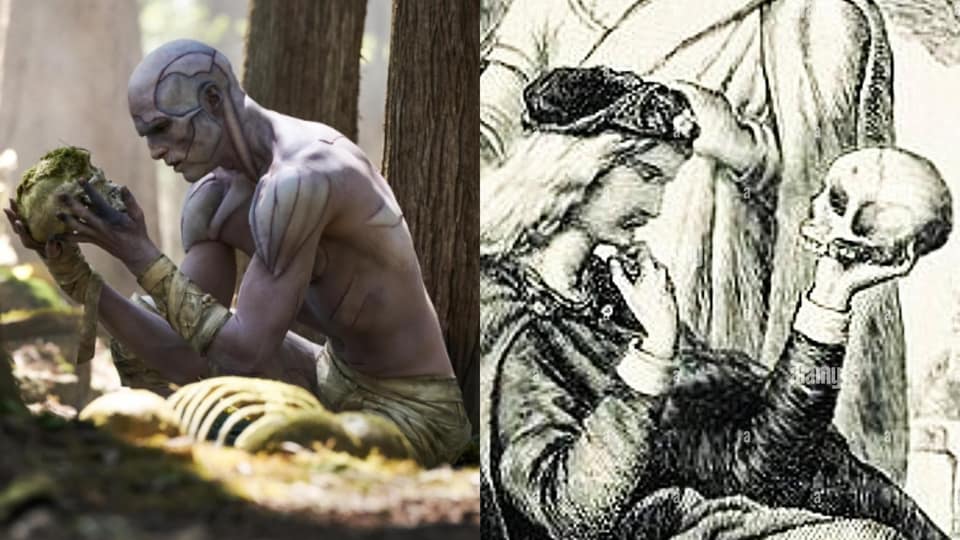
Hamlet and Yorick's Skull
Hamlet and Yorick's Skull is an immortal vision out of Shakespeare's Hamlet. Several artistic renditions of this continue to co-exist, though Eugène Delacroix's 1828 frame is arguably among the most jarring. The frame is set to represent the mortal contemplating his own mortality as he holds the demise of another's in his very hands. Jacob's creature unravels a similar moment in this poignant still from the film.

The Incredulity of Saint Thomas
Caravaggio created the The Incredulity of Saint Thomas between 1601 and 1602, its primary themes essentially honouring the five sense over the concept of blind belief. Though not absurdist in form, it's pretext can still be categorised the same as Doubting Thomas inserts his fingers into Christ's flesh, so as to be able to believe his resurrection. Victor, has a similar moment, albeit with his own creation. Though he sees what he has essentially birthed, he still needs to believe with all his five senses.

Empress Elisabeth of Austria
The portrait of Empress Elisabeth of Austria, was painted by Franz Xaver Winterhalter in 1865. The portrait represents the silent burden of beauty and perfection. Wrapped in refinery and weighed down by a characteristic poise, it's a tragic frame with the ethereal beauty of it just wisping through. Mia as her namesake, embodies the same.

Medusa
Caravaggio's Medusa, believed to have been painted between 1595 and 1598, freezes the moment beauty turns to horror. The entirety of Frankenstein's lore also treads the same line. Medusa's wrathful gaze possessed the ability to turn life to stone. Similarly, Victor's creation, though absurdly beautiful in its own way, still stood encased in horror.

Vanitas
Simon Renard de St. André's Vanitas dates back to 1650 and stands as an ornate reminder of decay always being the end-form of bloom — anything birthed, must die. The same frame in Frankenstein represents an ironic nod to what happens when man choses to defy this seminal law of nature.

Death on a Pale Horse
Speaking of the law of nature, John Hamilton Mortimer's Death on a Pale Horse (circa 1775) upholds death as the ultimate truth. The rider frozen to his death on a collapsing, heeling horse is essentially a foreshadowing of how Victor and his creature's story descends to doom.

Frankenstein is currently streaming on Netflix.


