
 E-Paper



Passing the baton of greatness: How Saurav Ghosal mentored Anahat Singh to historic World Junior glory
Former ace squash player Saurav Ghosal shares how humor, honesty and tough love helped shape Anahat Singh into India's first World Junior Squash champion.

 Prefer HTon Google


When on July 25, 18-year-old Delhi girl Anahat Singh stood atop the podium at Niagara-on-the-Lake in Canada, becoming the first Indian ever to win the World Junior Squash Championship, it wasn’t just a victory for her. It was a watershed moment for Indian sports. Standing proudly in her corner was Indian squash legend Saurav Ghosal, a pioneer who spent decades breaking glass ceilings himself, now watching his young prodigy achieve what no Indian before her ever could.
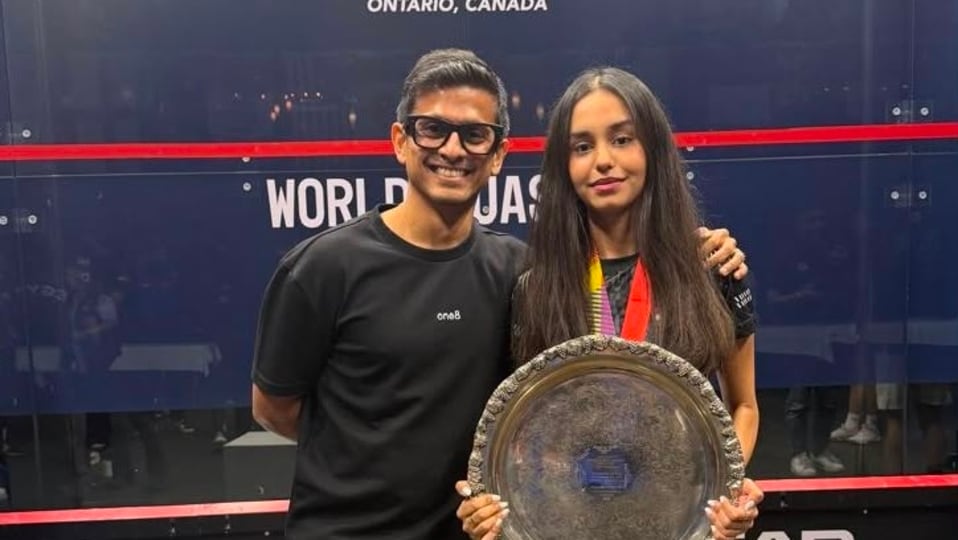
Behind the high-intensity rallies and glittering trophy, however, lies a deeply human mentorship rooted in humor, tough love, and mutual respect. For Saurav, mentoring Delhi’s squash sensation isn't about being an intimidating figure with a clipboard; it’s about shape-shifting into whatever role she needs on any given day.
"I’m a friend first and foremost," Saurav reflects. "I want to be someone who is relatable to her. Sometimes I’m a coach, sometimes I’m a mentor, sometimes I’m a friend. It oscillates, and honestly, that’s the way I like it to be."
The Secret Weapon: Turning a Loss into Leverage
Working with a generational talent like Anahat requires tact. Naturally gifted with sheer finesse, court awareness, and a lethal drop shot, getting her to break old habits wasn't always straightforward. Saurav recalls an early training session where technical advice wasn't quite translating into action on court.
That’s when he tapped into what truly drives her: an absolute, burning hatred of losing.
"I put in a condition where she could play however she wanted, and I’d just expose that technical weakness we were trying to fix. And I beat her," Saurav reveals with a chuckle. "Her distaste of losing made her immediately want to do whatever it took to get better. That was the key to unlocking her game. To show her that if she didn't adapt, she'd lose—because she will do everything humanly possible to avoid that feeling."
Since then, the trajectory has been meteoric. In Canada, facing a gauntlet of top Egyptian seeds, Anahat executed tactical game plans with clinical perfection, proving that when her competitive switch is flipped, few in the world can stop her.
Fearless, Unfiltered, and Unapologetically Herself
Watching Anahat dominate on the global stage brings a touch of nostalgia for Saurav. Having retired from professional squash in 2025 due to a hip injury, he often looks at the teenager’s fearless demeanor with admiration.
"If I could go back in my career, I wish I was as fearless and had the same ambition at her age as Anahat does today," Saurav candidly admits. "We didn't have the foundation back then that this generation enjoys. If I had her sheer belief when I was 15, I think I would have been a better player and done even greater things."
Yet, despite all the tactical tweaks—whether it’s honing her forehand into a lethal weapon or perfecting her cross-court lobs, Saurav and co-coach Grégoire Gaultier are firm about one rule: they aren't trying to create a carbon copy of themselves.
"She is Anahat Singh, and she has her own identity," Saurav says. "It's about getting the best out of that identity, both on and off the court. Off court, she's casual, chill, and keeps things light. That balance keeps her grounded."
With squash officially making its Olympic debut at Los Angeles 2028, Indian eyes are firmly set on the teenager who is rewriting the record books. But for Saurav, the formula for her future remains simple: keep having fun, keep daring the braincells, and keep expressing herself on court. After all, as Indian squash enters an exciting new era, the mentor knows that the biggest win of a career can sometimes belong to the next generation you helped build.


