
 E-Paper



Thread by thread: Five slow fashion experiences across India
From Tamil Nadu to Varanasi, discover workshops and craft villages where you can learn about the craft and responsibility woven into India’s handlooms.

 Prefer HTon Google


In the era of trends and purchases just a tap away, fashion’s relationship with sustainability has become increasingly fractured. According to earth.org, a non-profit environmental news organisation, today’s fashion industry emits more greenhouse gases than international flights and shipping combined, and uses one-fifth of the world’s wastewater through dyeing alone. The growing slow fashion movement, however, is beginning to mend that bond, thread by thread.
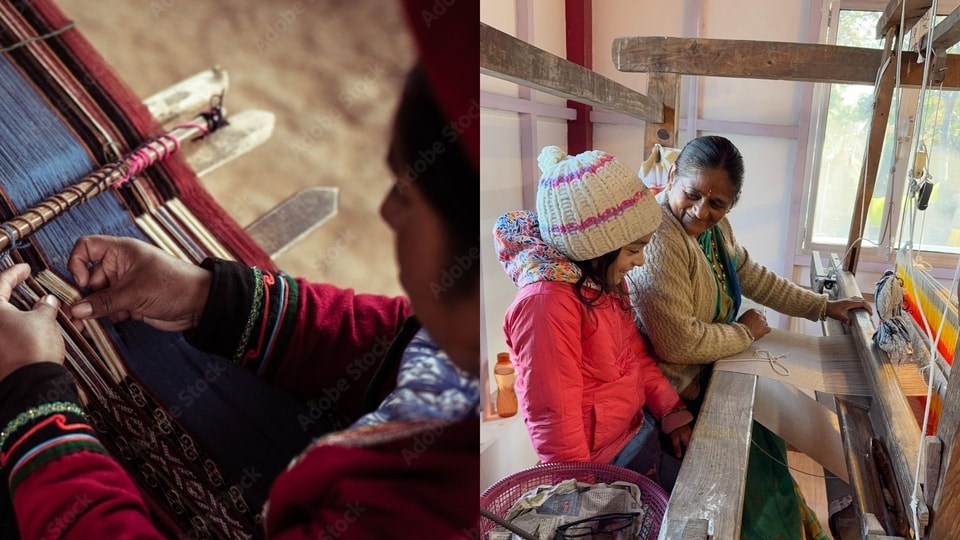
When art explorer Simeen Kaleem recently shared on instagram that she spent 100 hours in Lucknow learning authentic chikankari, one comment summed up what many were thinking: “It must be amazing to learn all of this from the source.” The post got over 11K shares, capturing the growing movement of people wanting to understand fashion by meeting its makers.
India, home to one of the oldest textile traditions in the world, is now seeing a revival in handloom literacy. Beyond the museums and designer ateliers, several workshops and villages are opening their doors to travellers curious about the craft itself, inviting them to watch, spin, dye and even weave alongside artisans. “When we first launched this workshop, all twenty slots were filled. You could see the spark and the joy of making something with your own hands in everyone there,” says Sathyan, program coordinator at the Vivekananda Cultural Centre, Chennai when asked about the popularity of such workshops.
From the silk weavers of Varanasi to the cotton sarees of Bhujodi in Gujarat, here are five places across India where you can see the story of slow fashion come alive in real time.
Kasar Devi, Uttarakhand
Tucked amid the pine-clad slopes of Kasar Devi in the Kumaon Hills lies Kartavya Karma’s weaving hub, where tradition meets travel. Under the supervision of some 300 artisans, the atelier runs immersive programmes from three to five day bundles ( ₹15,000 for five days) that trace the passage from fibre to fabric. Visitors are invited to spin cotton on the charkha, thread warps of hemp, nettle or jute, and finally weave a muffler or shawl on a handloom, without electric or mechanised power. “When you sit at the loom, you realise every thread is a story,” explains Gaurav Agarwal, the founder of Kartavya Karma. “We aim to revive Himalayan handloom culture and make the visitor not just a spectator, but a craft-learner.”
Nearest airport: Pantnagar airport
Chennai, Tamil Nadu
In Chennai, Tula is putting what designer Sushmita R.K calls “the second skin” of garments under the microscope: the fibre, the process and the people. At their hands-on workshops, participants trace its full lineage from rain-fed desi cotton to charkha spinning, from natural dyes to hand-woven cloth. “Textiles are the second largest polluter after oil. The Nila River in Tamil Nadu has died under synthetic dye loads. We tell the participants everything to make them more aware,” says Sushmita. “We explain how rural incomes collapse when hybrids and synthetics dominate the market.” In their workshops, priced from ₹500 to ₹2000 based on the selection, the spinning becomes meditative by helping the participants slow down the pace and sharpen their observation. With a 1000-year-old tradition of deriving colors from non-polluting renewable plant sources like bark, leaves, flowers, roots and age-old art of handspinning using amber charkha, Tula highlights the skills required for making clothes from organic rainfed desi cotton. As a non-profit that aims to raise more awareness, Tula also runs coconut-shell-button workshops, natural-dye labs and talks on micro-fabrics and plastic rain textiles.
Nearest airport: Chennai International Airport
Bhujodi, Gujarat
In the weaving village of Bhujodi, just outside Bhuj in Gujarat’s Kutch district, the craft of pit-loom hand-weaving and Bhujodi weaving is still alive and immersive. Participants in the weaving experience here warp the yarn, learn the traditional kanji/rolled-yarn preparation, then sit at the pit-loom, spin raw cotton on the charkha and weave alongside the artisan community. Vankar Chetan of the Handloom Design Centre shared a few lines from a poem he wrote for a visitor, “We don’t just weave thread, we weave the story of my hand, my land and my life, a poem without ink, our tradition is weaved thread by thread,” The multi-generational craft cluster (his workshop runs in a family that has practiced for more than ten generations) opens its doors to visitors who want to learn about handlooms while also living the life of an artisan for as long as the visitor wants. “You learn to weave with a rhythm when we sing bhajans, you eat the same food as we do, you sleep under the same roof, and with every day you spend, you learn more about what we do and why we do it,” shared Vankar Chetan.
Nearest airport: Bhuj Airport
Banaras, Uttar Pradesh
In the heart of Varanasi, where faith and fabric intertwine, travellers can now step inside the city’s centuries-old weaving heritage through the Weaver’s Village Experience ( ₹3,500 onwards) by Mahadev Tours. Once patronised by Mughal emperors like Akbar, Banaras’ brocade weaving is still practised in the bylanes of Madanpura and Bunkar Colony, where the clatter of looms fills the air. Visitors witness the full process, from zari threading to the creation of rich Jangla, Tanchoi, and Butidar patterns, and can even try weaving under artisan supervision. “We wanted travellers to understand how deeply weaving is tied to Banaras’ soul,” says Avinash Sharma, founder of Mahadev Tours. “Here, weaving is not just an occupation, it’s a way of life.” The tour also explores the changing face of the craft as local artisans adapt brocade techniques to scarves, home décor and stoles, keeping the art relevant for a modern audience.
Nearest airport: Lal Bahadur Shastri International Airport
Pranpur, Madhya Pradesh
A short drive from Chanderi, the quiet village of Pranpur has transformed into India’s first craft and handloom tourism hub. Known for its chanderi weaving, here, travellers can walk through lanes where looms are heard inside every home for free, watch sarees being woven in front of them, and dine at India’s first Handloom Café run entirely by women. “It’s one thing to wear a handloom, and another to see it being made,” says handloom evangelist Swati Mukund, who has visited twice. “Watching a saree come alive thread by thread is deeply moving.” What began as a small local effort has grown into a thriving model of rural tourism: visitors now number nearly a hundred cars a week, many buying directly from weavers. “It’s like watching Make in India come alive,” she adds.
Nearest airport: Bhopal Airport


