
 E-Paper



100 km in 100 hours: Ghaziabad-Aligarh Expressway stretch scripts history
Union minister Nitin Gadkari said that the 118 kilometre-long Ghaziabad-Aligarh stretch of NH34 is an important trade link.


A 100 kilometre-long road has been constructed on the Ghaziabad-Aligarh Expressway in a record time of 100 hours, according to the ministry of road transport and highways. The historic feat was achieved by laying bituminous concrete and is a testament to India’s advancement in road infrastructure, an official statement added.
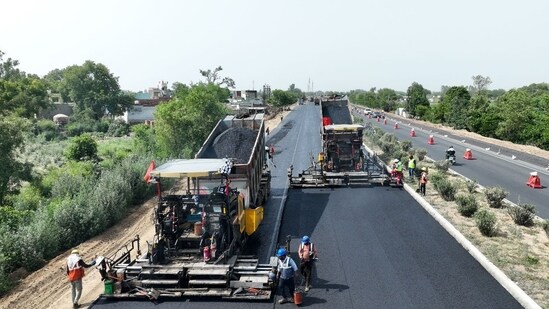
The road was built by Ghaziabad Aligarh Expressway Pvt Ltd, a Special Purpose Vehicle (SPV) of Cube Highways Trust, in collaboration with EPC contractor Larsen & Toubro Limited.
Union minister Nitin Gadkari said that the 118 kilometre-long Ghaziabad-Aligarh stretch of NH34 serves as an important link for trade across industrial hubs, agricultural areas, and educational institutions. It plays a crucial role in enabling the smooth movement of goods and services and boosts economic development, he added.
Lauding the achievement, Prime Minister Narendra Modi tweeted, “A notable accomplishment on a very important highway route. It manifests the importance given to both speed and embracing modern methods for better infrastructure.”
Read: This highway to cut travel time between Noida to Delhi-Mumbai e-way by 3-4 hours
Spanning across a bunch of cities in Uttar Pradesh, including Dadri, Gautam Buddh Nagar, Sikandrabad, Bulandshahr, and Khurja, Gadkari emphasised on the government’s goal to facilitate exceptional mobility, encourage commerce and development by establishing world-class highways at the fastest speed without compromising on quality.
The minister also talked about India’s commitment to sustainability and cost-effectiveness by implementing Cold Central Plant Recycling (CCPR) technology in the project. The minister said this innovative green technology involves utilising 90% of the milled material, which amounts to nearly 20 lakh square metres of road surface. He said that the consumption of virgin materials has decreased to a mere 10%.
"’By adopting this approach, we have significantly reduced fuel consumption and the associated greenhouse gas emissions, thereby making a substantial contribution to lowering our carbon footprint,‘" Gadkari said.


