
 E-Paper



1 million candidates, 1,000 centres: NTA prepares to hold CUET
Last week, NTA wrote to Vice Chancellors of all universities across the country to assess and provide closed areas in their campuses for setting up examination centres. NTA has drafted subject experts and school teachers from across the country to prepare question papers.


A million candidates. Each applying for at least five universities. A possible 60,000 subject combinations.
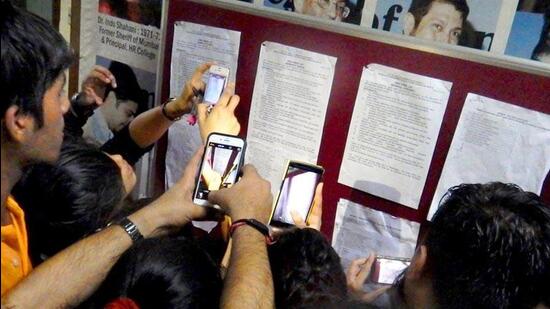
Those are the mind-boggling statistics of the first-ever common university entrance exam (CUET) that will be conducted by the National Testing Agency (NTA) for undergraduate admissions to 86 universities between July 15 and August 10.
According to officials in NTA, the results will be declared by August 20.
The agency will conduct the computer-based test in 554 cities across India and 13 cities outside the country at around 800-1000 centres. “Although 1 million candidates have applied for CUET-UG, each of these candidates have applied to at least five universities on an average; therefore, the total number of applications are over 5 million,” said one NTA official who asked not to be named.
NTA has already been conducting some of the country’s major entrance exams including the Joint Entrance Test (JEE) for admission to engineering colleges and the National Eligibility Entrance Test (NEET) for admission to medical colleges. But CUET, the officials cited in the first instance said, poses challenges at an entirely different level.
According to the first NTA official: “In NEET and JEE (Mains) there are no subject combinations. It is either Physics, Chemistry and Mathematics or Physics, Chemistry and Biology and everybody takes these combinations only. Here there are around 60,000 combinations. That makes CUET-UG a big exercise. Therefore, it will be conducted over 10 days in more than 15 shifts, which is the longest duration of any entrance exam ever conducted in India. Though CUET is a complex exam, it won’t be a challenge for NTA since the agency is already conducting almost all the major entrance exams in the country.”
It may be the most complex, but CUET won’t be the largest. That distinction remains with NEET.
“In terms of number of applications NEET still gets the highest number of applicants. This year it is 1.8 million. But in terms of complexity and number of subjects CUET-UG is the biggest exam of the country,” the first official said.
Conducting the exercise also means scaling up infrastructure. “The number of centres may go up to 800 to 1000. We are in the process of finalizing that. But after the introduction of CUET, the infrastructural requirement of NTA will increase. The agency is planning to set up examination centres for computer based exams in more than 600 districts across the country,” the official added.
Last week, NTA wrote to Vice Chancellors of all universities across the country to assess and provide closed areas in their campuses for setting up examination centres.
NTA has drafted subject experts and school teachers from across the country to prepare question papers. “The question papers have been prepared over the span of three months. There will be different sets of question papers of each subject for different days,” said a second NTA official, speaking on condition of anonymity.
The exams themselves will also be high-security ones, to prevent any malpractice.
“We are exploring the possibility of having iris capturing arrangements at the examination centers. If it happens, this will be the first time NTA will be doing iris capturing in any exam,” the second official said.
The assessment will be conducted in computer-based format and an answer key will be issued immediately after the examination. “There is a set standard operating procedure that will be followed for assessment. NTA is following the same for other competitive exams. We will invite objections to the questions and answer keys in case there is any typographical error or issue. We will relook at the objections received. But it won’t take more than 10 days to complete the process and declare the results once the CUET is concluded,” the second official added.
The results of students will be sent to the universities they have applied to.
The Union government said in March that it would conduct CUET-UG, in line with the National Education Policy (NEP) 2020, and made its score a mandatory yardstick for all central universities while keeping it optional for others. As many as 86 universities —43 central universities, 13 state universities, 12 deemed universities and 18 private universities— are participating in CUET-UG this year.
CUET-UG will be divided into four sections I-A, I-B, II, and III. While Section I-A and I-B will have language subjects, section II will test the domain specific knowledge of candidates. There will be 13 and 19 different languages in section I-A and I-B, and 27 domain specific subjects will be offered under section II. Section III will be a general test. Overall, candidates can take a test in a maximum of nine subjects i.e 2 languages + 6 domain specific subjects + one general test or 3 languages + 5 domain specific subjects + one general test.
Educationist Meeta Sengupta said, “The CUET is a pioneer in bringing standardisation to a large and diverse set of student needs for entry into higher education, and so its results must be used with due caution and context. A useful tool to inform selection, it is best used as a part of a set of criterion based on student goals and institutional fit. This balanced approach can help resolve the current conundrum in university admissions.”


