
 E-Paper



3 BJP leaders nominated to Puducherry assembly, will help tighten control on govt
The nomination of 3 BJP leaders to the Puducherry assembly has raised its effective strength to 33 and strengthens the bargaining capacity of the BJP, which won 6 seats in the Puducherry elections, as against 10 seats won by the alliance’s senior partner All India NR Congress.


The Centre on Monday nominated three Bharatiya Janata Party leaders as legislators to the Puducherry assembly. This is the second time that the Centre has appointed three BJP members as nominated legislators of the House.
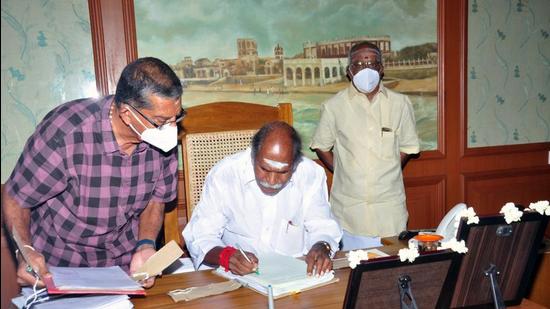
The central government’s notification on the nomination of three legislators, K Venkatesan, VP Ramalingam and RN Ashok Babu, effectively raises the strength of the Puducherry assembly to 33; 30 members were elected on May 2 in the assembly elections.
A 2018 Supreme Court verdict had made it clear that the nominated members in the Puducherry assembly could vote on the Budget or a trust vote, ruling that the Union Territories Act 1963, which empowers the Centre to nominate three MLAs, did not differentiate between nominated and elected members.
The three MLAs nominated by the Centre in the last assembly were instrumental in the fall of the previous Congress government led by V Narayanasamy in February this year and the imposition of central rule. Some Congress heavyweights had also defected to the BJP ahead of the assembly elections in April and helped the saffron party open its account in the 6 April elections. The last time the BJP had an elected member in the assembly was in 2001.
In the latest round of elections, the BJP, which fought the elections in alliance with the All India NR Congress and the AIADMK, ended up with 6 seats.
The alliance leader, All India NR Congress founder N Rangasamy, was sworn in as chief minister on Friday to form the NDA government. He is yet to name his council of ministers which is expected to include several BJP legislators. The BJP also wants one of its legislators to be designated as a deputy chief minister post.
Rangaswamy has had to go slow on the induction of his council of ministers since he tested Covid-19 positive a day earlier and is undergoing treatment at a private hospital in Chennai. The first medical bulletin from the hospital on Monday stated that he was stable and was maintaining normal oxygen saturation.
The nomination of the three legislators raises the BJP’s effective strength in the assembly to 9, much closer to the 10 seats won by the AINRC. The majority mark in the 33-member assembly is 17; it was 16 when Rangaswamy took oath.
This will give a cushion to the ruling alliance but experts believe it could end up complicating the relationship between the BJP and its alliance partner.
“This is surely a challenge to Rangasamy,” says political analyst Raveendran Duraisamy. “There can no longer be one-upmanship. It will be more like a 50-50 partnership between AINRC and BJP.”
Their third ally, AIADMK drew a blank in the April elections. The Congress just has two MLAs while its ally the DMK has six. A record number of six independent MLAs were elected this time.


